




After The Echo asked men’s soccer players about team rules, including the team’s former rule of fining players $1 for not speaking English, UCA athletics media relations staff said student-athletes should not respond.
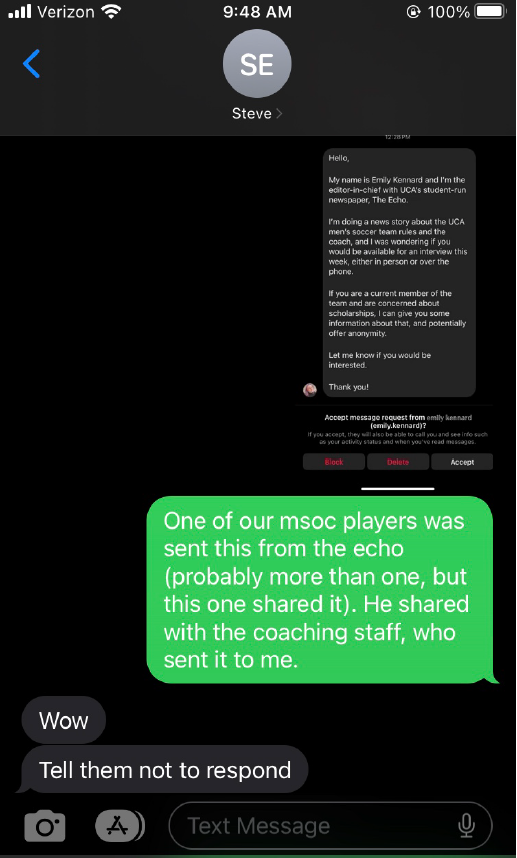
Ryan Thiele, assistant director of media relations for UCA athletics, texted a screenshot of an Instagram message from The Echo’s editor-in-chief, which was sent to multiple student-athletes, to Associate Assistant Director for Media Relations Steve East.
“One of our msoc players was sent this from the echo (probably more than one, but this one shared it). He shared with the coaching staff, who sent it to me,” Thiele said in a text to East.
“Wow,” East replied. “Tell them not to respond.”
The text correspondence was sent to The Echo on March 13 in response to an Arkansas Freedom of Information Act request.
Thiele did not respond to multiple requests for comment about the text message conversation.
Senior legal counsel with the Student Press Law Center, Mike Hiestand, said, “There’s just no way, really, that a school is going to be able to tell a student-athlete they cannot talk about a newsworthy matter if they choose to talk about it.
“Telling them they can’t speak out on this English-only sort of policy that apparently was in play — or some other significant policy where the coaching staff was doing some really bad things — to tell them they can’t talk about that, that would be a clear violation of the First Amendment,” he said.
UCA’s student-athlete handbook for 2023-24 states under its “hints for dealing with the media” section: “Do not criticize your teammates or your coaches through the media. If you have concerns, share them with your teammates or your coach, not the public.”
Hiestand said, “Students are protected by the First Amendment when they’re on campus, and there is no asterisk saying students except for student-athletes. That doesn’t exist. Student-athletes are going to be treated the same.
“The athletic department can certainly make suggestions that they don’t criticize their program or teammates, but they really do need to be in terms of suggestions,” he said.
East said there can be consequences for athletes who make critical comments to the press.
“Each individual coaching staff will make the decision on potential consequences for student-athletes who criticize teammates or coaches through the media,” East said.
The student-athlete handbook also states, “You should never agree to a telephone interview unless the arrangements are coordinated through the Sports Information Office. If you receive an interview request, ask the media representative to make arrangements through the Sports Information Office. You should not receive calls or visits from the media which have not been arranged by the Sports Information Office.”
East said, “We recommend all interview requests go through our office so we can monitor and coordinate our media interactions.
“This is a policy for our student-athletes to follow but it is not a requirement. There are no consequences for not following the policy, although each situation will be reviewed with the particular student-athlete and particular coaching staff and the policy will be reiterated,” East said.
“Our policy, which we share with our coaches prior to each school year and they in turn share with their student-athletes, is all media requests need to come through our office. The policy is the same for all professional media organizations, including radio, television and print,” he said.
Hiestand said, “We’re seeing a lot of this around the country, where student media are being told, ‘If you want to have an interview with a faculty member or some school official, you have to go through the public information office. They have to approve the interview,’ and those sorts of gag rules, they’re ruled clearly unconstitutional.”
Hiestand said it would be up to student-athletes to challenge the constitutionality of these policies.
“The problem in all these things is you would have to have a student-athlete that’s willing to come forward and say, ‘No, I don’t agree with this. I want to be able to speak.’
“That’s obviously, probably, a big part of why these sorts of policies continue to exist in lots of places, is because student-athletes aren’t willing to stand up and say, ‘I want to talk, and I don’t like this policy.’”
“That can be difficult for employees, and it can be difficult for student-athletes,” Hiestand said.