

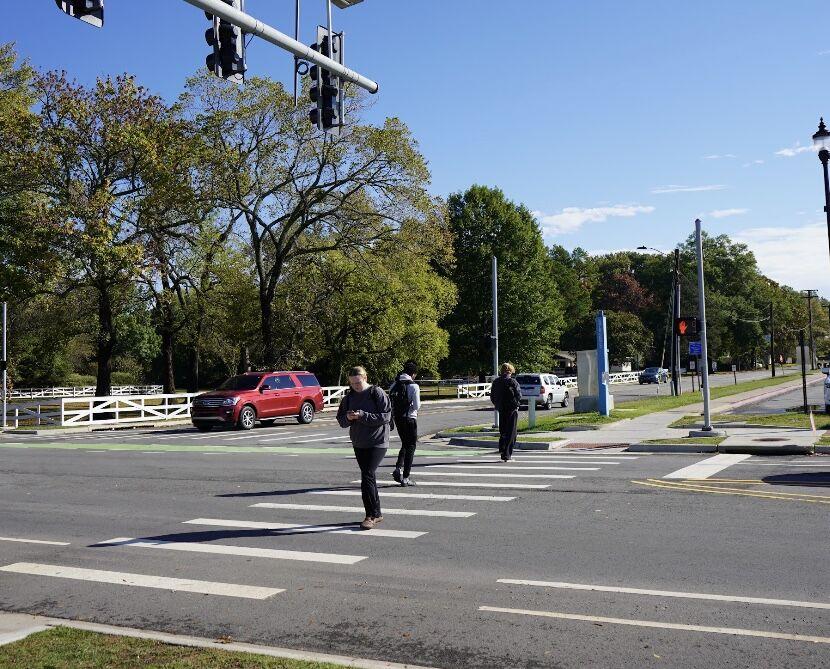
Students and staff say they have to scurry across timed pedestrian crossings at signalized intersections on Donaghey Avenue and Bruce Street.
On the crosswalk at Donaghey Avenue and Robins Street, sophomore marketing major Frankie Adams said, “I feel like I have to walk really fast to get across it.”
Some students were unbothered by the pedestrian crossing cycle; Kade Howard, history and anthropology junior, said, “I use it just about every day. It usually only makes me wait for not more than a minute.
“It’s a crosswalk, you gotta wait a little bit. I’m not too bothered by it, usually,” Howard said.
Sophomore entrepreneurship and innovation major Emma Davis said, “It’s definitely a little bit short on time to cross versus not crossing.”
History major and junior Rachel Curtis said, “I use it every day. I have to. It gives us about nine seconds to go across it, and the longest I’ve waited is probably a minute or two.”
Some at the Bruce Street and Augusta Avenue crosswalk said they felt rushed by the signal.
Trisha Clark, an arts administrator said, “I don’t really think it gives you enough time.”
“These crosswalks are pretty quick. I have thought about that because I live right here, and I work right here.”
Robby Burton, higher education institution program coordinator in the arts agreed with Clark about the crossing time. He said he uses the crossing “every morning.”
“By the time you get almost halfway, it turns green again. You don’t really have enough time. I’d say another 15 seconds added to it, at least.”
According to ArcGIS and Google Earth software, which use satellite imagery, from sidewalk ramp to sidewalk ramp, the crosswalk in front of Wingo Hall measures around 50 feet wide, spanning three car lanes and two bike lanes; the crosswalk across Bruce Street where pedestrians were surveyed is also around 50 feet wide.
Director of Transportation and City Engineer Kurt Jones said, “Timings for pedestrian crossings are based on recommended values in the Manual on Uniform Traffic Control Devices (MUTCD) based on the geometry of the crossing.”
Depending on pedestrian volume, the manual suggests a four to seven-second minimum for the white “walk” symbol and suggests signals should give pedestrians a second for every 3.5 feet for the pedestrian change interval, whenever the red hand starts flashing.
The manual also recommends at least a three-second buffer period afterward, where the hand is red, but where the connected traffic signal does not release vehicle traffic.
The signal at the crossing by Wingo Hall at Donaghey Avenue and Robins Street makes pedestrians wait around 50 to 60 seconds and gives around 19 seconds total to cross including a three to four second buffer period.
“The sum of the time of the pedestrian change interval and the buffer interval shall not be less than the calculated pedestrian clearance time,” according to the manual.
For a width of around 50 feet, that time should be at least 14.3 seconds — but the pedestrian crossing at Donaghey Avenue and Robins Street gives around 12 seconds to cross during the pedestrian clearance and buffer periods combined.
The manual provides plenty of accessibility guidance, stating, “Where pedestrians who walk slower than 3.5 feet per second, or pedestrians who use wheelchairs routinely use the crosswalk a walking speed of less than 3.5 feet per second should be considered in determining the pedestrian clearance time.”
Hannah Dolan, junior economics major said, “The crosswalk I think is fine. I think it’s a little short.
“I have a friend who has trouble walking fast, … it’s kind of quick. You have to book it across there,” she said.
Several people surveyed at both intersections said someone with mobility issues would “probably” struggle to get across in time.
While waiting to cross Donaghey Avenue, Frankie Adams said, “I feel like it would be way harder if I had mobility issues. If I had a broken foot, I don’t think I’d be able to walk across it in 10 seconds.”
Health science major and sophomore Gracie Simpson said, “I think it could use a little bit more time,” but that she felt like the timing felt “about the same” as other crossings.
Accounting major Kate Hale was waiting to cross Donaghey Avenue with a friend.
“I use it every day. I think it needs to be a longer walk time because it goes fast. Like, we just missed it because we were watching a video,” Hale said. It changed again while she was speaking, and she and her friend booked it across: “Oh wait, let’s go.”
To avoid the waits, jaywalking crime sprees break out at both pedestrian crossings in the 10-minute breaks between classes.
At Augusta Avenue and Bruce Street, art studio major and sophomore Sydney Fallon said, “This one, I usually just walk whenever.”
“I think it’s a little ridiculous, it’s like, what, 10 seconds once it starts going,” Fallon said. “I’ll be down there, walking toward it, and I’ll see a flashing light and I’m already screwed over because I didn’t make it in time. It could be a little longer.”
Supply chain management major and senior Emily Johnson said, “It takes a while to change to walking, so a lot of people just go when it’s clear instead of waiting on it.
“It’s not my favorite. I’d rather go up there and use that one [a nearby rapid rectangular flashing beacon mid-block crossing down Bruce Street] but sometimes it’s not plausible. But that one, you don’t really have to wait on anything.”
Conway’s Director of Transportation Kurt Jones said, “When the button on a pedestrian signal is pressed, it sends a call to the signal program letting it know that it needs to work a pedestrian crossing into the cycle. It can take anywhere from a few seconds to 30 seconds or more for the ‘walk’ signal based on where the signal is in its cycle and the traffic conditions.
“Traffic signals typically have phases such as protected left turn arrows and pedestrian ‘walk’ signals that are only cycled in when a call is detected. They are sometimes programmed with a default priority to the main travel direction as well.”
The nearest crosswalk south of the Donaghey-Robins crosswalk is around 800 feet away, or around 15% of a mile. It is beside the Arkansas PBS building at 350 S. Donaghey Ave and is a mid-block crossing with flashing lights and a pedestrian refuge island in the middle lane.
The nearest pedestrian crossing north of the Donaghey Avenue and Robins Street measures around 650 feet away, or around 12% of a mile, according to ArcGIS and Google Earth, and is a rectangular rapid-flashing beacon.
Jones said, “Generally, we try to avoid mid-block crossings, and require an RRFB at any mid-block crossing.”
“The RRFBs greatly enhance the safety of mid-block pedestrian crossings; however, they are not perfect, and pedestrians should still use caution when utilizing them. RRFBs do not offer the same control/safety as a crossing at a signalized intersection,” Jones said.
Jones said, “Motorists generally don’t pay any attention to the crosswalk itself unless there’s a pedestrian in it.”
Arkansas state law says when there is no walk sign, all motor vehicles must yield to pedestrians on marked crosswalks — but Jones said pedestrians should still cross with caution.
“Painted crosswalks have no real safety benefit and can actually make crossings less safe in some situations by giving the pedestrian a false sense of security. The purpose of a crosswalk is to direct the pedestrian to the safest place to cross — usually at an intersection controlled by either signals or stop signs,” Jones said.