




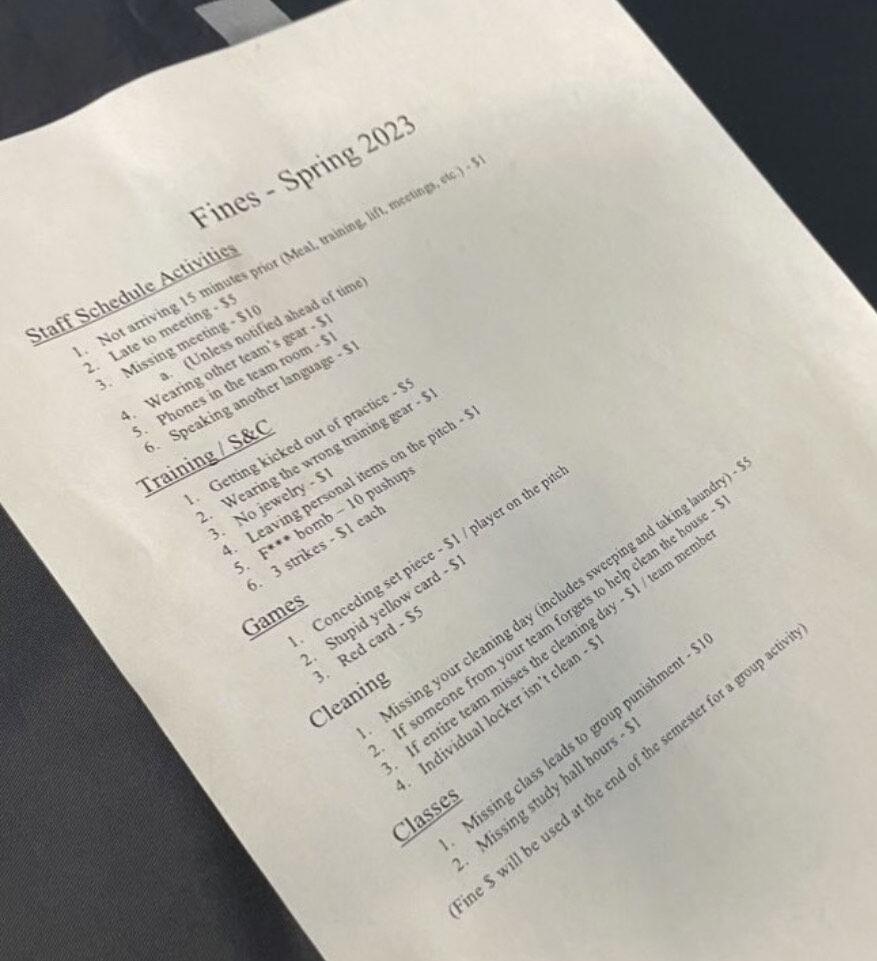
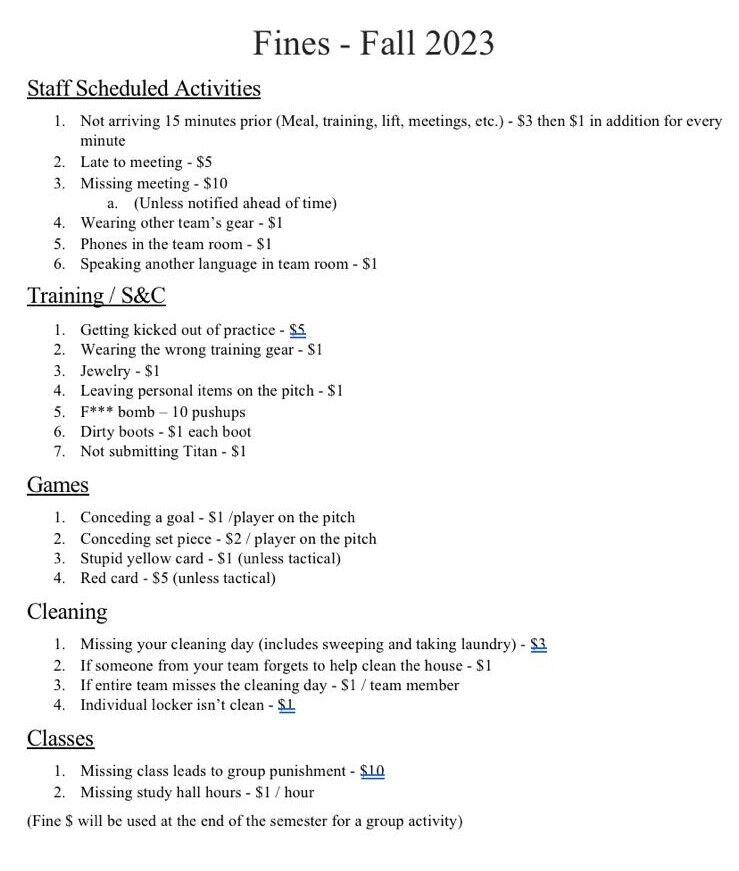
According to lists of fines and a former soccer player, the UCA men’s soccer team fined its players for not speaking English.
The list of fines from fall 2023 said players were fined $1 for “speaking another language in the team room,” and funds from fines were “used at the end of the semester for a group activity.”
The list of fines from spring 2023 said players are fined $1 for “speaking another language,” but did not specify where the rule applied.
The American Civil Liberties Union of Arkansas said that the discipline could have potentially violated Title VI of the Civil Rights Act of 1964.
“In general, any discipline in education or extracurricular activities for not speaking English only or disparate punishments based on race, color, national origin or language spoken would raise a concern of potential violation of Title VI of the Civil Rights Act of 1964 for discrimination as to race, color or national origin as well as equal protection under the law as guaranteed by the U.S. and Arkansas constitutions,” said Megan Bailey, the communications director for the ACLU of Arkansas.
“We can’t analyze or opine on this specific situation as we don’t have all the facts, but in general, athletic programs and other extracurricular activities can apply additional rules for participation that don’t apply to students at large,” she said.
Head coach Frank Kohlenstein said fines are no longer used as discipline, and that not speaking English is no longer a punishable offense.
“We have nothing to do with the players doing fines and we actually have gotten them to stop doing that,” he said.
Kohlenstein said the team’s five-person leadership group switched the team to a more equitable way to distribute punishments, a spinning wheel that doles out exercises for infractions.
“We have some players that drive into the parking lot in $100,000 cars, and we have some players that have to walk over here. So if you have money fines, it’s not equal. So we got them to go away from that, and the leadership group liked that idea,” he said.
“Just the other day, I said something and I had to spin the wheel,” Kohlenstein said.
Former UCA soccer player AJ Korpal, who transferred from an English soccer team, said Kohlenstein told the players it was “rude” for players to speak Spanish around him.
“We were all on the porch and some Spanish lads were talking to each other. I was speaking to people, and he just stood there, saying nothing,” Korpal said.
“The next day, everyone goes in,” he said. “And he just basically shouts at everyone and basically says, that was so rude to speak Spanish in front of him because he doesn’t understand what’s going on.”
Korpal said when players didn’t speak English, Kohlenstein would ask, “What language do we speak here?”
“He tries to make you look stupid for speaking your own language. He’d be like, ‘What language do we speak in America?’ and everyone would have to go, ‘English.’”
“And he says, ‘So what language should we speak here?’ And then everyone would go, ‘English.’ So then he’d be like, ‘So why are we speaking Spanish? Can anyone tell me?’”
Kohlenstein said he pushes players to speak English because that’s the language their classes and tests are in.
“If they do [speak other languages], it’s not a problem, but we try to encourage people,” he said.
“That’s part of why they come here, is for an education in the United States. If all they wanted to do is speak Italian, what should they do?
“If you want to come to the United States, you better learn to speak American, because there is a difference between the English in England and the English that we speak,” Kohlenstein said.
“Under this staff, our foreign athletes have done better [academically] than our domestic athletes,” he said.
Korpal said Kohlenstein made the team captain include the fine for not speaking English on the list.
The team’s previous captain did not respond to comment about the fines.
“One lad didn’t even know how to speak English, so he was basically banned from talking,” Korpal said.
He said the player “wouldn’t open his mouth, because he [the coach] f**king shouted at him, in English, and do the slow, slow words, and going, ‘Do you not understand?’ It doesn’t matter how slow you say it. … No matter how slow you say it, he still ain’t going to understand what you’re saying, because he doesn’t speak the language,” Korpal said.
“It was actually quite comedy sometimes. For me, anyway. For the other lads, I can’t imagine it was,” he said.
Kohlenstein said, “The university has a really good intensive English program, so people tend to come from all over the world to be involved in that, and we actually had three players that were involved in it in the fall. We have to commend that program because we can see their growth in being fluent in English.
“When you go into the team room, we’re expecting you to speak English,” he said.
Kohlenstein said making sure everyone speaks the same language is important for communication during games.
“When we go out on the field, and you’re involved in really high competition, and someone is trying to get you to do something but they don’t know how to say it in your language, that could affect performance,” he said.
“We actually had a problem in our last match where one of our Spanish players was saying something to one of our domestic players, and then there was a problem in the communication,” he said.
“To me, the foreign player needs to learn how to communicate because the domestic player … I don’t think it’s up to him to adjust, although we encourage them to embrace the culture of others.”
Another issue Korpal pointed out with the team was that the coach would threaten to take away athletes’ scholarships, he said.
“He’d always say about how scholarships aren’t official, and that he could always take them at any point in time,” he said.
Regarding student-athlete scholarship awards, Director of Athletics Brad Teague said, “The coach decides who and how much. Scholarships are granted for the year and cannot be reduced during that period.
“If the scholarship is not renewed for the student after the academic year-end, it is a decision made by the coach based on many factors, none of which can be athletic performance. It is typically academics or behavior,” Teague said.
Kohlenstein said he only takes away athletes’ scholarships if they quit the team or “if they say they’re not going to be here anymore.”
“If they don’t show up, there’s all sorts of things. They don’t wanna practice anymore,” he said.