

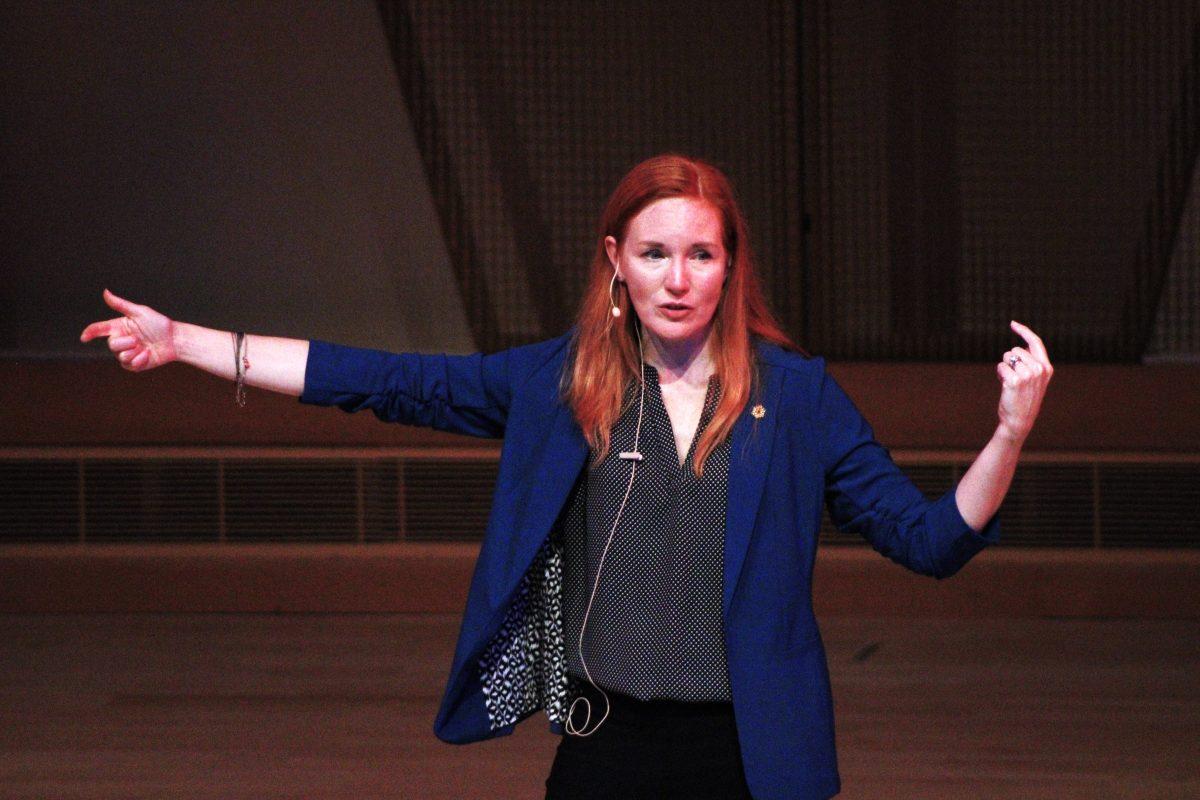
Amber Straughn, a NASA astrophysicist, expounded on her work on the James Webb telescope, detailing its contributions to the knowledge of galaxies and stars.
Straughn spoke to audience members from around the country April 7 at the Windgate Center for Fine and Performing Arts.
The audience erupted in laughter and applause when Azida Walker, associate professor of physics and astronomy, introduced Straughn.
“Dr. Straughn is an astrophysicist at the NASA Goddard Space Flight Center in Maryland,” Walker said. “Cooler than that, she’s from Bee Branch, Arkansas — that’s really cool.”
The Arkansas native discussed her work with NASA to better understand space and the growth of galaxies. Straughn also answered questions about the April 8 eclipse.
Straughn said NASA sent out sounding rockets, small rockets that “go up and do a quick experiment,” from the Wallops Flight Facility in Virginia.
“There’s three different ones happening during different phases of the eclipse and the main reason for that is to learn a little bit about some of the details of what’s going on in the upper atmosphere of the Earth during the solar eclipse,” she said.
Straughn said she viewed the 2017 eclipse from Nashville with her husband, Matt Straughn.
“One of the cool things that I wasn’t expecting at the 2017 eclipse was the leaves the shadows from the leaves made little crescents,” she said. “So just make sure you have your eyes open — look for weird things that happen.”
The majority of Straughn’s lecture honed in on her work with the James Webb telescope, which she is the deputy project scientist for.
Straughn walked the audience through how the telescope was assembled and the process of launching it into space.
“Of all of the deployments that happened over two weeks, we had over 300 single-point failures — meaning 300 things that if any one of them had gone wrong, it would have been mission ending,” she said. “All of them worked. This was definitely a moment of celebration among our team once we had the telescope deployed.”
Steve Scharmer, a self-proclaimed “space geek,” traveled from Florida to hear Straughn speak.
“I’ve been a follower and a fan of hers, especially through the James Webb Space Telescope,” Scharmer said. “She announced she was giving this talk a few months ago. I knew I wanted to go to the eclipse, but I was trying to choose where. So when I heard she was giving this talk, and I had never been to Arkansas, I thought, ‘Well, I’ll go to Arkansas and I’ll see her.’”
Madison Bruce traveled from Jacksonville, Arkansas, for Straughn’s lecture because she wants to be an astrophysicist when she grows up.
“I really enjoy watching these kinds of things,” Bruce said. “It’s just so inspirational and helps me push through.”
Bruce said her favorite part of the lecture was the question-and-answer session.
“It really opened my eyes as to how much knowledge she really had,” she said. “A close second was definitely the pictures, seeing how much is out there. It’s just beautiful to know.”
Straughn used pictures from Hubble and the James Webb telescope to provide visuals of her work. One of these images was “the cosmic cliffs of the Carina Nebula,” which was one of the first images released from the James Webb telescope in July 2022.
“One of the fun parts of my job at NASA is I’m one of the few people who get to see the images before they are released to the public,” Straughn said. “This is the image that made me cry first because it’s just so beautiful and on more than a scientific level. Of course, I find beauty in the science, but just from a human level — it’s absolutely stunning and beautiful.”
Straughn said her interest in astrophysics sparked the moment she looked up at the sky from the rural farm in Bee Branch.
“I challenge you all to go outside at night,” she said. “Look up at the stars. Go outside tomorrow, look up at the eclipse, and just allow yourself to be taken away and think about what a wonderful thing it is to be human in this vast universe that we’re all a part of.”