



In a collaborative effort between UCA, the Arkansas Department of Education (ADE) and Harvard University, the eclipse not only dazzled the eyes of human viewers of the eclipse but also dazzled the sensors of 250 data-collecting circuit boards spread across the state.
While these devices can fit in the palm of a hand, they are capable of collecting temperature and light data surrounding the eclipse.
William Slaton, professor and director of engineering physics, spearheaded the data collection project and said, “We don’t know of any other state-wide coordinated data collection project like this in the history of Arkansas or other states.”
Slaton said that he first reached out to the ADE’s computer science specialists in August of 2022 with the idea for an eclipse data-logging project.
“Over the course of a few meetings we converged on the final project — 250 data loggers covering as much of the state as possible.
“I distinctly recall the phrase ‘Go big or go home!’ so that’s what we did,” Slaton said.
Each of the 250 data loggers has a circuit board and a microcontroller board called a Raspberry Pi Pico W – or “Pico” for short – that work together in the data-collecting process.
“The components on the [circuit] board are used to take the environmental light and temperature and turn them into a measurable voltage,” Slaton said.
Slaton said this voltage is then sent to the Pico where the voltage is measured. He said the Pico, which has a Wi-Fi chip to accurately keep the time and date, can be programmed so the circuit board data can be stored on it to be later shared and analyzed.
In a KATV ABC 7 article, ADE Secretary Jacob Oliva said, “We also were able to partner with Harvard University by implementing light sound devices that are going to work with our blind students and what they’re able to do is take the solar eclipse and as the sunlight beams begin to dim, the light sound device will change to musical tones.”
“So we’re making sure every student in Arkansas is able to participate in this wonderful learning experience,” Oliva added.
Slaton and the ADE also partnered to develop educational materials and training courses that covered topics in coding, basic circuits, astronomy and data-logger needs so Arkansas schools could be part of the data collection process.
“ADE recruited computer science and science teachers all across the state to attend training workshops at the 15 educational co-ops. They were able to have all 75 counties in the state represented,” Slaton said.
“Teachers will log the GPS coordinates of where the data was collected and all of the data will be made available to teachers for analysis with their students over the next academic year,” he said.
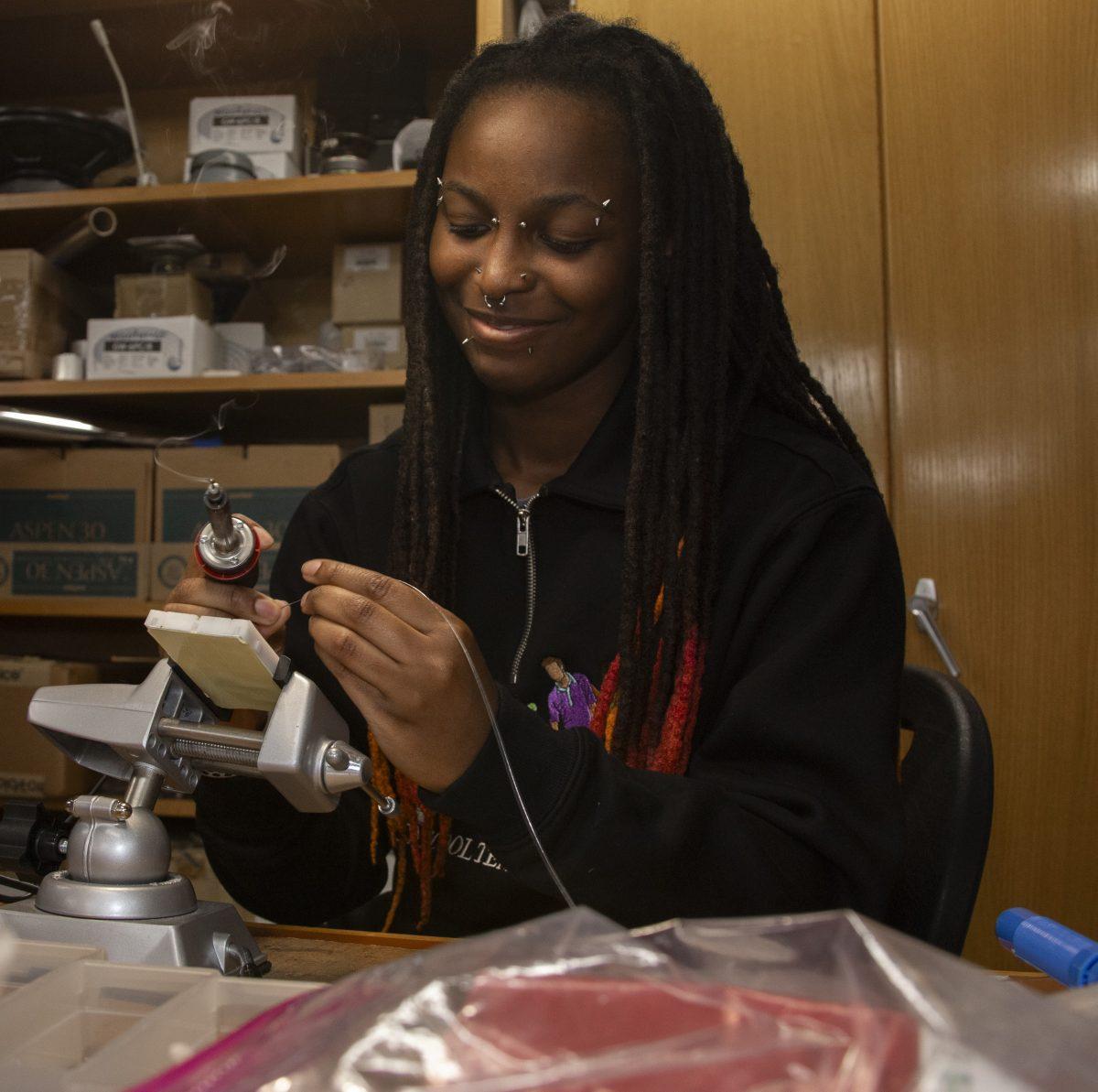
Honey Norfolk, a sophomore double majoring in engineering physics and sociology and minoring in computer science, also played an integral role in the project behind the scenes.
Tucked away deep in a physics lab room in Lewis Science Center, Norfolk could be found soldering each of the 250 Picos needed for the data loggers, each Pico requiring 40 minuscule, carefully placed dots of liquid metal.
While showing some of her practice soldering work, Norfolk said, “I started out ass. I was burning the thing. You can tell I was getting better but I was burning the thing and pouring way too much.”
“You can fry the Picos and cause them not to work,” she said. “I got better over time, thankfully.”
“At the beginning, it would take me three hours to do three,” Norfolk said. “It was really hard to get comfortable doing it.”
Norfolk said she started in February and put in 20 hours of work a week.
Often, she would come in after class at 1 p.m. and stay in the lab until 8 p.m., taking an hour break for dinner.
She started coming in to work on weekends in March so she would get the Picos done in time for the eclipse.
“Three Saturdays I came in and literally spent 8 a.m. to 6 p.m. in here,” she said.
Norfolk originally became involved in the project in the summer of 2023 after inquiring with Slaton about research opportunities she could be involved with while she took summer courses.
By that time, she said the project had been an attempt to use VEX Robotics tools that could be sent out to schools and she could code through the programming tool C++, but she said the project would end up evolving into the circuit board project over time.
She said she did a little programming at the start but once the “big boys” with “computer science degrees” started getting involved, she allowed them to handle the coding and took on soldering as her main task.
Norfolk said she also got to help with traveling and teaching students how to use the data loggers.
“It’s special to me because I don’t really see myself as an educator… but I am really passionate about teaching VEX Robotics, and I think that’s kind of where the original passion for it was.”
Norfolk said she enjoyed getting to help make “science obtainable and easy, especially here in Arkansas” because “a lot of people don’t get exposed to that.”
Slaton said, “I hope teachers and students see UCA as a place where cool and meaningful things happen.
“I also hope the project fosters more collaboration between computer science and STEM teachers. Basic programming is a skill that reinforces science just as much as mathematics does. Science needs to incorporate both.
“I’m hopeful there are some future projects with ADE in this area that we can pursue,” she said.
“Additionally, science is a team endeavor. Hopefully, students and teachers will see that working together we can do more than each working individually,” Norfolk said.