




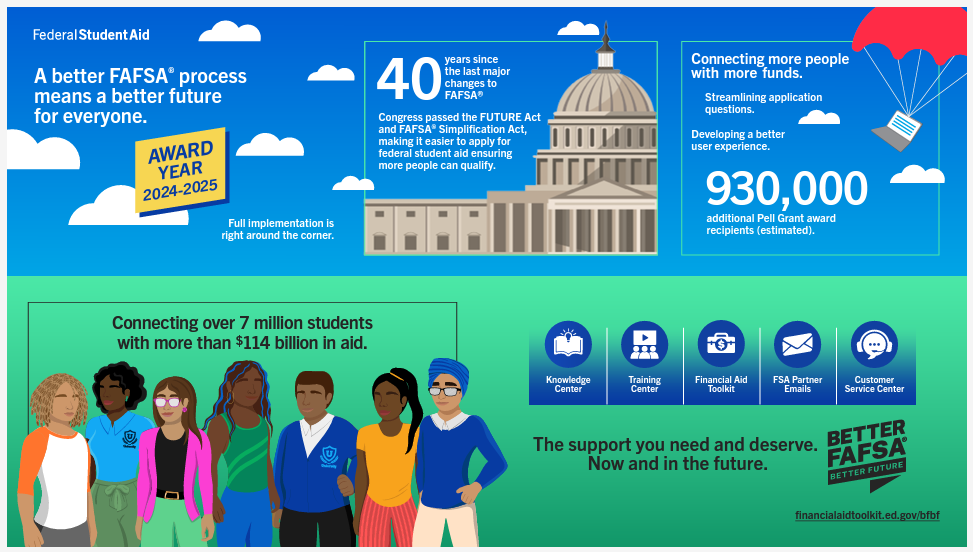
The U.S. Department of Education’s delay in the release of the new FAFSA forms and data has left the UCA Financial Aid office to handle both parent and student confusion.
“We definitely feel the pressure in not having that information,” Kristin Jetts, UCA financial aid specialist, said.
“Parents who have never done this before can’t afford to do this, and it’s really frustrating,” Jetts said.
The slow rollout results from several factors. “They revamped the whole FAFSA application process, and so their website and everything is different,” Jetts said.
She said shifting to a new central processing system has led to some challenges.
“On the school side, even once we get the data, we will have to test our data to make sure that all of the correct information is all together and doesn’t leave anything out,” Jetts said.
As a result, the financial aid office has been left in the dark about the amount of loans and grants a student is eligible to receive.
A significant change to the 2024-25 form is the addition of the student aid index (SAI), which uses a scale of numbers to determine specific loans.
“That calculation is different,” Kimberly Stubbs, director of financial aid, said.
“One of the reasons why they’re waiting until March to release data to us is because they are basically going back in and adjusting it a little bit more,” Stubbs said.
“They’ve been looking at some inflationary costs, and they’re taking some of those things into consideration to recalculate the SAI numbers again,” Stubbs said.
The new calculations will reevaluate the sum of Pell grants that will be allowed to lower-income students.
“Typically, in the past, we’ve had a Pell chart to look at,” Stubbs said. “If a student comes in, we can look to see what the estimated family contribution is.”
This year, the federal government will not be releasing a Pell chart that determines these amounts.
Stubbs said the lack of data has left students and parents in the unknown, but with the new system, there will be new benefits for families to reap.
“They are looking at various income levels — those are changing to some extent — but, for the most part, I think what they’re doing, in the long run, is going to be helpful for students,” Stubbs said.
The renovated system, for those who have filled out the new application, is said to be less complex than the previous model.
“It’s simpler; it’s not as long. There’s not as many questions,” Stubbs said.
Stubbs said she wants students to keep in mind that they’re open to questions and concerns and they are welcome to visit any time between 8 a.m. and 4:30 p.m.
“I really want students to feel that they can come into our office and they can talk to us and that we’re happy to at least try to ease some of that stress,” Stubbs said.