
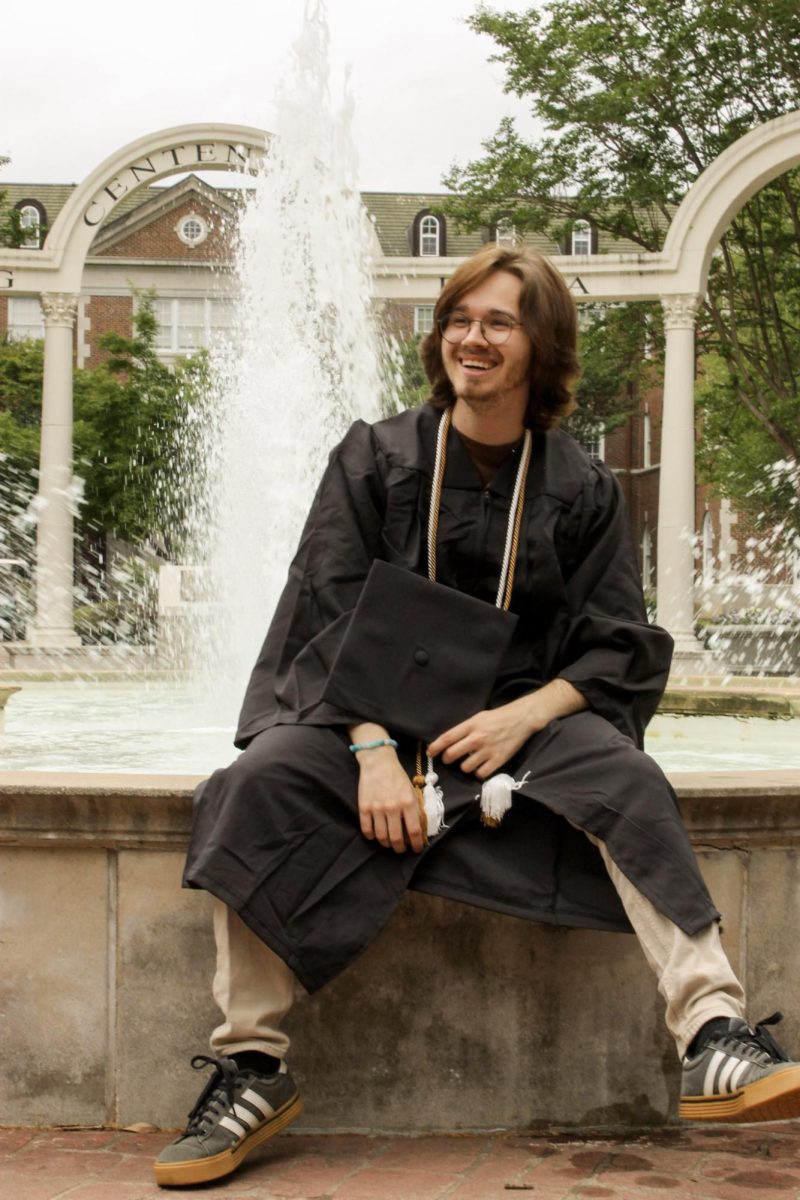



Schedler Honors College student Seth Orvin’s research on AI bias has been accepted for publication in Undergraduate Research and Creative Activity, the National Collegiate Honors Council’s journal for student research.
Orvin, a senior computer science major, chose to do his research project based on the misconception that artificial intelligence is objective and unbiased.
The purpose of the project was to investigate whether or not images created through artificial intelligence would replicate real-world biases, focusing on race and gender stereotypes in STEM.
“As a computer science major, I’m aware of how notorious STEM fields are for such stereotypes and how deterring they might be for people from untapped groups looking to pursue STEM,” Orvin said.
To perform the study, Orvin used three AI image generators: ImageFX, Stable Diffusion and Adobe Firefly.
Orvin used the generators to make 300 AI-generated images of workers in various STEM field positions, like software developers and biologists.
After creating the initial images, Orvin manually entered each subject as male or female.
Orvin took note of the races used most commonly in the images but did not enter any specific ones himself.
“I did not manually label a race for each individual image’s subject,” Orvin said. “An image alone does not provide enough information to confidently categorize someone under an identity as socially constructed as race.”
Through the project, Orvin said he discovered that of the three AI image generators, ImageFX and Stable Diffusion enforced stereotypes that those in STEM positions are expected to be males of white or Asian descent, while Adobe Firefly displayed men and women equally and had more proportional race inclusion.
The research project was made through a year-long seminar course taught in conjunction with Arizona State University.
Leah Horton, associate dean of Schedler Honors College, and Jenny Dyck Brian, Barrett Honors Faculty Fellow at Arkansas State University, taught the course as part of the Justice and Equity Honors Network.
Horton said, “We covered a variety of justice and equity issues in the class: race, school-to-prison pipeline, reproductive justice, Indigenous justice, political extremism, poverty, environmental justice and climate change, immigration and refugees.”
“Students were exposed to a lot of ideas that expanded their worldviews,” she said. “Class discussion was central to the course and students were able to talk through their ideas with other students in order to come to fuller understanding.”
Students in the class also had the opportunity to spend a week in Washington, D.C., meeting with justice and equity professionals.
Orvin said, “The presentation experience was unique because it capped off a week in D.C. spent interacting with leaders in the justice space from organizations such as the National Science Foundation, the Syrian Emergency Task Force and the National Institutes of Health.”
After the symposium, Orvin said Horton and Brian suggested that his work be published.
Orvin said, “Wanting the work to be as accessible as possible, I submitted to Undergraduate Research and Creative Activity, a journal that freely publishes its articles online and accepts research across multiple disciplines.”
Orvin’s work was accepted for publication by the journal in September. In October, it was published online as one of two articles under the journal’s STEM category.