



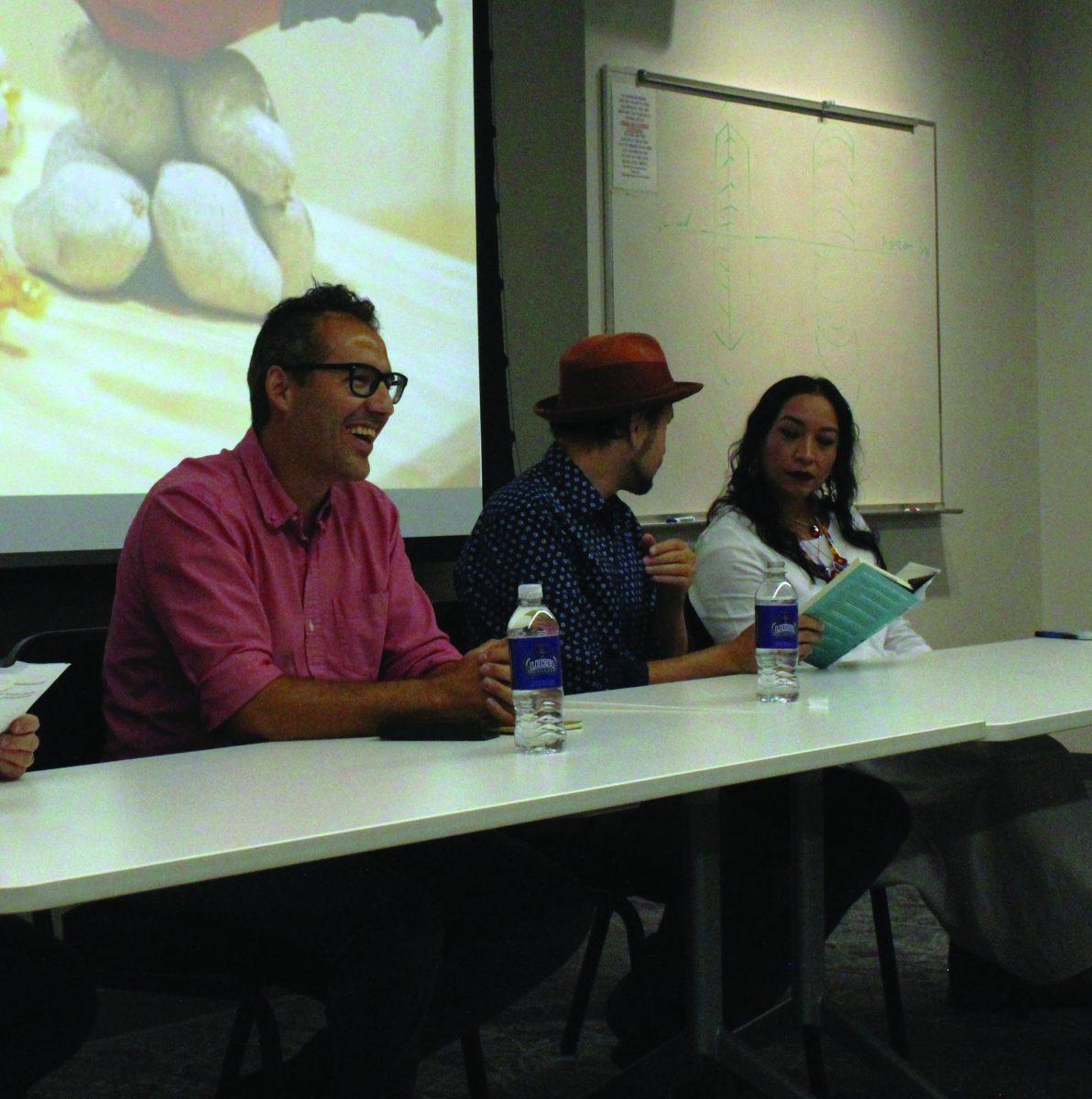
Artist in Residence Jonathan Christensen Caballero sparked conversation between panelists about art activism and Latin American labor Sept. 19.
The event was a part of the Artists in Residence program, hosted by the College of Arts, Humanities and Social Sciences. CAHSS brings artists who practice various mediums to UCA to expand the student body’s knowledge of the arts.
Caballero is a multidisciplinary artist and Kansas City Art Institute sculpture shop technician. He visited art students at UCA to share his mixed-media work that focuses on the human figure and the histories of Latin American laborers in the United States.
When Caballero moved to Lawrence, Kansas, he said he was unsure about what art to make. However, Caballero was inspired by the history of the Mexican families in Lawrence.
“Mexican families moved there originally to work for the Santa Fe Railroad Department, and they intentionally brought families over because the job itself was dangerous and not very well paid, and so people were less likely to actually flee from that job if they brought over the whole family,” Caballero said. “Then they had the company apartments where the families lived.”
Caballero said the residents in these apartments grew fresh produce and flowers to feed their families and “beautify their home.”
After learning about the history and the gardens of the Mexican families in Lawrence, Caballero said he “chose pieces of produce” that were mentioned in the oral histories of these families and took molds and casts of them.
Caballero said his exhibition, “Finding La Yarda,” “has a responsibility to both tell those hardships and those truths that are people’s lives, as well as then the parts that are outside of work, as well as sharing the humanity and the beautiful and joyful moments that are part of their lives as well.”
At the panel discussion in the Windgate Center, Caballero was joined by Magaly Licolli, Benjamin Garner and Alejandro González Landeros.
Licolli is originally from Mexico but has been organizing poultry workers for 10 years in the United States.
Licolli pursued a theater degree at the University of Arkansas, but realized “that was not what I wanted to do because I was pretty much the only Mexican there at the department and there was a lot of racism and issues with English being my second language.”
Licolli said after her time at the University of Arkansas, she began helping former poultry workers.
Licolli said, “When I began working in these jobs, I realized the horrors of the stories of what the workers were facing. To me, it was shocking to learn that behind your chicken sandwich, there is a lot of suffering, a lot of inhumanity.”
Licolli said, “And on top of that, people were silencing the workers. Nobody wanted to talk about poultry workers. They want to talk about immigrants, but nobody wanted to touch on the poultry workers, even though they were the immigrants that came to do their job in Arkansas.”
“I think for us, living in Arkansas, it is crucial to learn what this industry is about,” she said.
Licolli said to show support for Latin American laborers, Arkansans can create “the spaces where people or the workers can come and share the stories, like with churches or schools with teachers. Any space can be helpful for us to create the base of allies or supporters we need.”
Caballero said individuals can build “empathy” and think about “contributions, whether it’s in the construction industry, whether it’s in factories, whether it’s in agriculture, whether it’s in the service industry.”
Caballero’s exhibit, “Finding La Yarda,” will remain in the Windgate Center Gallery until Oct. 4.