



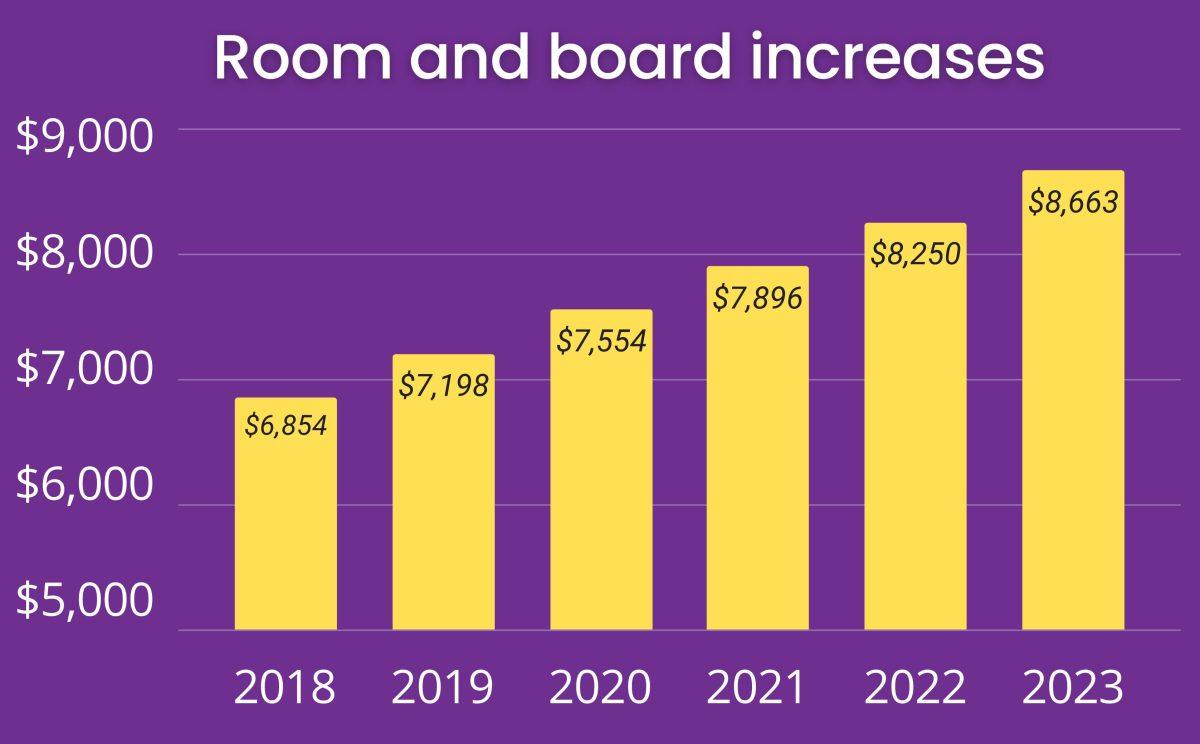
Students will see the highest percentage increase in room and board rates since 2019, following a 5% increase approved by the UCA Board of Trustees during its February meeting.
Based on a double-occupancy room with a total access meal plan, the room and board rate was raised from $8,250 to $8,663 — a 5% increase amounting to $413.
Since a 5% increase in 2019, the board has increased the rate in smaller percentages.
-
In 2019, the rate was raised from $6,854 to $7,198.
Story continues below advertisement -
In 2020, it was increased to $7,554, a 4.95% increase.
-
In 2021, it was increased to $7,896, a 4.52% increase.
-
In 2022, it was increased to $8,250, a 4.48% increase.
-
The February policy increases it to $8,663, a 5% increase.
Board Policy No. 632 explained the rise in rates. “These funds will be available to help cover the 5% increase in the Aramark contract and allow for necessary service enhancements and upgrades.”
The rate increase policy says, “For the 2023-2024 academic year, Housing anticipates an annualized occupancy rate of approximately 95%.”
-
In 2019, a 99% occupancy rate was predicted.
-
In 2020, a 93% occupancy rate was predicted.
-
In 2021 and 2022, none were given due to COVID-19.
Student Government Association President Courtney Clawson delivered comments on behalf of the student body about the increase.
“Students cringe at any thought of an increase — no matter what it is — and try to push back when we first hear about one,” Clawson said. “However, we recognize that the university and everyone involved did and still do everything they can to make sure these increases are as low as possible.
“We understand that this increase is necessary in order to keep UCA functioning the way that it needs to. We are very thankful for a university that keeps students and our wallets at the forefront for every decision.”
UCA’s unrestricted/unallocated cash dipped to pre-pandemic numbers, according to Terri Canino, interim vice president of finance and administration.
In December:
-
FY20 reported $27,973,996
-
FY21 reported $31,861,501
-
FY22 reported $31,649,946
-
FY23 reported $25,162,921
“As of December we’re at $25 million, and the previous two Decembers we were at $31 million. We received the HERF funding for the last two years — around $6.5 million each of those years — unfortunately, that’s over with.”
Additionally, Canino reported a total income for the University of $191,144,489 as of October. A $5.5 million increase to $196,671,823 is projected for June 30.
Canino reported no gains or losses as of the October revised budget, with expenses equaling income. In the June projection, a $5.9 million gain is predicted.
As for projected expenses, a $2.4 million gain was found in scholarships and fees, but a $2.2 million loss in purchases and utilities caused the two to “net each other out,” citing a nearly 38% increase in utility costs.
President Houston Davis announced that faculty and staff can expect a 2% cost-of-living adjustment in July.
“Last year we talked about the fact that we needed to respect that our students and their families were certainly dealing with inflationary pressures, but guess what — our families are also dealing with inflationary pressures. We want that [increase] to be the first of three years in a row,” Davis said.
In other business, Academic Affairs will restructure following the expected retirement of Associate Provost Jonathan Glenn.
Provost and Executive Vice President of Academic Affairs, Patricia Poulter, said Glenn “shared that he was probably going to be retiring in the next few years.”
UCA will not fill his position following his retirement.
The Board welcomed its newest trustee, Jim Rankin, replacing Robert ‘Bunny’ Adcock. Rankin is the president of Trinity Development and was appointed by Gov. Sarah Huckabee Sanders.
Vote Everywhere, also known as Bears at the Ballot, received the Bear C.L.A.W.S. award, which stands for celebrating the lofty achievements of our wonderful students. Senior Annabelle Van Asche accepted the award on behalf of the group.
Three professors were awarded the title of Distinguished Emeritus: Emogene Fox, professor of health education; Kenneth Barnes, professor of history; and John Choinski, professor of biology.
The board will next meet 10 a.m. May 25 in Wingo Hall.