




UCA is the first college in Arkansas to receive a $30 million GEAR UP grant from the U.S. Department of Education to increase college preparedness in middle schools.
Victoria Groves-Scott, dean of the College of Education, said that getting the Gaining Early Awareness and Readiness for Undergraduate Programs grant is a significant achievement for UCA.
“This one’s geared toward middle school, but there are middle school and high school programs for students who are in lower socioeconomic areas,” Groves-Scott said. “It provides assistance to help them plan and prepare for college.”
The GEAR UP grant will be used to help sixth and seventh graders in 11 school districts: Blytheville, Brinkley, Camden Fairview, Clarendon, Little Rock, Pulaski County, Helena/West Helena, Jacksonville, Lee County, Marvel/Elaine and Hope.
A kick-off event for the grant was held Nov. 27 in the Brewer Hegemen Conference Center. Partners and members of the districts were able to discuss the grant and its potential over the next several years.
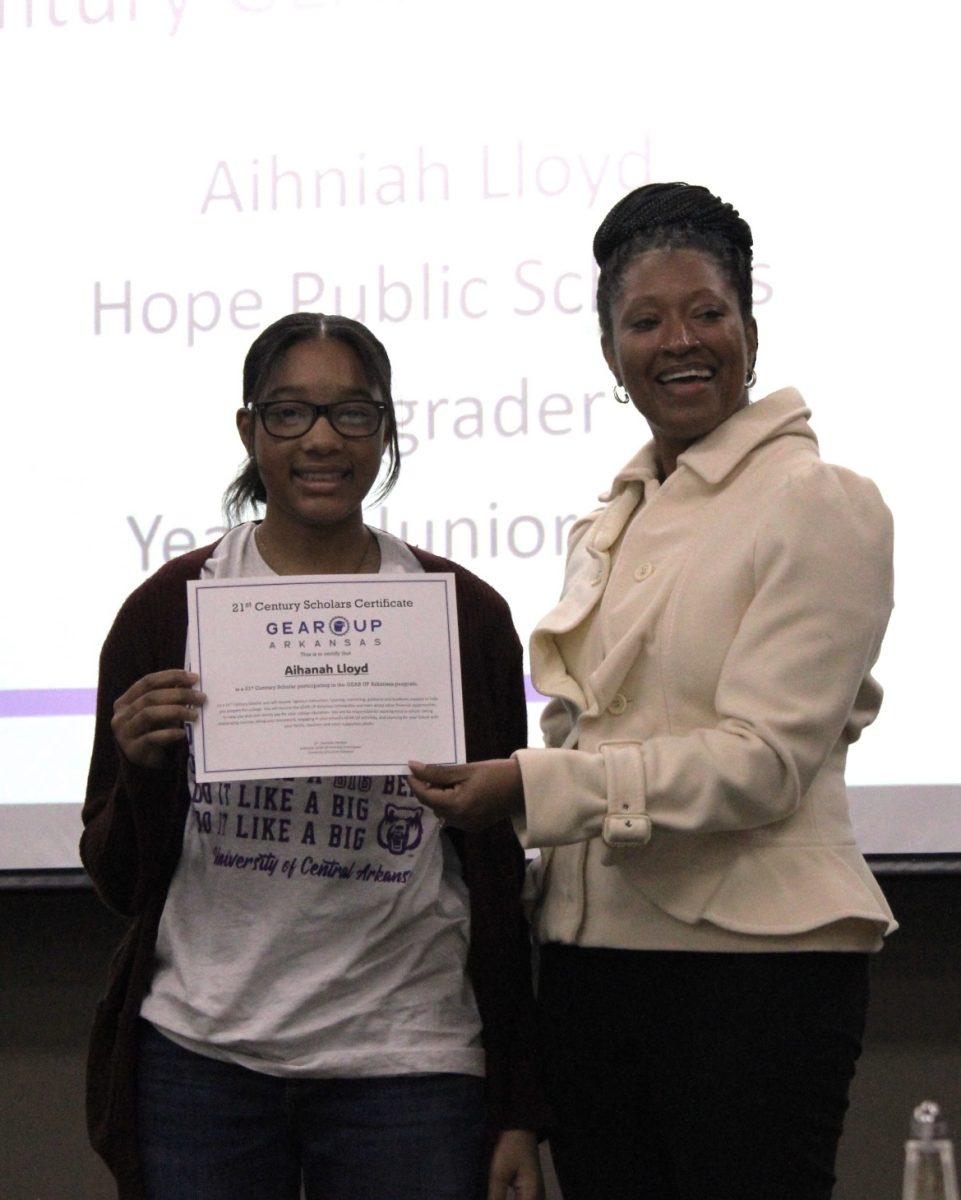
Aihniah Lloyd, a seventh-grader in the Hope school district, was the first student awarded a certificate for the GEAR UP grant.
Lloyd said she hopes the grant gives “all students a chance for college.”
Education professor Charlotte Parham, the principal investigator of the grant, played a primary role in securing the funding.
Parham said, “The principal investigator is the person who actually applied for the grant. Any grant that a university has, someone has to research it and apply for it, and then if they get it, then they’re the principal, researcher or investigator for implementing the grant at the university.
“So when you’re writing for the proposal, you lay out all the different things you would do if you got the money. And then if you get the money, then it’s your job to execute it and make sure that the university does what it is agreed to do in writing the grant.”
Groves-Scott said the grant will aid the 11 school districts over seven years.
“It was based on their rating for free and reduced lunch, and that’s how the federal government defines districts and their poverty level — by the percentage of students that qualify for free and reduced lunch,” Groves-Scott said.
Parham said every sixth and seventh grader in the districts will be automatically put in the grant programs, but parents can opt out.
Parham said she applied for the GEAR UP grant because she worked in the K-12 school systems and has been in education for over 25 years.
“I really get that you have to have intentionality in that system in order for students to be successful,” Parham said. “So our role in the College of Education is to train teachers to teach with fidelity in the classroom.
“I’m in leadership study, so my job is to help train administrators to implement programs to help students be successful. So GEAR UP is a good fit for what I do and for what the university wants to do from the College of Education. We want to be a system that helps equip students and teachers and families to be successful.”
Groves-Scott said the grant will allow first-generation students to have more confidence in themselves and their education.
“I was a first-generation college student and grew up in northwest Arkansas and didn’t even think about the possibility of going to college, it just was so outside of the realm of what my parents envisioned for my future,” Groves-Scott said. “I was just really lucky that I was in a program and had faculty members and high school teachers who are like, ‘You need to think about going to college.’
“I think that for students who are lower socioeconomic and first-generation college students, they just can’t see their future on a college campus. They never explored that, and this gives them the opportunity to hope and dream and to think about careers that require college degrees that they would have never imagined themselves doing,” she said.
Groves-Scott said the GEAR UP grant is very competitive; when UCA first applied three years ago, it didn’t get the grant.
Parham said only a few states receive GEAR UP grants and the application process is only open every few years.
“I connected with people who have successfully implemented GEAR UP in other states, and they gave me insight as to what this looks like, in real-time; they gave me input on challenges and what works, and what doesn’t work,” Parham said. “We can learn from what they’ve already done, so that was probably the hardest part. It was a big grant and just thinking about and learning what it is, and the magnitude of how impactful it can be.”
Parham said while doing research, she watched testimonial videos of students in other states who benefited from the GEAR UP grant.
“I think the thing that I’m most looking forward to is having Arkansas students, in the 11th or 12th grade, just talk about it and how it changed their narrative or what they thought was possible in life,” Parham said.