




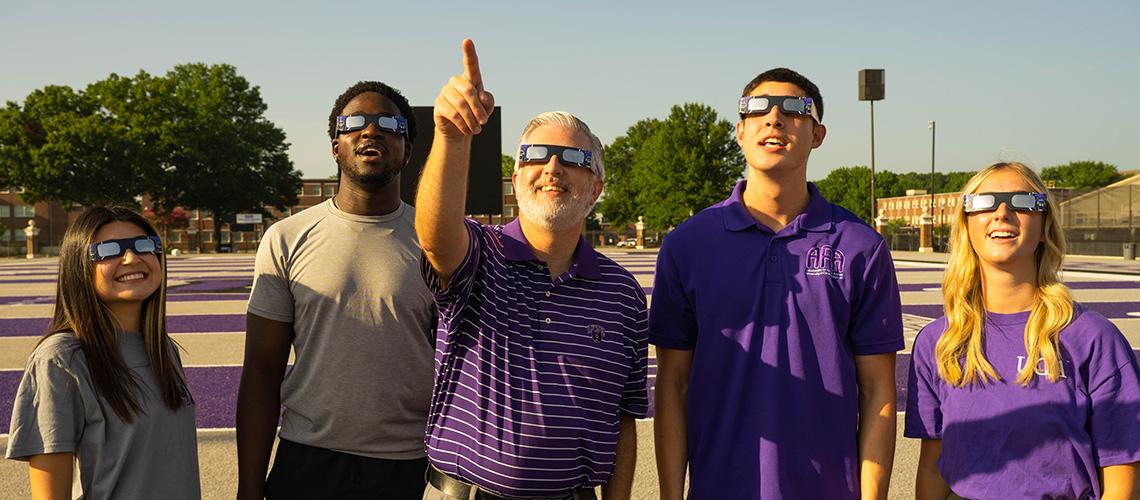
UCA’s Eclipse Steering Committee has a constellation of festivities prepared in advance for the total solar eclipse next year, including asynchronous classes, dance numbers, eclipse accessories and a speaker from NASA.
The committee gathered over Zoom on Sept. 21 to discuss the immersive events designed to celebrate the total solar eclipse on April 8, 2024, for students, Conway natives and newcomers alike.
Chief of Staff Amy Whitehead led the meeting and outlined the committee’s expectations for how the eclipse will “serve as an educational resource for Central Arkansas” and affect campus safety.
“Our driving focus has been let’s have a safe, fun and educational experience for our students, faculty and staff, number one,” Whitehead said. “And then if we can also be a resource and a gathering place for Conway or the larger central Arkansas community then we want to be able to do that, as well.”
Estes Stadium will be open to the public from about 10 a.m. to 4 p.m. through “come and go” general admission, and people can view the eclipse from the comfort of their blankets or the bleachers.
According to Whitehead, instruction will be asynchronous “so that everybody has the opportunity to participate and enjoy this really special event.”
“We’re going to partner with the Chamber of Commerce to have concessionaires and food vendors,” Whitehead said. “Maybe some arts and crafts vendor selling eclipse-themed wear. We will be handing out our eclipse glasses.”
There are several other events in line to prepare for the big day, such as a showing of the 1992 French silent film “A Trip to the Moon” April 7 and a dance performance of “Concealing the Moon” March 28 at the Windgate Center.
“We’re going to have art exhibits. We’re going to have dance performances. We’re going to have speakers,” she said.
Amber Straugn, an astrophysicist from Bee Branch, Arkansas, who works for NASA, will speak at Reynolds Performance Hall; professor of art history Gayle Seymour is bringing a pet-friendly event to the College of Business lawn.
Whitehead said “there’s a low prediction of 70,000 visitors for Arkansas and a high of 281,000.”
The Arkansas Space Grant Consortium donated approximately 33,000 viewing glasses, and the committee ordered 25,000 UCA-branded eclipse glasses.
Whitehead said UCA Emergency Management Coordinator Carol Walton is working with the Arkansas Department of Emergency, Transportation and Tourism to ensure the campus is “ready for an influx of visitors.”
“She will be a point of contact for our joint emergency operations center that we’ll have on campus the day of the eclipse,” Whitehead said. “We’ll have tight, tight — physically and communication-wise — connections with Conway fire, Conway police, Pafford Medical Services.”
Scott Austin, an associate professor of astronomy and physics, elaborated on the science behind a solar eclipse in an interview.
“A solar eclipse occurs when the moon’s shadow intersects the Earth,” he said. “If the part of the moon’s shadow called the umbra intersects the Earth, then a spot of totality about 120 miles wide will be cast on the Earth. Given that the Earth and moon are moving, the spot of totality moves across the Earth’s surface at speeds between 1,000 and 5,000 mph.”
The path of totality for the eclipse will pass over parts of Mexico, Texas, Oklahoma, Arkansas, Missouri, Illinois, Kentucky, Indiana, Ohio, Pennsylvania, New York, Vermont, New Hampshire and Maine.
“All of those areas will be ‘hot spots’ for the event,” Austin said. “The odds of cloud-free viewing are better southwest of Arkansas, and the odds of cloud-free viewing get worse the further northeast of Arkansas you go.”
Austin’s biggest piece of advice is eye safety.
“The only time it will be safe to directly look at the eclipse without filters is during totality,” he said. “If any part of the disk of the sun is visible, then one must use special filters or solar eclipse glasses, otherwise retinal damage will occur.”
For more information on the eclipse, visit eclipse.aas.org/eclipse-america-2023-2024, eclipse2024.org/eclipse-cities/city/5621.html and uca.edu/eclipse/.