




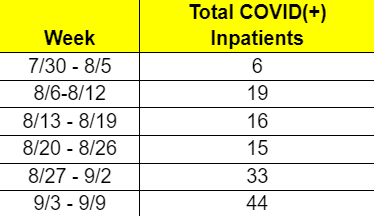
Since UCA Medical Director Dr. Randy Pastor’s email to students Aug. 31 about COVID-19 cases increasing on campus, 2,211 cases were reported in Arkansas during the first week of September.
UCA’s Medical Director Dr. Randy Pastor said he used data from the Arkansas Department Of Health’s data hub in his email about cases in Arkansas having more than doubled.
There, the ADH reported Sept. 7 that Arkansas had 9,475 cases in August. Arkansas only had 2,065 cases in July, meaning cases more than quadrupled.
Arkansas has had 45,617 reported cases so far this year, and 427 COVID-related deaths, according to the ADH data hub.
Following The Echo’s reporting Sept. 6 about a professor asking COVID-positive students to come to class with a mask, Provost Patricia Poulter sent an email later that afternoon to UCA’s Council of Deans, clarifying what policies faculty can set in their classrooms and reaffirming that UCA is still following CDC guidelines for COVID-19.
“It is critically important to campus health and safety that faculty do not require in-person attendance for students who are sick and potentially contagious. Students with appropriate medical notification must be excused from attending class in person and must be allowed to make up any work dependent on that attendance, or be provided a reasonable alternative,” she said.
Director of Media Relations Fredricka Sharkey said in a Sept. 5 statement to The Echo, “COVID-19 will continue to be with us, likely for years to come. Individuals must make personal health care decisions just as they would in cases of influenza, the common cold or other illnesses.”
“The UCA Student Health Clinic continues offering free COVID-19 tests for faculty, staff and students during our normal operating hours Mondays through Fridays. The bivalent vaccine is also available to the UCA community and their families through the Student Health Clinic,” Sharkey said.
Sharkey linked the CDC’s guidance on “Isolation and Precautions for People with COVID-19,” which offers an isolation and exposure calculator, in addition to guidelines for people who test positive.
“We encourage students to follow the latest guidance from theCenters for Disease Control and Prevention and take the necessary precautions to keep themselves and their peers safe,” she said.
According to the guidelines, “You should isolate from others when you have COVID-19. You should also isolate if you are sick and suspect that you have COVID-19 but do not yet have test results.”
The guidelines also state: “Stay home for at least 5 days and isolate from others in your home. You are likely most infectious during these first 5 days. Wear a high-quality mask if you must be around others at home and in public. Do not go places where you are unable to wear a mask.”
More guidelines for individuals are available at CDC.gov/coronavirus.
Sharkey said, “We hope that students will remain in contact with their professors in the event of a positive COVID-19 test or any other illness that would keep them from attending class.”
Pastor said UCA is no longer tabulating COVID-19 data.
Professor Benjamin Rowley, who has a doctoral degree in microbiology and immunology, said as the main public health crisis of the pandemic has subsided, so has the financial support for resources like testing and tracking, which “takes a lot of money, material and time to do properly.”
Rowley said, “We’re not in the same bad spot that we were in during the early days of the pandemic,” pointing to “vaccines, antiviral meds and a degree of natural exposure immunity in place in the population now.”
Rowley said his experience is “not directly clinical,” and that he is not giving medical advice.
He said while no vaccine is perfect, and levels of effectiveness can vary with COVID-19 variants and subvariants, data shows vaccines protect individuals.
“I cannot stress this enough — the data consistently shows that COVID-19 vaccines, given across populations, help to keep people from being hospitalized, needing ventilator support or dying,” he said.
However, he said vaccines aren’t perfect: “The vaccines are not foolproof, do not work in every individual, and may induce differing levels of protective responses. No vaccine works 100% of the time.”
For example, “Immunocompromised individuals may not make as much protection from a vaccine dose as a person with a healthy immune system, and the response initiated may not last as long,” he said.
But, “Vaccines aren’t about individual responses,” Rowley said. “They’re about getting enough people in a population resistant to or protected against an infectious agent that the agent can’t get a foothold in that population.”
“Each healthy person who is better protected by a vaccine is less likely to acquire and spread an illness to someone who is less protected by a vaccine. It’s the indirect protective effect and one of the benefits of vaccines given across populations,” he said.
“COVID-19 is endemic now. It will likely be around indefinitely, and we may need to change our thinking to make it ‘cold/flu/COVID season,’ and adapt our strategies accordingly to best protect populations,” he said.
However, unlike the cold and the flu, which “largely disappear in the summertime, and spike back up in the wintertime,” experts saw COVID-19 spiking in the summer, too.
“We have definitely been seeing those winter spikes in the upper hemisphere. But what was somewhat unexpected were the summer spikes that so far have happened,” he said.
Rowley said the common cold, the flu and COVID-19 “tend to get lumped together because they’re transmitted via respiratory droplets.”
“The illnesses they cause tend to induce a lot of coughing and sneezing. Airborne transmission of illness is especially insidious and hard to control contrasted with a virus that is, for example, sexually transmitted or transmitted by direct close contact,” Rowley said.
In addition, as temperatures drop, airborne illnesses typically spread more, too.
“For several of these viral infections, they really like to replicate in the cells of the upper respiratory tract, and at a few degrees cooler than the rest of the core body temp,” he said.
He also said there’s been research about droplets persisting when humidity is low, like in the winter, but human behavior can also affect illness rates as temperatures drop.
“We stay inside more in the winter time, so we’re around each other in enclosed spaces more, potentially leading to greater chance of illness spread,” he said.
Rowley said COVID-19 was a “wild card” for experts, and it left a lot to be researched.
“We’re still studying the 1918 influenza pandemic, learning more about it and publishing papers/books on it. COVID-19 is going to be like that,” he said.
“It was essentially a new virus in the human population. We weren’t sure at all what the morbidity and mortality rates would be until we monitored them in real time during the early, and ongoing, days of the pandemic. Health officials were very worried that mortality rates might be like the related MERS [Middle East respiratory syndrome] coronavirus infection,” he said.
While COVID-19’s mortality rates — “how many people die once they’ve contracted it” — ended up not being as bad as the 2012 MERS outbreak, Rowley said even a low-seeming mortality rate means a lot of people will die globally.
The CDC reported Sept. 7 that 1.1 million Americans died with COVID-19 and 6.3 million were hospitalized with the virus.
Rowley said infection outcomes also vary: “Don’t forget about the possibility of ‘long COVID.’”
“It isn’t either ‘I lived’ or ‘I died.’ It might be ‘I lived, but I have long-term health complications from my infection,’ or ‘I lived, but I was in the hospital for a month and I have those bills to contend with now.’ People tend to forget about that nonbinary possibility for outcomes,” he said.
Timothy Purkiss, Hendrix’s director of summer programs and UCA graduate, said that Hendrix’s administration has altered its COVID-19 response strategies to reflect the virus becoming “more endemic to the community.”
He has been a member of Hendrix’s COVID-19 steering committee “since the beginning, since 2020.”
Hendrix no longer tracks on-campus cases, but he said the university still monitors data from Conway Regional and CDC.
“They kind of keep us in the loop in terms of hospitalizations in the community, and of course, we pay attention to CDC data as well,” he said.
“It does seem that more people are getting sick right now, and that could be related to the start of school,” Purkiss said.
He said Hendrix’s COVID-19 committee never dissolved but went “offline” in spring 2023.
“The committee is still together. We are just not meeting until the president or the senior leadership calls us back into action,” he said.
“We have plans that are written down and ready to go, should we be called upon,” he said. “A lot of our plans and policies and mitigation strategies that we use can be switched back on.”
“We’re mostly trying to focus on trying to support those who are dealing with COVID or any other illness,” he said.
“Dining still provides to-go meals for ill students and residence life still supports any students who are dealing with illness in terms of if they need a place to stay away from a roommate, or helping them with supplies,” Purkiss said.
Purkiss also said Hendrix faculty can require masks in their classrooms as a medical accommodation with approval from the administration.
To make an appointment for either a COVID-19 test or a bivalent vaccine, students and faculty can go to uca.medicatconnect.com or call (501) 450-3136.