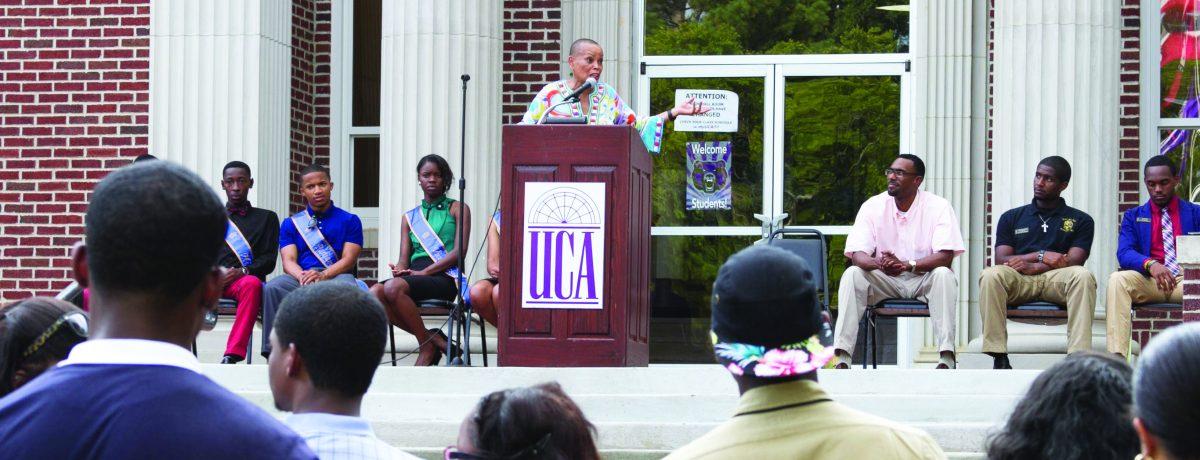



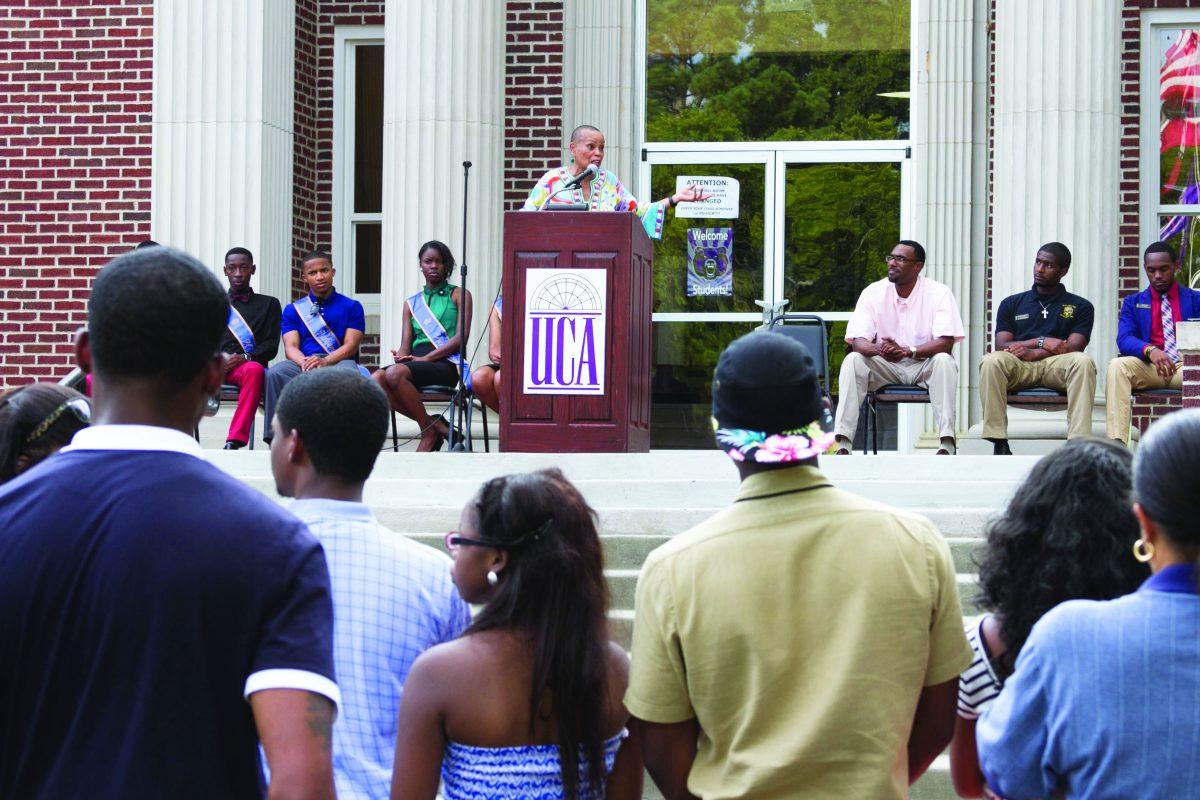
District 33 Democratic Sen. Joyce Elliott (left) discusses Martin Luther King Jr.’s legacy following the March on Washington at an anniversary event Aug. 28 in front of Main Hall. | PHOTO BY MACKENZIE PHILLIPS
While national leaders commemorated the 50th anniversary of Martin Luther King Jr.’s “I Have a Dream” speech Aug. 28 in Washington, D.C., Arkansas figures were on campus to share what the civil rights pioneer’s words meant to them.
Democratic Sen. Joyce Elliott, representing the 33rd District, spoke to the crowd about King’s legacy of encouraging people to have dreams and achieve them.
“The very essence of a march means that we are going forward,” she said. “There are a lot of things wrong, a lot of things that have not been resolved, but less you think there have not been incredible changes, just imagine that today, on this day, standing on the very same spot that Dr. King gave his speech, a man named Barack Hussein Obama spoke in that same spot.”
Three U.S. presidents – Jimmy Carter, Bill Clinton and Barack Obama – attended and spoke at the Washington, D.C. ceremony. Thousands gathered at the National Mall to watch as speakers described the significance of the date in history.
King’s most-noted words from his Aug. 28, 1963 speech about looking beyond race carry a legacy of hope for many people and the message crosses generational lines.
“Celebrations and commemorations happen for a day,” Elliott said. “But their work was for a lifetime and it still goes on.”
UCA’s NAACP chapter and the Theta Psi chapter of Alpha Phi Alpha partnered for the event.
Sophomore Richard Deante Gaskins, Alpha Phi Alpha vice president and UCA NAACP president, explained the influence King’s speech had on future movements.
“The march had an obvious impact both on the passage of civil rights legislation and on nationwide public opinion,” he said. “It proved the power of mass appeal and inspired imitators with the anti-war, feminist and environmental movements.”
Junior Sharetta Criner said she first heard King’s speech at an event in Memphis, Tenn. that commemorated the 40th anniversary of his assassination.
“The march, to me, symbolizes hope and change,” she said. “I know it’s a little cliché.”
Criner said she was encouraged to see a mixture of races attend and that she hopes “we continue on this march forward.”
Elliott challenged young people in minority groups to be more socially aware and active as a voice.
“Will you please lay claim to your country.” she said. “Will you please stop acting as if this is someone else’s country and you don’t have responsibility for making it better.”
When people compare themselves to King, Elliott said it gives them a license to do nothing. She told the story of how Bayard Ruston and A. Phillip Randolph were leaders of the March on Washington.
“Many have never heard their names,” she said. “You too can make things happen, whether or not you get credit.”
Elliott said it is vital for people to wake up in order to achieve their dreams.
“These people, on this day, woke up to the alarm clock of Dr. Martin Luther King and the alarm clock reminded us about the dream and all the work we had to do,” she said.
Elliott said pressing topics include lesbian, gay, bisexual, transgender and questioning inequality (LGBTQ), healthcare costs, poverty and ineffective immigration policies.
“LGBTQ people have a hard way to go in ways that we don’t think about,” she said. “These are the civil rights issues of this day.”
Faulkner County NAACP Chapter President Charles Holloway agreed with Elliott on disparities among minority groups, saying that the “torch is being passed to continue the march.” He said America is challenged with economic inequality and injustices in the legal system.
“There are limited opportunities today, and frankly many aren’t offered to minorities,” Holloway said. “Though there is a reason to celebrate today, Dr. King’s dream is not a reality.”
Elliott echoed the sentiment Holloway shared regarding how the African-American population and other minority groups are treated in the court system.
“I think that what happened with Trayvon Martin is a testimony to how far we have not come,” she said.
Martin, a 17-year-old high school student, was shot and killed by neighborhood watch volunteer George Zimmerman on his way home in Florida. Zimmerman was found not guilty of second-degree murder and manslaughter, saying he acted in self-defense. Elliott said it was nice to see that a cross-section of people was not silent about the verdict.
Elliott and Holloway each issued a request to attendees in their concluding remarks. Elliott encouraged young people to be active citizens who vote when given the opportunity and Holloway said education will prepare a generation to fight for justice.