




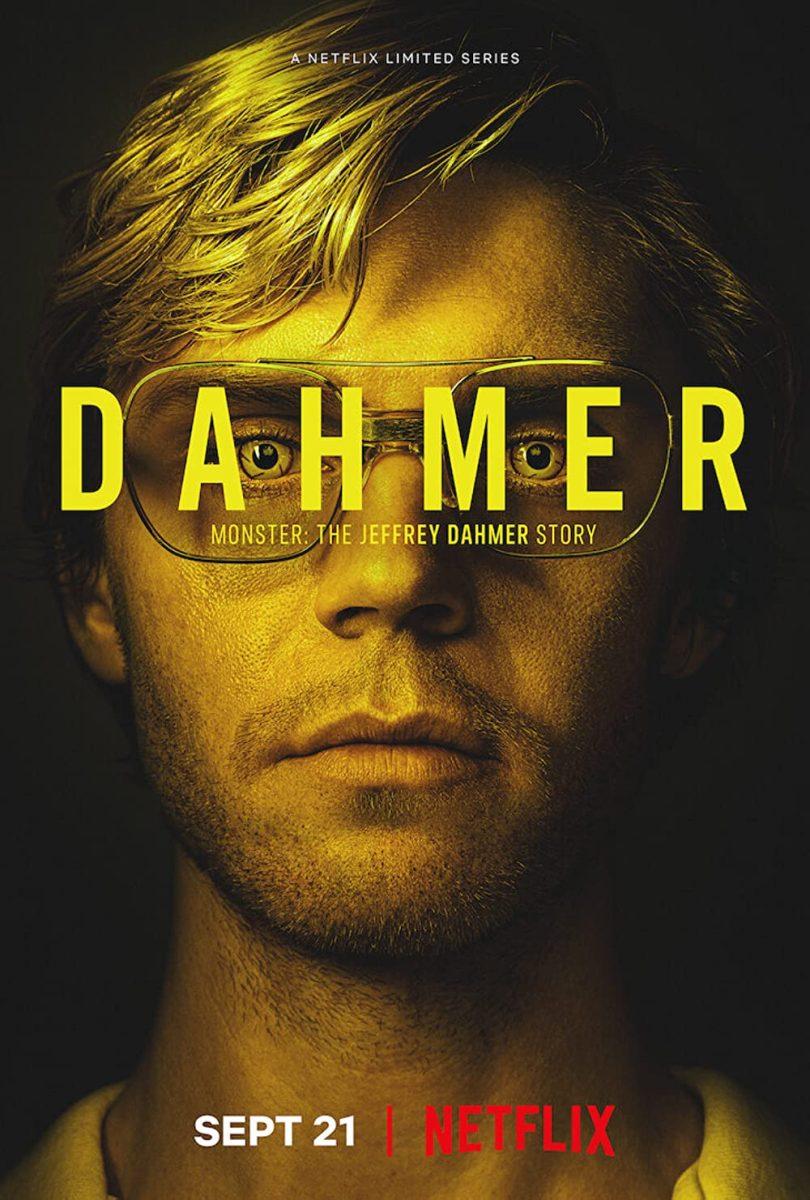
Netflix’s “Dahmer — Monster: The Jeffrey Dahmer Story” is an awkwardly directed show that does more harm than good for its audience’s perception of the serial killer and his victims.
Ryan Murphy and Ian Brennan direct the show; Evan Peters, most known for his various roles in Murphy’s “American Horror Story,” stars as Dahmer.
“Dahmer” is reminiscent of David Fincher’s Netflix series “Mindhunter” due to its macabre directional style and deep dive into the psyche of a notorious serial killer.
The show starts at the beginning of the end when Dahmer lures a man into his apartment and attempts to kill him, but the man escapes and brings the police back. Dahmer is arrested, and the show launches into a series of disordered flashbacks that portray his descent into madness.
“Dahmer” has an eerie, soft glow and captivating cinematography. Each shot is tediously constructed, and it pays off.
Even the most gruesome scenes are difficult to peel your eyes from. The set props, such as the fake organs and dead bodies, are so mesmerizingly well-made that you can smell the appalling stench through the screen.
“Dahmer” also does an impeccable job of copying the real Dahmer’s apartment. The comparison pictures are almost identical.
While Peters captures Dahmer’s bizarre mannerisms well, the show’s acting and dialogue often fall short. For example, Penelope Ann Miller’s performance as Dahmer’s mother, Joyce, is downright comical. Her delusional screams feel more like a mockery of a mentally ill person than an accurate portrayal of one.
The dialogue also suffers from unrealism. In one scene, Dahmer’s father Lionel (played by Richard Jenkins) screeches, “I’m not a black bear in one of your nightmares!” These outrageous, impracticable outbursts hurt the show’s legitimacy.
Behind the show’s informative facade is an unfortunate truth. Despite what the show wants its viewers to believe, Dahmer’s victims are not given the respect they deserve.
Instead, they are reduced to nameless caricatures of real people that died because of Dahmer’s vile nature and the police’s failure to investigate the missing victims properly.
The sad irony of it all is that despite many attempts to humanize the victims, “Dahmer” miserably fails. Reports show that no one in the victims’ families was contacted before the show was produced.
This action, or lack thereof, proves that Netflix has no real intentions of helping the victims and their families. No one received any compensation for Netflix’s usage of their stories, even though Netflix is no doubt collecting millions since the show’s release.
This glaring issue taints any attempt to give the victims justice. By the show’s end, you know more about how the victims were gruesomely murdered than anything about their lives. Their aspirations, hobbies and distinct personalities are all swept under the rug so that Dahmer can shine.
After all, the show is feeding off its audience’s sick fascination with trying to understand what could possibly drive someone to commit such despicable acts.
While “Dahmer” is undeniably a triumph for its cinematography and prop design, it comes off as an ingenuine cash grab for Netflix to profit off its audience’s morbid curiosity.
“Dahmer” is available to stream on Netflix.