


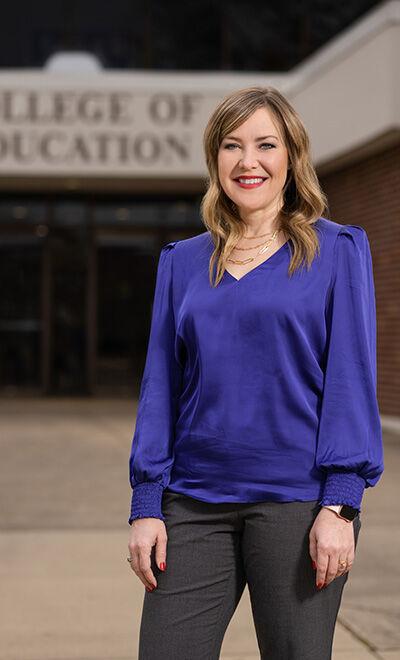
Susanna Post graduated from the University of Arkansas at Fayetteville with a degree in math and computer science, but after working for a few years in the oil and gas industry, she decided to go back to school at UCA to receive her teacher licensure.
Post said she always considered being a teacher, but a professor had encouraged her to pursue math and science because it added more work opportunities. Her family moved to Texas and that’s where she began working in the oil and gas industry for the next 13 years.
“Then a local homeschool co-op asked me to teach a couple of night classes. Once I started that, I knew I had to find a path back to full-time teaching. I wanted to do more than make money. I wanted to make a difference,” Post said.
This brought her to UCA’s MAT program where she encountered a teacher that truly inspired her, Aimee Dyson. “In her classroom, we were always engaged in meaningful conversations, and I always left my time with her feeling challenged and inspired,” Post said.
One of her favorite lessons from that class that shaped her own teaching style was assessment strategy. Instead of a final exam with pen and paper, the students were asked to gather objects and use them to create a representation of everything they learned that semester. It forced the students to think hard about what they learned and summarize it in a creative way.
Post said, “I took that strategy and used it successfully in my classroom. But the greatest lesson was to think outside the box. That lesson gave me permission to be innovative without fear of being ineffective.”
Post began teaching after her time with Netherland, Sewell & Associates Inc. and XTO Energy, which made her favor project and problem-based learning for her students. She started at Belle Point, an alternative High School in Fort Smith where she taught math and business courses for grades 7-12 for five years. Post said she worked hard to make math engaging for her students.
“Because I had seen math used in the real world, I wanted to offer my students the opportunity to connect with math in authentic ways. Project-based learning was a huge hit with my students,” Post said.
Post is not the average teacher with a quiet classroom, as she encourages open discussion and chooses to be more of a facilitator of the teaching. She uses music, movement and art in hopes that her students will engage with each other and learn content in a creative way.
Her favorite subject to teach is quantitative literacy, which is usually taken by seniors. Post enjoys working with seniors and teaching them real-life applicable lessons in math that they can use when they graduate.
Her unique background is what Post attributes to her success in making math engaging and presenting it in a creative way. “We created tattoo designs… toured art exhibits, explored the school’s attic, and connected with the community to keep math relevant and fun.”
Post’s platform as Arkansas Teacher of the Year has been “Closing the Empathy Gap. I feel very passionate about empathy being the key missing component in many of our classrooms,” Post said. “Learning about brain science and the importance of empathy definitely shaped me as a teacher.”
Building relationships with students ─ which according to Post is the most important part of teaching ─ starts first by listening to them and seeing how they interact with other students, as well as going out of your way to make them feel seen and heard. Post said she would attend her student’s events or games outside of school as well. “When students see you at events you don’t have to attend, it sends an incredibly powerful message: I genuinely care about you, and it goes way beyond the math you’re learning in class.”
Post continues to educate, though she will be more so educating teachers now on how to improve math instruction as the new math coordinator in her district. She hopes to create positive learning environments across the district and still teach a few lessons at the alternative school.