

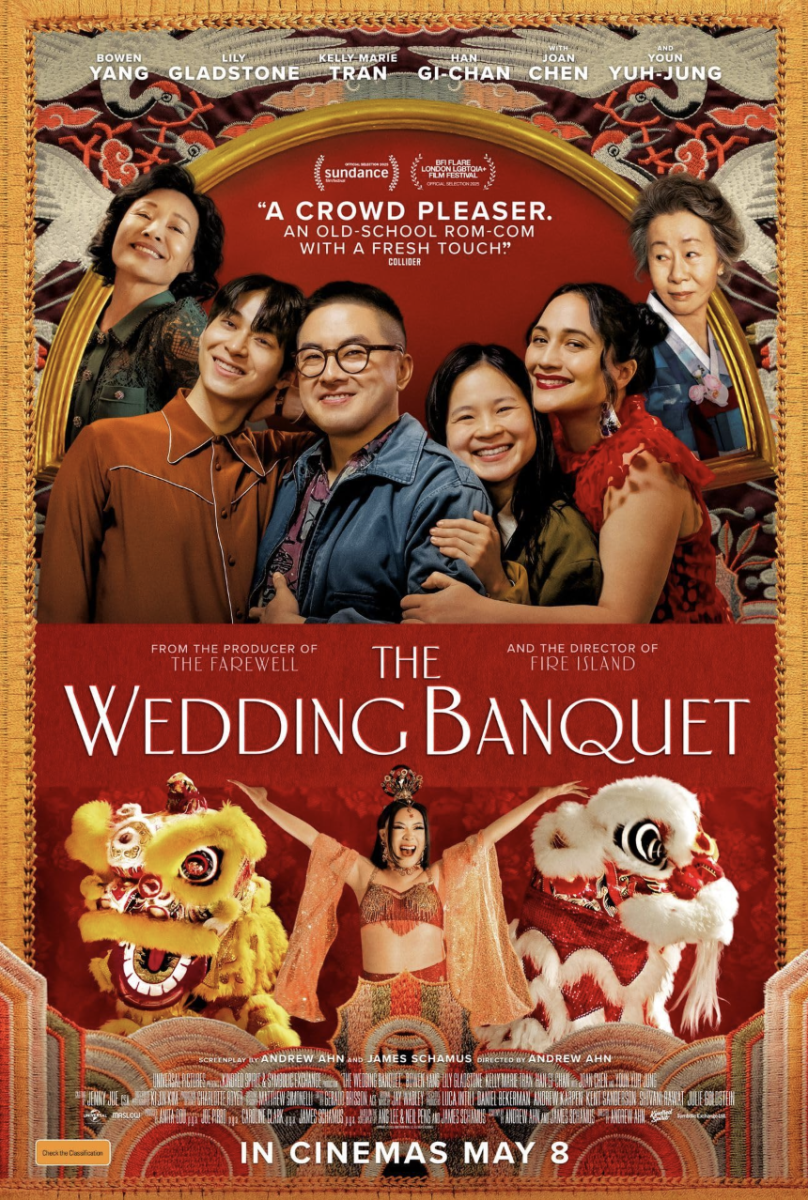
“The Wedding Banquet” updates the 1993 classic with a heartfelt remake that has notable star power and a more modern sensibility.
Andrew Ahn’s latest film follows the lives of two queer couples — Lee and Angela, and Chris and Min, who also happen to be best friends.
All four friends want different things: Lee wants to raise a child with Angela, but Angela is terrified of being a bad mother because of her childhood with her mother and Min wants to marry Chris, but Chris isn’t ready to commit because of a bad case of indecisiveness.
After the second IVF procedure fails, Lee and Angela are faced with a problem – Lee can undergo IVF one more time, but she doesn’t have the money.
Attending university for grad school in America, Min belongs to a wealthy but traditional family in Korea. As his visa expires, he is forced by his grandmother to take over the business or move back to Korea.
Since Chris isn’t ready to commit, Min arranges a fake marriage with Angela in exchange for the funds for another IVF operation.
The wildly absurd plan faces scrutiny when Min’s grandmother travels to America to see their wedding.
The film deals with themes of tradition, chosen family vs biological family, and queer identity.
With a diverse cast of stars, the film shines with likeable and complex characters.
Angela (Kelly Marie Tran) has a complicated and resentful relationship with her mother, Joan (May Chen). Angela struggles to accept her place in the world, but loyally supports her partner and friends.
Lily Gladstone gives a resounding performance as Lee, the older and wiser partner of Angela who desperately wants to start a family. Gladstone’s portrayal of Lee reveals a gentle character with a depth of lived experience.
Min (Han Gi-chan) is an innocently optimistic art student. His joyous performances provide a welcome relief to the more heavy moments of the film.
SNL’s Bowen Yang brings his signature charm to the role of Chris, mirroring his comedic talent from the show.
The story walks a tight line of dealing with complicated issues, like coming out as queer to a traditional family, in a manner that remains heartfelt, sincere and comedic.
The film avoids judgment, focusing on the characters’ emotional wounds and presenting their viewpoints alongside those of their peers.
A major change in the remake is the shift from taking place in New York City to Seattle, a city known for its leading embrace of queer culture. Set in the suburbs, Seattle is a more fitting location for the film’s themes of family.
This film is Korean director Andrew Ahn’s fourth feature. Ahn’s films typically focus on the livelihood of queer individuals.
The film was co-written by Ahn and James Schamus. Schamus wrote the original 1993 film.
An endearing remake of the queer classic, “The Wedding Banquet” is a thought-provoking and engaging story that needs to be watched.
The film released April 18 and is in theaters now.