



Brady Corbet delivers his magnum opus with “The Brutalist”.
It’s often said that art imitates life. An artist’s experiences, whether that be a collective or an individual experience, shape the art we consume. And by extension, that art shapes us.
“The Brutalist” follows a Hungarian architect’s attempts to rebuild his life after being freed from a concentration camp. Our protagonist, Lázló Tóth (Adrien Brody), emigrates to Pennsylvania to stay with family while he tries to find his missing wife and niece. After wealthy businessman Harrison Lee Van Buren (Guy Pearce) learns about Tóth’s background as an architect, he hires Tóth to build a community center. The project quickly balloons into a multi-year endeavor as Lázló Tóth’s artistry conflicts with Van Buren’s ego and American ideals.
Make no mistake, the synopsis for this film does it no justice. The film is divided into an overture, two parts, and an epilogue. Including the 15-minute intermission between parts one and two, the film runs over three and a half hours.
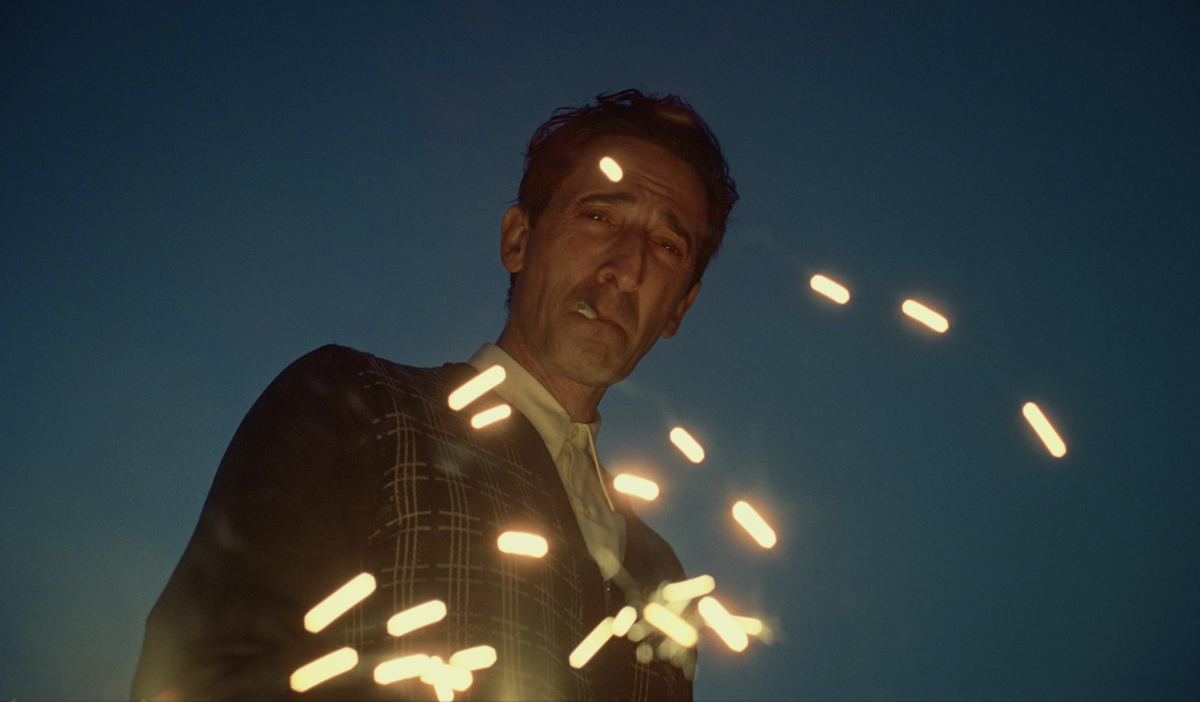
The first time that Lázló Tóth is shown is in a long take of him navigating the halls of a vessel. Besides the occasional glimpse of light, the figure of Tóth can barely be made out. The soundtrack provides a sense of unease. The viewer is unsure what’s happening. Eventually, Tóth makes it out of a large ship. The contrast of the unlit ship the viewer saw prior to a now fully lit up and vibrant sky is blinding. Tóth cheers. The soundtrack arrives at a crescendo. He points at an object in the distance, an indicator of his new life – The Statue of Liberty. After a brief glimpse at the statue, the camera pans towards the sky.
This chaotic opening lets the viewer know what they’re going to be watching. A film that’s unapologetically authentic in replicating the emotions of its protagonist.
Despite the long runtime, the film is paced exceptionally well. No matter what the story, viewers will always get exhausted by a film over two hours (looking at you, “Oppenheimer”). The intermission in the middle is a well-earned break that allows viewers to use the bathroom, get a refill or take a nap.
The intermission also acts as a great indicator of the tonal shift that the story undergoes between the two parts. The first half is all about the American Dream. The second half is a deconstruction of the American Dream. The story becomes darker, more disjointed and ultimately, sadder.
Brody shines in his performance. There are so many mannerisms of Tóth that the viewer will come to expect. After watching the film, separating the actor from the character will be a struggle. The other actors are amazing as well. Felicity Jones plays Tóth’s wife, Erzsébeth Tóth. Jones depicts a character who spent years confined to a wheelchair due to osteoporosis. Jones does a great job depicting Erzsébeth’s disability. The only performance that was lacking was Joe Alwyn as Harrison Van Buren’s son. He was too much of a caricature for a capitalistic industrial villain.
The production of “The Brutalist” is just as incredible as its story. After the release of his debut feature film, “Vox Lux” (2018), Brady Corbet announced the development of his next film (which would be “The Brutalist”). After delays with COVID-19, filming began in 2023. The film was shot in Hungary on 70mm Vistavision film.
It’s unbelievable that a film of this caliber was only made for under ten million dollars. Compared to similar Post-WW2 epics, the film is incredibly cheap.
Following a limited release last year, “The Brutalist” finally reaches audiences nationwide. The film was nominated for 10 Academy Awards, including best actor, best supporting actor, best directing, and best picture.
This is a film that will continue to be revered for decades to come because of its performances, plot, scale, cinematography, and set design.