




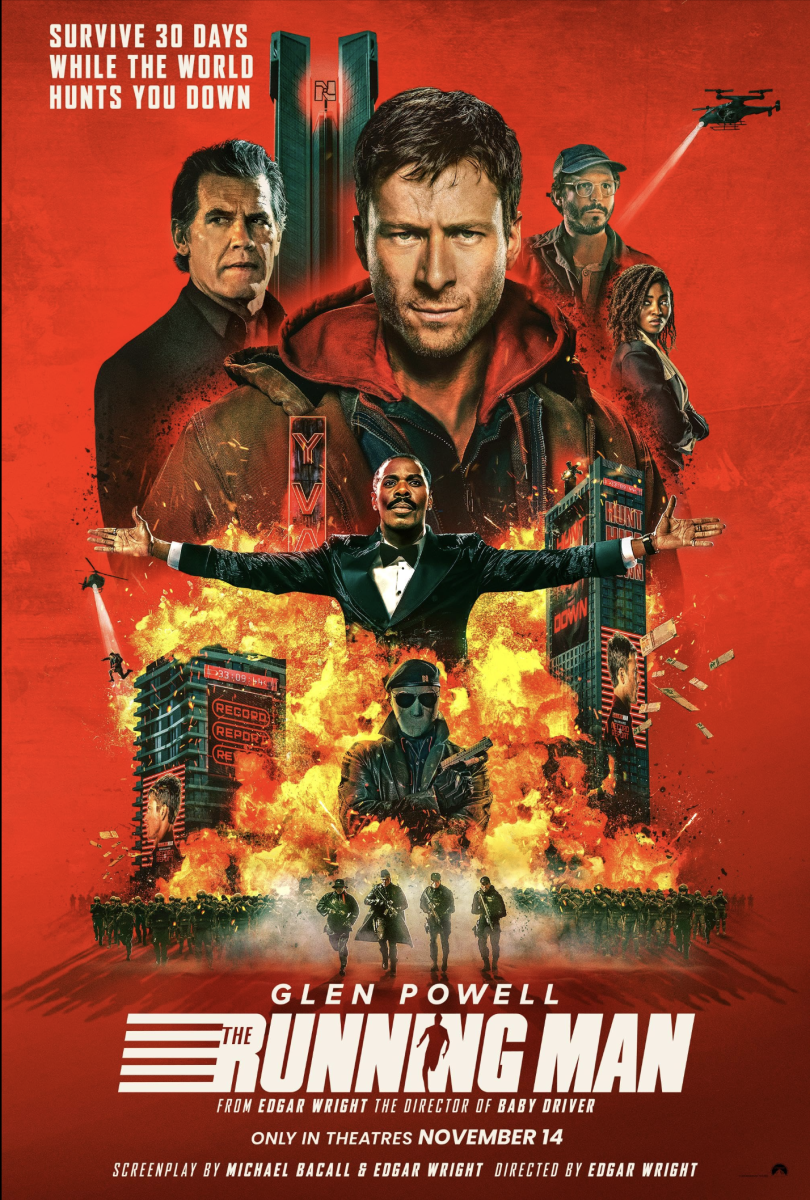
In a dystopian future where children might torch someone alive for a lifetime supply of Fun Twinks cereal, Edgar Wright’s adaptation of “The Running Man” hit the screens sprinting and has rarely slowed down since its Nov. 14 release.
Based on Stephen King’s 1982 novel (written under the pseudonym Richard Bachman), this new version trades the campy chaos of the 1987 Arnold Schwarzenegger film for a darker, more faithful take on King’s dystopian vision.
The result is a brutal, fast-paced action thriller that delivers plenty of adrenaline, even if its social critique doesn’t always land.
Glen Powell stars as Ben Richards, a desperate father whose two-year-old daughter needs expensive medication he can’t afford. Ignoring his wife Sheila’s (Jayme Lawson) pleas, Ben signs up for “The Running Man,” a mega-violent reality TV show where contestants are hunted by professional assassins for 30 days. If he survives, he wins a billion dollars. If not — well, nobody ever has.
Powell, fresh off “Top Gun: Maverick” and “Hit Man,” proves he’s ready for leading-man status, bringing a mix of rage, charm and vulnerability to Richards. His physicality is front and center, but it’s the moments of humor and emotional tension that lend depth to his performance.
He’s not a Schwarzenegger type, despite the film’s frequent admiration of his upper body; instead, Powell leans into a slicker, more self-aware persona that suits Wright’s tone.
The film’s antagonist, McCone (Lee Pace), leads the Hunters — a team of celebrity assassins who chase contestants through city streets.
Josh Brolin plays Dan Killian, the calculating executive behind the game show empire, who sees Ben Richards not as a desperate father but as a ratings goldmine. Killian recognizes Ben’s volatile temperament and physical grit as perfect fuel for the spectacle, exploiting his desperation to drive viewership.
The film effectively uses these two characters to personify the dystopia’s economic divide: Killian represents the untouchable elite, profiting from human suffering, while Ben is the working-class everyman forced to risk his life for survival.
Wright, known for “Shaun of the Dead,” “Baby Driver” and “Scott Pilgrim vs. The World,” brought his signature kinetic style to the action. A standout sequence inside a dingy hotel (a nod to the book’s YMCA setting) and a trunk-shot car chase showcase his ability to make chaos feel fresh. The film’s relentless pace powers through plot holes and plausibility gaps, keeping viewers too entertained to question the logic — at least until the credits roll.
Supporting performances from Michael Cera and Daniel Ezra help modernize the digital narrative. Cera plays Elton Parrakis, a rebellious ally who injects sharp wit and anti-establishment energy into the story. Ezra portrays Bradley Throckmorton, whose character delivers a clever update for the internet age — an element absent from King’s 1982 vision.
Colman Domingo’s energetic performance as the flamboyant host who whips the crowd into a frenzy adds even more energy to the already high-paced action.
King’s original novel imagined a world ruled by corporations, plagued by environmental collapse, mass surveillance, and even a resurgence of polio.
Set in a near-future America, a dystopian, anarchistic police state dominated by corporate media networks, the story unfolds in a society where poverty is rampant, healthcare is scarce and FreeVee, a nonstop stream of trashy reality shows and violent game spectacles, keeps the masses pacified.
It’s a chilling vision, and while the film doesn’t fully unpack the weight of its world, it captures enough of its essence to resonate.
Wright’s adaptation nods to these deeper themes, though it doesn’t delve as far into King’s ingenious blend of gore and systemic critique. “The Running Man” may not be the most profound dystopian tale, but it’s a stylish, high-speed update that injects fresh energy into King’s story.