



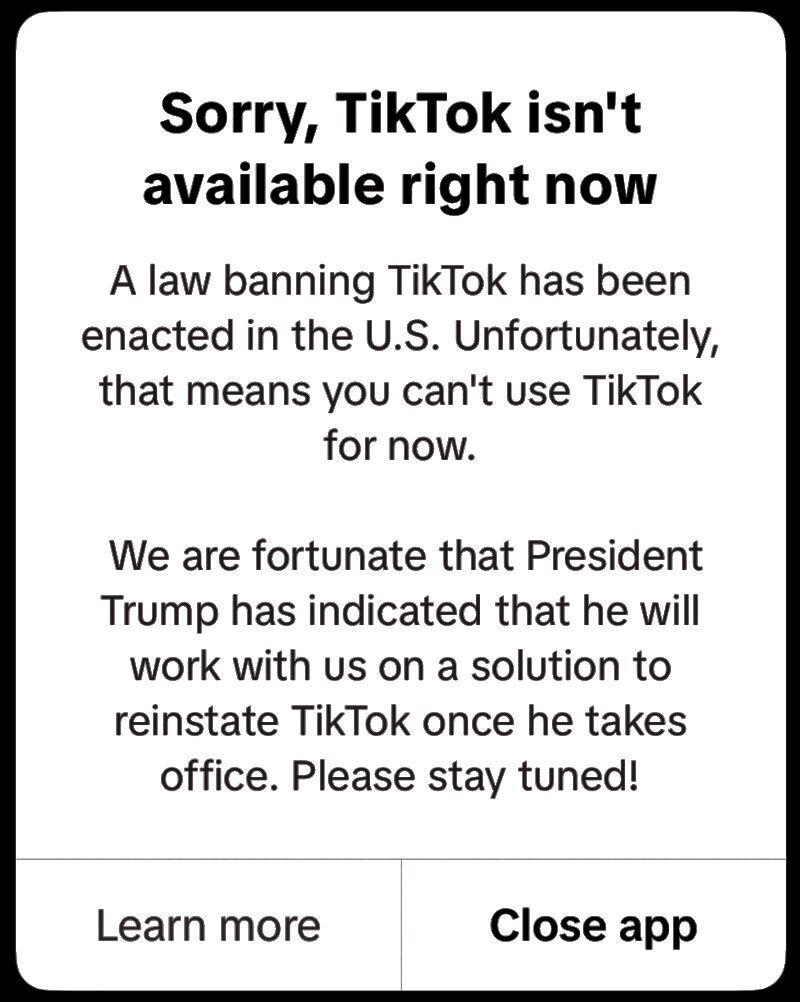
After years of threats and petitions to ban the app, TikTok finally went dark Jan. 19.
Last Saturday night, those on the app were met with an “Important update from TikTok” which warned users “that a US law banning TikTok” was scheduled to take effect that evening, forcing the app to make its services “temporarily unavailable.”
Less than an hour later, the app was disabled with a message that read, “Sorry, TikTok isn’t available right now.”
The ban followed the Supreme Court decision to uphold a bill signed by former President Joe Biden, which promised to deactivate the app in the US unless its Chinese-owned company sold TikTok within the year.
In the weeks leading up to the ban, users have reposted their earliest original TikToks, shared unposted drafts and saved their favorite videos from the platform.
Senior theater major Emberlynn Pendergraft said social media is like a photo album.
“I thought about just taking all of it and saving it somewhere,” Pendergraft said. “I was like one of those loner kids that didn’t have any followers, and so it just became like a photo album of sorts, right? And now it’s memories. Now it’s a photo album, and it’s like pieces of my life.”
TikTok was restored after being banned for approximately 12 hours but not before it was removed from the Google Play store and Apple’s App Store, making it impossible for any user to redownload.
Some students felt that losing TikTok meant losing social connections and were happy to see the app active again.
Senior computation linguistics and business Chinese major Abi Whitley said, “There’s certain friends that I only talk to through TikTok. I don’t have access to any of their other social media. They’re people that I met through TikTok, and it feels like it was really exciting to get that back because these were people that otherwise I wouldn’t be able to talk to.”
Senior creative writing and psychology major Brooke MacDonald said things were only slightly different after deleting the app.
“I did move to Instagram reels, and it’s basically the same thing I feel,” MacDonald said. “So I haven’t been missing it too badly, but I feel some of my other friends who didn’t move to Instagram, I’m kind of missing seeing what they’re liking.”
Even after the Supreme Court’s ruling that banning TikTok did not violate the First Amendment, some still believe the ban is an infringement on their freedom of speech.
MacDonald said, “I definitely think it’s a violation of your freedom of speech because of the fact that it was just a social media. The fact that we don’t even have the choice anymore to have it or not have it, that it was just straight up banned just doesn’t sit right with me.”
Pendergraft said, “I think that the whole idea is that we’re introducing censorship into an app that was previously uncensored.”
Whitely said, “It felt more like violating speech protection if you’re going to ban something because you don’t agree with the ideology that most people align themselves with on an app like that. That’s just very controlling, in my opinion.”
Journalism professor Rob Moritz disagrees with such sentiment.
“You know there are sometimes when the local government makes a law or something where they’re basically saying anybody who’s critical of the mayor will be shut down or will be arrested. That’s a First Amendment issue,” Moritz said. “I’m not sure that this falls into that category.”
Many are attributing TikTok’s restoration to President Donald Trump who signed an executive
order Jan. 20 postponing the app’s deactivation for 75 days and allowing the app to continue its search for a US buyer.
The app’s “Welcome back!” message said, “As a result of President Trump’s efforts, TikTok is back in the US!”
Moritz said the app’s access has always been tied to politics given that more than half the states in the US have restricted TikTok from government devices.
“I think mostly red states have done that. I’m not sure how many blue states have done it. And I think a lot of it was that President Trump said he was for doing that. But now he’s changed his mind,” Moritz said. “I think maybe he’s politically catering to a younger audience.”
Whether the app will find a buyer or not is uncertain.
Moritz said, “I’m curious as to who will come in. Could be Elon Musk, for all I know. I doubt it. He’s already spent all his money on Twitter.”
Whitely said, “I know that Mr. Beast is talking about buying it. I hope that doesn’t go through either, because Mr. Beast is a terrible person.”
Regardless, countless Americans are thankful to have the app back after its short-lived death and anxious to find out its fate in the next three months.