

Author and philosopher Carol Wayne White offered a unique perspective on religion by delving into the intertwined world of eco-spirituality, religious naturalism and wonder.
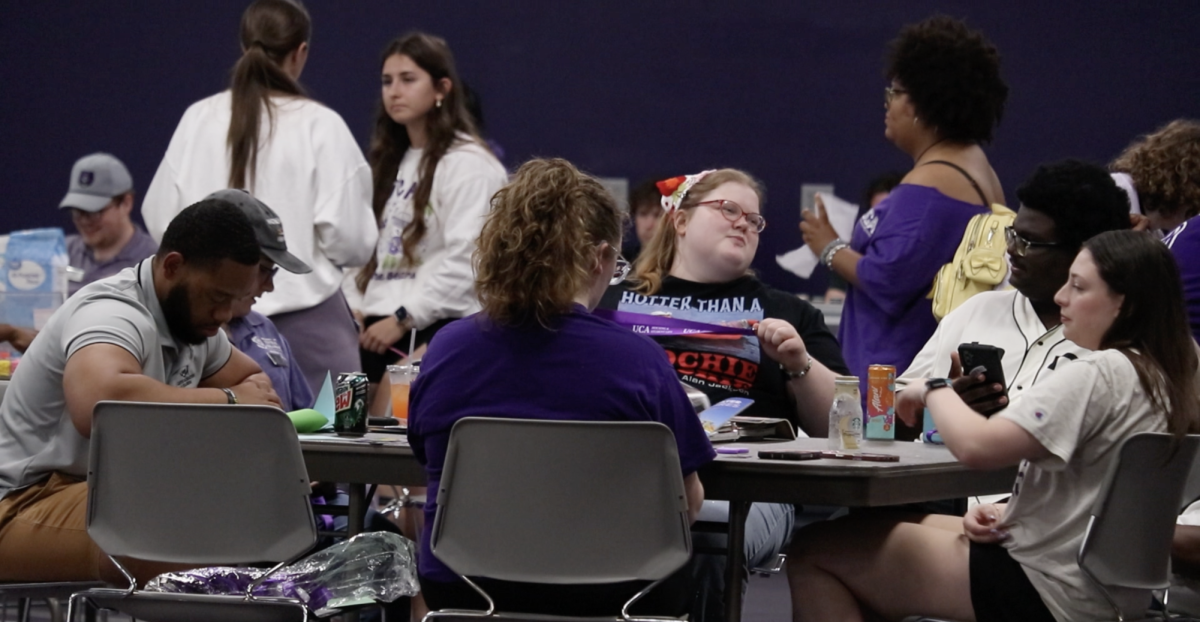
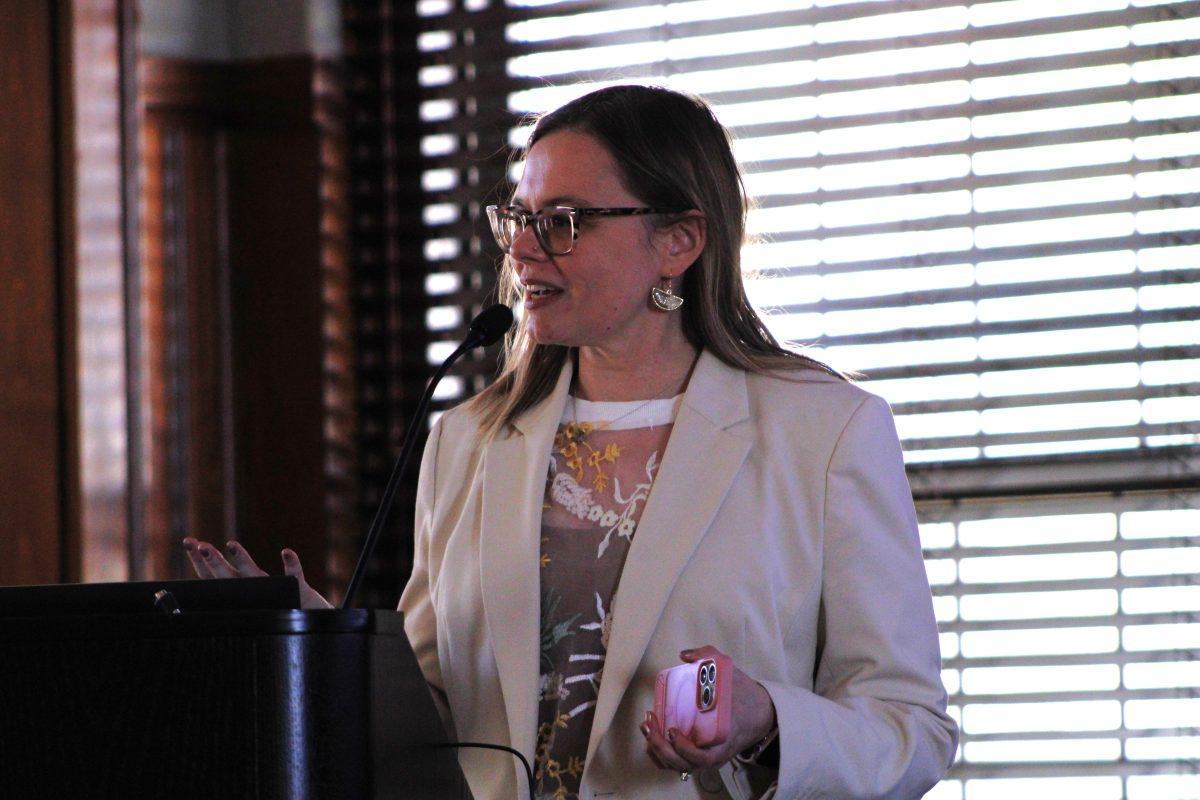
Wayne White met with UCA via Zoom in the McCastlain Ballroom on April 5 to present her public lecture, “Religious Naturalism and Wonder: Towards an Eco-Spirituality of Living, Experiencing, and Seeing Differently.”
Taine Duncan, chair of the Department of Philosophy and Religion, introduced Wayne White.
“It is also my great honor to be able to actually hear more from professor Carol Wayne White tonight,” Duncan said. “I was really amazed with the depth of engagement, the ways in which professor Wayne White was able to connect with students this morning at a special brunch that we had.”
Patricia Smith, dean of the Schedler’s Honors College, encouraged the attendees to open themselves up to new perspectives.
“As we embark on this journey of intellectual exploration and discovery and wonder with Dr. Wayne White, let us embrace the opportunity to engage in meaningful dialogue, to challenge our perspectives and to cultivate a deeper understanding of the world around us,” Smith said. “Let us begin a new conversation.”
Sophomore Annalaen Walls, an elementary education major, attended the event as an extracurricular for one of her honors classes.
“I chose this event particularly because the whole religious aspect really interested me,” she said. “I’m a Christian, so I was interested in how the speaker is going to connect religion, specifically Christianity, to nature.”
Walls said she enjoyed the part of the lecture and discussion when the concepts Wayne White presented conflicted with her personal beliefs.
“My favorite part was when I got challenged — I felt very challenged,” Walls said. “There was this thing that implied that religion, normative Christianity, for example, is limiting in a way — limits our experiences and limits our connections to people.
“That’s what interested me the most. It kind of came across as religion puts you in this box and you can’t really become fully one with nature if you’re religious. So, I was very interested.”
Sophomore Angelica Thomas, an environmental science major, said she was looking forward to seeing how Wayne White would connect religion with the environment.
“I do think there is value in understanding different perspectives and really seeing the interconnections between the sciences and religious things, to see how they go hand in hand.”
Thomas said, “My favorite part is truly the wonder part because that’s very actionable. I can actually see myself implementing that into how I live by understanding or reevaluating what I already do. If I think in this way, then I can understand life in a different way.”
Wayne White said one of the ideas behind eco-spirituality is everything being connected.
“We belong to a biotic community. It’s not just the human community,” she said. “Humans belong to this expansive biotic community. We are inextricably bound together in a web of mutual interdependence with other organisms.”
Wayne White explained no one thing or being within the biotic community is greater than another — everything is equally connected.
Clayton Crockett, director of religious studies, said he appreciates how eco-spirituality and religious naturalism view the world as an equal playing field.
“You don’t have this dichotomy or this opposition or this split-level universe where there’s spirit and divine kinds of things somewhere in another dimension and then you have the natural world and nature and matter and body and stuff over here,” he said. “It works against that and I appreciate that very much.”