




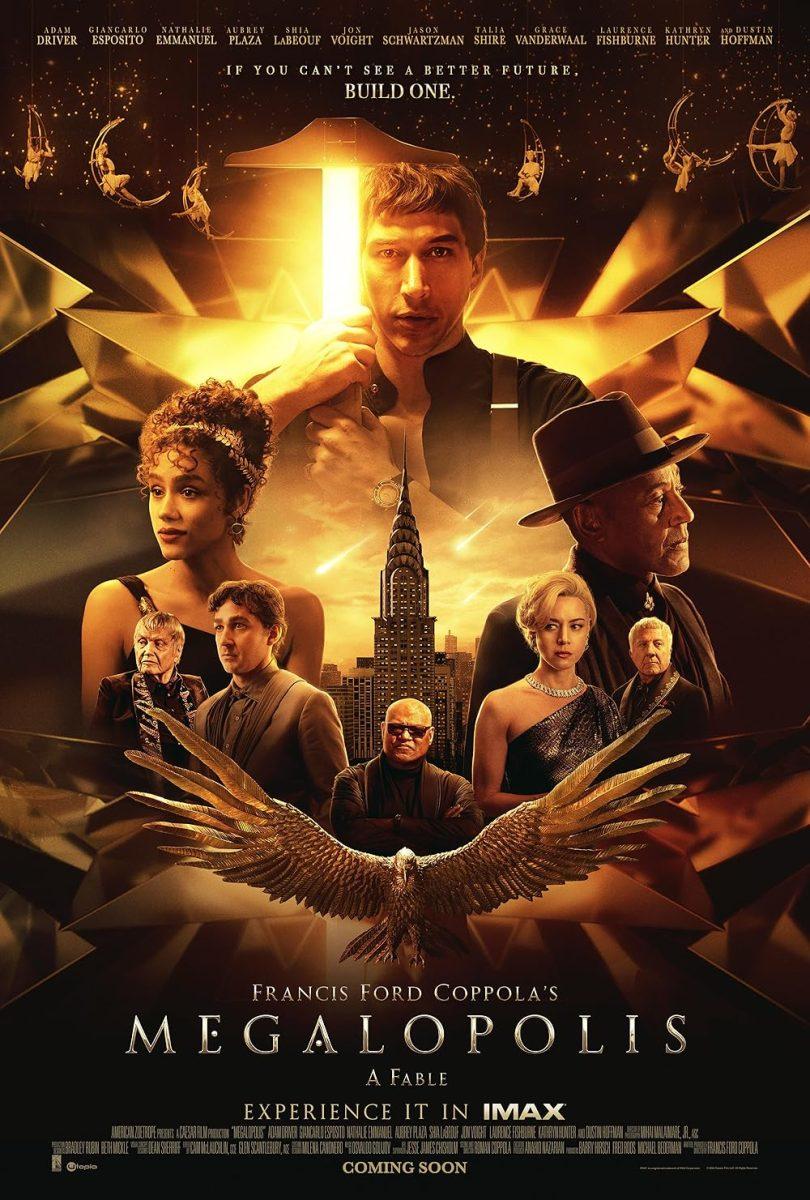
Renowned director Francis Ford Coppola fails to deliver a watchable film with his latest release “Megalopolis.”
The most intriguing part of the film is its development history, which is far more interesting than the film itself. Coppola has been interested in this project since the late 1970s. With that much time to conceptualize a film, you’d expect it to feel more finished than it is.
“Megalopolis” follows Cesar Catilina, an eccentric architect, who creates an advanced supermaterial known as Megalon. Catalina (Adam Driver) dreams of building a utopia with Megalon, but comes into conflict with Mayor Franklyn Cicero (Giancarlo Esposito).
In a less-than-subtle approach, Coppola equates the Roman Empire to the modern-day United States. The city the film is set in, New Rome, draws many parallels to New York City. Many of the characters are named after historic Roman figures while the costumes combine modern fashion with Roman setpieces. While it seems intriguing conceptually, it seems Coppola didn’t know what he wanted.
In fact, that statement holds true for almost all aspects of the film. The story introduces many ideas that are quickly abandoned. For instance, the main character, Catalina, possesses the ability to stop time. The film never explains where this ability comes from and why it is important and, most importantly, the ability is never used meaningfully in the story. The film should be longer to handle all these important ideas, but the truth is, the film should’ve cut many of its ideas to present a film worth watching.
Despite being independently funded by Coppola himself, “Megalopolis” has a respectfully-sized cast of actors: Adam Driver, Giancarlo Espoito, Audrey Plaza, Laurence Fishburne, Shia LaBeouf and Dustin Hoffman.
Unfortunately, the actors are misdirected, resulting in performances that do not fit the tone of the story.
Characters often burst into a monologue, giving speeches that sound intellectual and relevant to the plot, but upon further examination, they make no sense. In one scene, Catilina and Mayor Cicero argue about the future of New Rome, spouting quotes from Roman Emperor Marcus Aurelius at each other to prove their points.
What’s most disappointing is that there are threads of an interesting plot in the film, but Coppola’s desire to tackle many large topics results in the film coming off as very surface level.
Many sequences of “Megalopolis” result in laughably bad dialogue that’s difficult to piece together.
Considering “Megalopolis” on a metatextual level, there is an importance of films like this.
Coppola hasn’t had the best relationship with producers, and by extension, Hollywood, so it’s reasonable to think he wouldn’t want anyone to control his passion project.
With cinema, there’s a school of thought that the director is the auteur — the central creative force behind every aspect of the film. There have been films that have proved and disproved this theory.
“Megalopolis” disproves this theory. In decades to come, “Megalopolis” will be the prime example of a director who had too much control and no one to tell him “no.”
Only watch “Megalopolis” if you’re watching it with friends and prepared to laugh at every scene.