



The Japanese club organized its first semester event to introduce students to the various summer festivals celebrated in Japan.
The event showcased the festivals of Tanabata, Obon and Jugoya, providing students with an interactive opportunity to learn about cultural activities and enjoy traditional treats Sept. 18.
The Japanese club is committed to encouraging the appreciation and understanding of Japanese culture within the university and the surrounding community.
The club provides students with opportunities to engage in events and activities that allow them to immerse themselves in Japanese traditions, language and customs.
The club regularly posts upcoming events and pictures on Instagram @UCAJapaneseClub.
Beyond promoting the study of the Japanese language, the club seeks to build cultural bridges and cultivate cross-cultural connections.
The club first introduced attendees to Obon, a celebration that has been celebrated in Japan Aug. 13-15 for over 500 years.
Obon commemorates and remembers deceased ancestors, and on this day, the spirits return to visit relatives guided by paper lanterns.
Mia Okuno, a sophomore and member of the Japanese club, taught the participants about the Tanabata festival, which celebrates the meeting between the deities Orihime and Hikoboshi.
Okuno told the story of the deities Orihime and Hikoboshi, whose love was so profound that they neglected their duties, leading to the wrath of the king of heaven, who separated them across the Milky Way only to meet July 7.
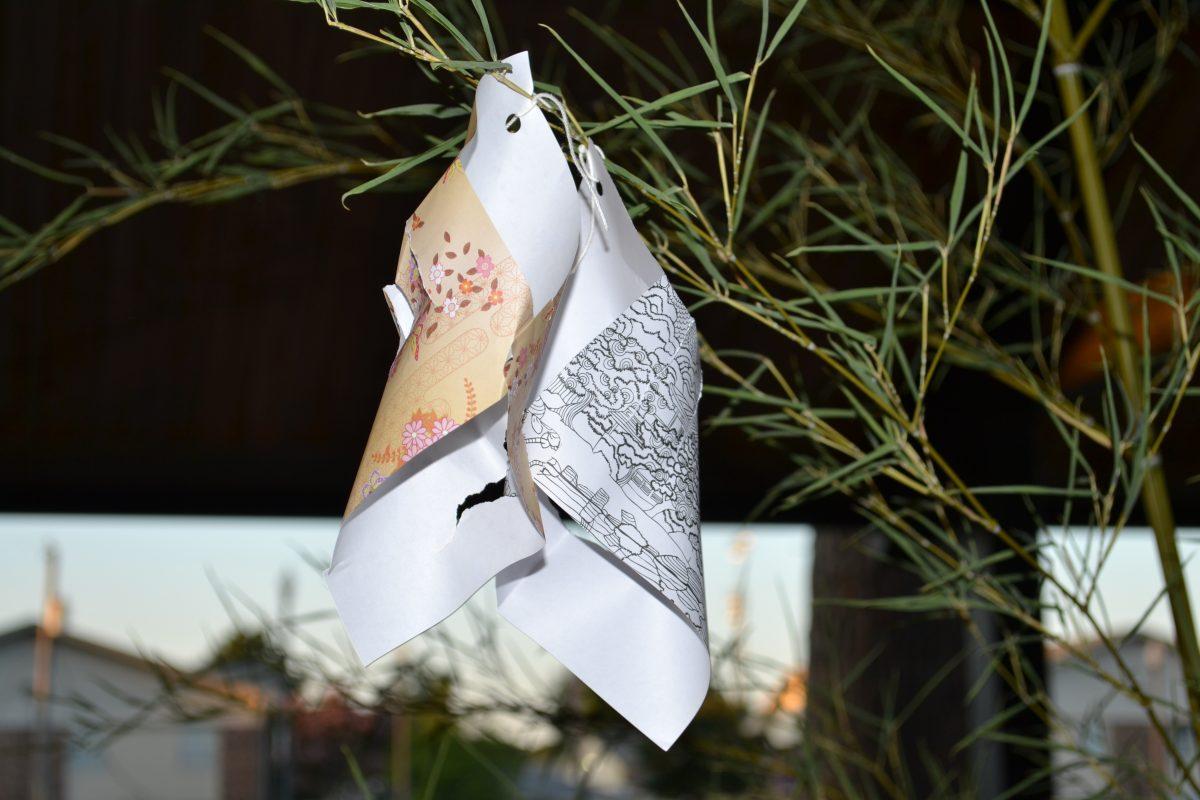
Then, attendees were given a paper with various designs, called tanzaku, on which they could write their wishes.
Okuno taught the participants how to fold origami to hang the tanzaku on a bamboo pole.
By the end of the event, the bamboo pole was adorned with brightly colored paper and origami, resembling a Christmas tree.
The Japanese club also offered treats to the participants. One of the treats was a chocolate-covered banana, which the Japanese club said is a popular festival treat. They also shared mochi, a dessert made of mochigome, which is glutinous rice. Students were served tea to enjoy with the various desserts.
As the moon began to rise, the Japanese club explained the celebration of Jugoya, which means moon-viewing in Japanese. Jugoya is a festival that pays homage to the moon.
David House, a Japanese instructor, discussed the contrasting beliefs about the moon in Western countries and Japan and its significance in the Jugoya festival.
House said, “What do you see when you look at the moon? You might see a face in the United States, but in other cultures, it’s seen as a woman brushing her hair. In Japan, many believe it’s a rabbit on the moon.”
House narrated the tale of the rabbit on the moon, and volunteers from the audience played the role of the rabbit, old man, fox and monkey.
The volunteers reenacted the story with the animals assisting the weary old man in finding food and the rabbit sacrificing itself to feed the man, who turned out to be a deity that immortalized the rabbit’s likeness on the moon for all to see.
Paul Bridgman, an attendee of the event, lived in Japan for most of his life. After moving to America, he described how different it was to adjust to the different cultures and manners and how nice it was to participate in these events.