



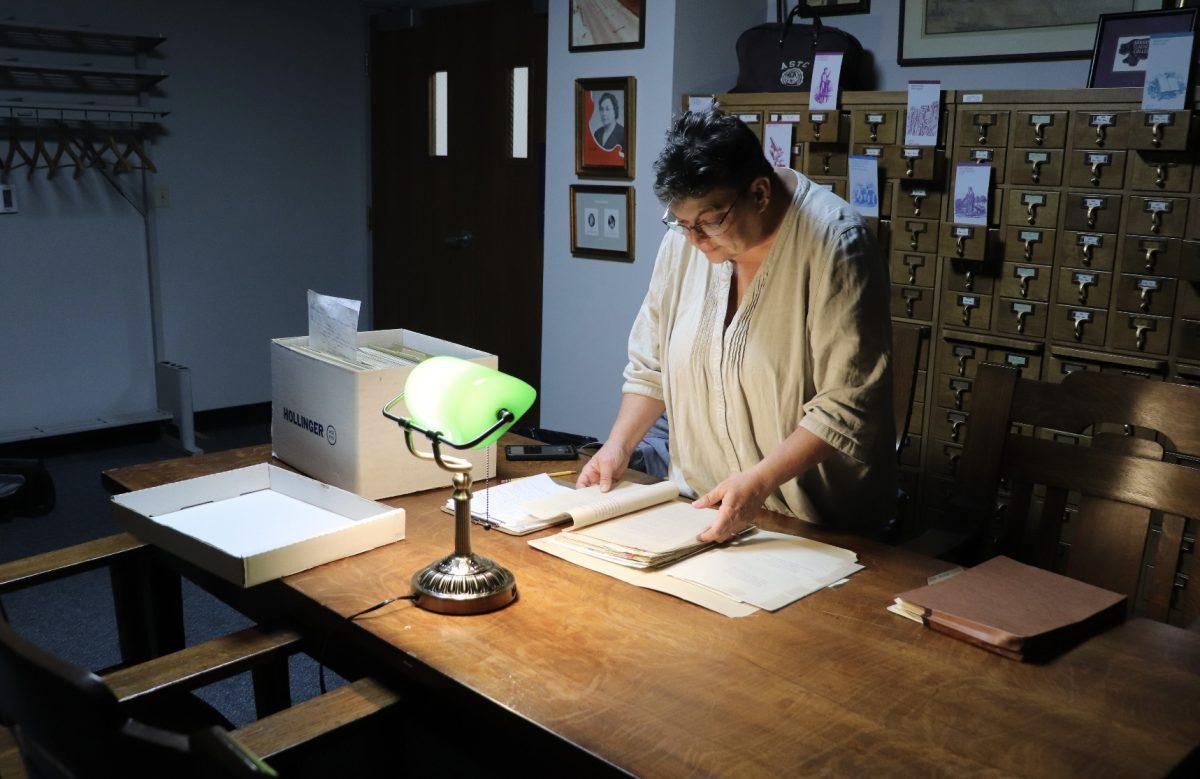
UCA recently hired Phoenix Smithey as an archivist and the new head of special collections at Torreyson Library.
Smithey took over from Daniel Klotz, who held the interim position from 2020. Smithey plans to expand access to and awareness of the archives.
“I really want to dismantle this idea of, like, mustache-twirling academia,” Smithey said.
“One of my favorite things about archives is you can do archival advocacy,” Smithey, who previously worked at the University of Arkansas at Little Rock Center for Arkansas History and Culture archive, said.
Her work in Little Rock included collecting and archiving “hidden histories.”
“Queer history, BIPOC communities, Indigenous communities, that kind of thing,” Smithey said. “I want UCA and the UCA Archives to be kind of this community hub and this advocacy center.”
Smithey said her plans include “getting out of the archive” and talking to classes about the archives and how they can use them.
The archives are tucked away deep in Torreyson Library and Smithey said students often need directions finding it their first time.
Smithey said “educating people about how to make an appointment” is part of the plan for expanding access but the archives are still open to walk-ins when they are able.
“We can’t always take walk-ins. Sometimes we’re full of appointments,” Smithey said.
Smithey said “digitizing as many of our resources as we can and explaining them and describing them in an ethical way” is part of expanding access to the library archives, as well as using metadata to facilitate keyword searching.
Smithey said she and archive staff are “really thinking about how we’re describing things.”
“If we don’t describe things well, people are going to see themselves represented in a traumatic and violent way,” Smithey said. “We’re also going through our collections to kind of see what’s there that’s hidden and working on that language.
While it’s mostly history majors that currently use the archives, Smithey said its resources are there for everybody.
“Primarily it is history majors and of course, I love them,” Smithey said. “But I also want to get out there and be like, ‘Do you know we have a chemistry professor’s papers?’”
“In this day and age where people’s opinions on information are almost more readily available than the information, I want everyone to come in and look at the primary source and interpret it for themselves,” Smithey said. “I want them to make their own opinions about information and about history.”
Smithey said the archives are also open to the public, not just UCA students and faculty.
“So many people are just … really interested and fascinated with the history of their state,” Smithey said.
“Social media is a big one too,” Smithey said, referring to ways to increase awareness of the archive. “My archive tech Shelbea Gentry is phenomenal and I just harass her all the time, like, ‘Should we make a social media post? Do you want to write a blog post?’ And she always says yes.”
Gentry said, “currently we have Facebook and Instagram and Twitter accounts where we’re more active.”
“Our strategic planning for that is to try and do a couple of posts on Facebook and Instagram a few times a week,” Gentry said. “Enough where we’re in people’s newsfeeds, but not so much where they just scroll by and don’t bother looking.”
Gentry said she also uses the Meta Business Suite, Meta’s marketing and analytics program for Facebook and Instagram, to post when viewers are most active, and is posting more stories on the archive’s social media.
“We’re trying to post more intentionally and more frequently, so that way our viewers see what we have and what we have to say about our collections,” Gentry said.
“The blog is where we typically highlight features on our collection material because we do have a lot back here,” Gentry said. “Sometimes we like to show our audience little snapshots of what we have that maybe helps with their research, or at least piques their interest.”
Blog updates are posted at uca.edu/archives/blog/.
“Although we have appointments, we do accept walk-ins now,” Gentry said. “If they [students] want to come by and look at something, definitely ring the doorbell. One of us will answer and try and help with their research needs.”
Smithey said, “We are trying to come out more into the campus and the library as a whole, so be on the lookout for us. We’re here. And we’re coming to see you in a non-scary way.”
“I strongly believe in an academic institution, the archive is for the students,” Smithey said. “I want them to be empowered, to see this as a safe space and to come in and use it when they need it because it’s here for them.”
“The lights are off to preserve the materials, not because we’re closed,” Smithey said.