



Since September, there have been three cases of sexual exploitation reported to UCAPD, with a combined $2,800 being lost by these students to their scammers.
In many cases, “sextortion” describes a person demanding money and threatening to send sexually explicit photos of a victim to their friends and family.
If the victim sends money, the blackmailer may continue to blackmail the victim for more money or share their pictures, anyway.
So far in 2023, UCAPD has received four reports of sexploitation.
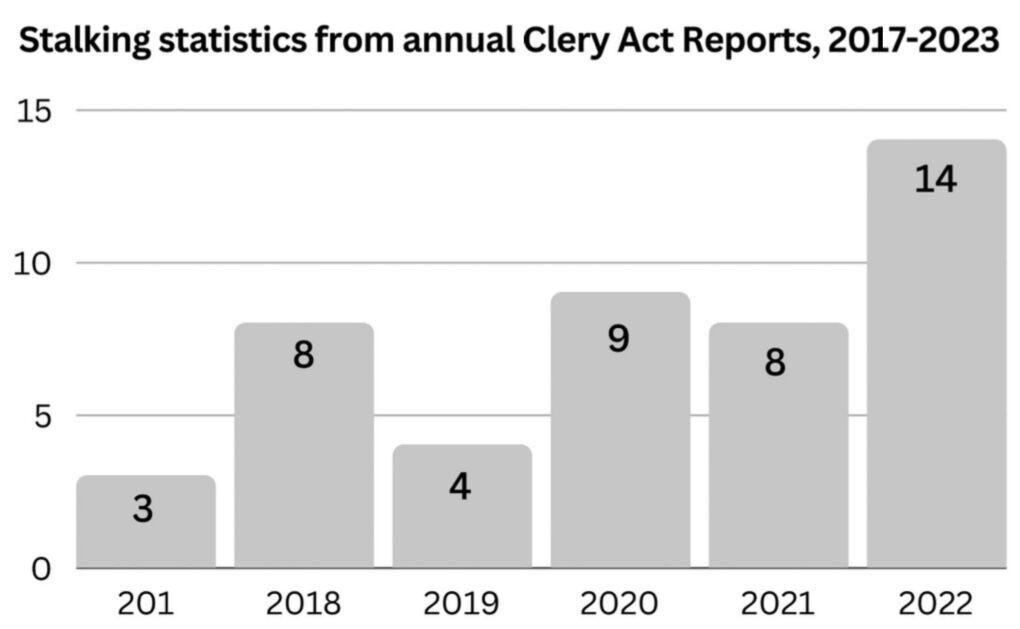
According to the Clery Act report sent to students Oct. 1, the number of on-campus stalking cases nearly doubled last year, from 8 reports in 2021 to 14 reports in 2022.
Under the Clery Act, sexual exploitation is considered stalking, which is defined as “engaging in a course of conduct directed at a specific person that would cause a reasonable person to fear for the person’s safety or the safety of others; or to suffer substantial emotional distress.”
“Course of conduct means two or more acts including but not limited to, acts which the stalker directly, indirectly, or through third parties, by any action, method, device, or means follows, monitors, observes, surveils, threatens, or communicates to or about, a person, or interferes with a person’s property.”
“It could be that we had an increase in the number of CSA [campus security authority] reports that were taken throughout the year [2022],” Sgt. Michael Hopper, public information officer for UCAPD, said. “We combined our report numbers with those report numbers to come up with the overall statistic.”
Hopper said the majority of stalkings in 2022 occurred using electronic devices.
“The technology is making a difference in the types and the number of these cases that we’re seeing,” Hopper said.
“Last year, we had two [sexual exploitation cases] … but I would imagine that those numbers are going to be a lot higher this year,” he said.
A victim of online sexploitation and UCA student said, “I was in communication with someone who’d messaged me one day. They’d followed a few of my friends on Instagram, so I figured they must have gone to school at UCA, or were at least local to the area.
“It was a fake account,” they said. “The person was not who they claimed to be, and threatened to expose me to my work, friends and family after obtaining sensitive information.”
They said the account used “fake photos, videos, and information about where they live” to trick people into sending personal information.
“I kick myself a little bit for it. Hindsight is 20/20, but there were signs that they weren’t who they said they were. I’m also definitely more thorough and cautious of who I talk to,” they said.
“Unfortunately, there’s little anyone can do about these kinds of things,” they said.
“My most valuable resources have been my friends and family who supported me through it all … It’s very difficult to track incidents like these through fake accounts, false information, etc.,” the student said.
Hopper said, “Generally, internet crimes are hard to track. You’re working with companies that may not necessarily want to release information.”
Hopper added that technology such as VPNs, which hide IP addresses also make investigating more difficult for local law enforcement as they don’t always have the resources to put toward investigations of that nature.
The student victim said, “The university police department was receptive to helping me through this. They offered every avenue available for reporting the crime and giving me time to submit my official testimony.”
Hopper said, “You got to be so careful when you’re out there online. It’s so easy to fall victim to some of these scams … We always encourage people to never ever send compromising photos to somebody that they’ve never met before.”
“If it happens, never send the money, because if they are truly … going to release any of those photos, there’s no amount of money that you’re going to send that is going to be satisfactory and they may release them anyway,” Hopper said. “Always, if you fall victim to one of these scams, contact law enforcement and make the report so we can start investigating.”
Hopper said, “We certainly encourage everybody if you’re a victim of crime to come and report it. If you ever feel unsafe come and call us, come and find one of us … We want to do everything that we can to make sure that our students not only are safe but feel safe.”
The student victim said, “It’s truly not your fault. It’s OK to confide in those closest to you. Know that you are not alone.”
If you need to report a case of sexual exploitation, UCAPD’s non-emergency phone number is (501) 450-3111 and is staffed 24/7.