




Central Arkansas has been sizzling for several months, with scorching summer temperatures affecting daily life on campus.
Despite most classes not being in session, UCA doesn’t completely slow down during the summer. Physical plant workers, maintenance workers and groundskeepers work all year round to keep the campus running and in good shape. This means that even in 100-degree temperatures, the grass is being mowed, construction is being done and buildings are being fixed.
Associate Vice President for Facilities Kevin Carter said that the heat impacts the daily operations of the maintenance and grounds workers.
“It does slow down work with our grounds department and maintenance teams working in places like attics and unconditioned mechanical rooms,” Carter said.
He also said that UCA prioritizes its workers’ health and safety in extreme temperatures.
“For the employees who work outside, we adjust their hours during the summer months to come in earlier so they can get their work done before the hottest part of the day. We also provide water and Gatorade for our employees and remind everyone to stay hydrated and take frequent breaks,” Carter said.
Typically, it’s easy to find a break from the heat by entering an air-conditioned building, but those units were also working overtime in the heat this summer, causing UCA to outsource help with heating, ventilation and air conditioning issues on campus.
Carter said, “In the past month, we’ve had a higher-than-normal amount of work orders for the HVAC department. Due to the extreme temperatures and humidity levels, air units have been running nonstop which puts a strain on them. In order to keep up with the high volume of work orders, we’ve hired an HVAC contractor to help us address these issues quickly.”
Similarly, some UCA athletic teams hold outdoor practices over the summer, where athletes exert themselves in the heat.
Head athletic trainer for UCA David Strickland said that while there hasn’t been an increase in heat-related illness among athletes this summer, they have had to adjust practice times and intensity in order to protect the athletes.
“The athletic trainers monitor the temperatures before and during each practice. With that information, we can alter practice as needed. Heat illnesses occur due to practicing in extreme heat but it is also the intensity of the work. These modifications to practice may consist of more water breaks where the athletes stop activity and rest. We may also need to change practice times and the intensity of the practice, or cancel and move the practice or game to another day,” Strickland said.
Strickland said that the entire athletic training staff and the coaches make sure athletes are safe during hot summer practices.
“Our coaches are very understanding of any modifications needed and want the best for our student-athletes and any alterations in practice times or intensity is well-received. It definitely requires a multidisciplinary approach in keeping our athletes safe. Everyone plays a part, from the strength staff, coaches to the athletic trainers and administration,” Strickland said.
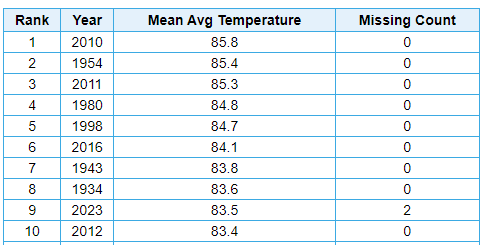
Even as hot as it has been this summer, based on the average temperatures recorded, 2023 was the ninth-hottest Arkansas summer, with an average temperature of 83.5 degrees.
THV11 Chief Meteorologist Tom Brannon said that while this summer has had some recording-breaking hot days, there have been fewer 100-degree days this year compared with others.
“There have been hotter summers in Arkansas. In 2022 we recorded 18 100-degree days in Little Rock. In 2023 so far, 14,” Brannon said.
Meteorologist at the National Weather Service in Little Rock Jeffrey Hood said records began at Little Rock in 1879. He also said that June through August is the meteorological summer and explained why this summer has felt so hot.
“A persistent ridge of high pressure has been parked over the middle and southern parts of the country. This has prevented any storm systems from moving into the area and disrupting the heat, also this has limited rainfall amounts across the state. When soil moisture conditions dry out, temperatures can begin to really climb,” Hood said.
Brannon said Little Rock’s hottest recorded temperature was 107 degrees on Aug. 26, which broke the 106-degree record from 2000. Hood added Pine Bluff also reached 107 degrees that day.
Brannon said he expects the temperatures to continue: “I believe this warmer-than-average trend will continue through at least mid-September. We’ll still be warm, but gradually cool as we head toward the latter part of the month.”
Hood said that predictions for temperatures past September are unclear, but average precipitation across the state increases in the upcoming months, much like in the spring months.