

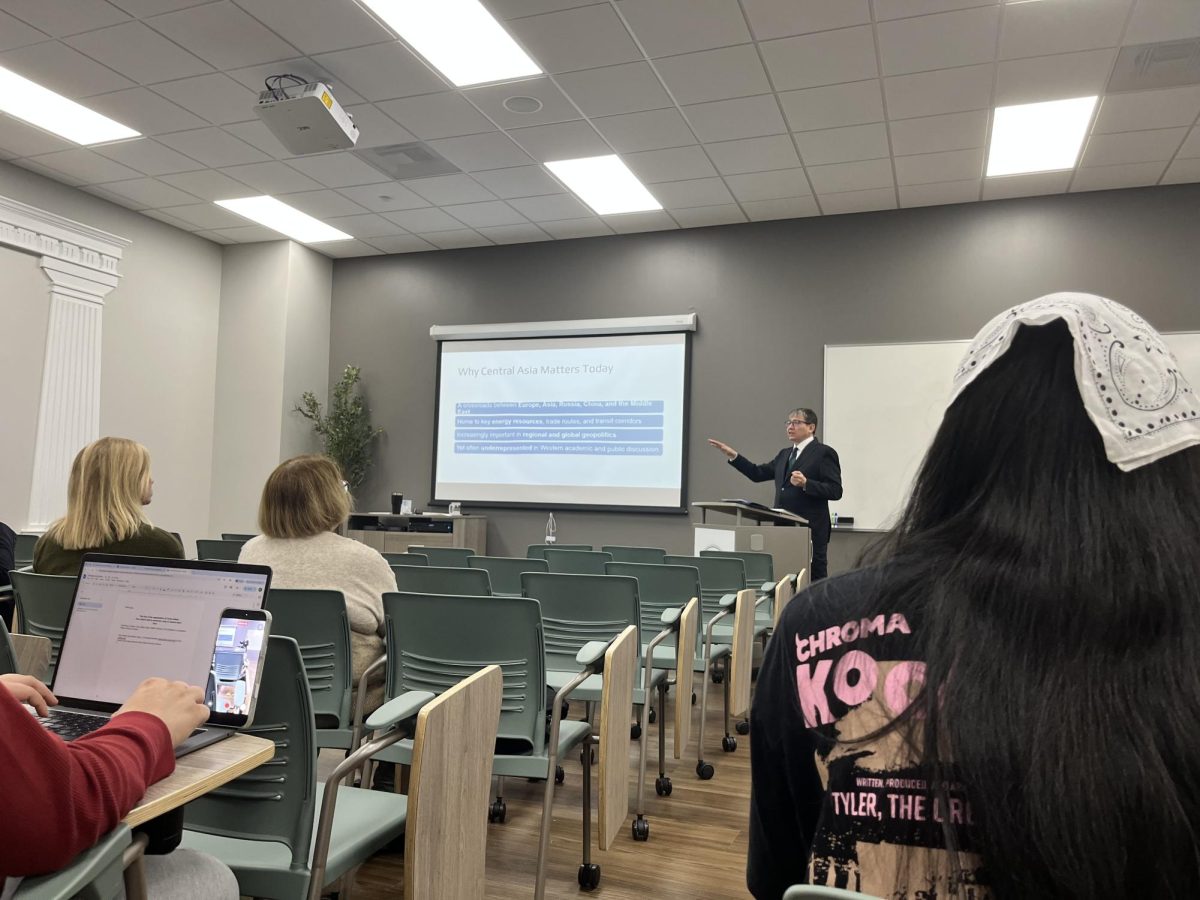
On Thursday, March 12, the Center for Global Learning and Engagement hosted Ulan Nukan to give a lecture titled, “Rise of the Organization of the Turkic States: Can Culture Lead to Economic Unity in Central Asia?”
On top of the exclusive lecture the event offered food to the attendees afterwards with the opportunity to talk to Nukan. There were vegetarian style dumplings, cheeses, fruits, crackers and more. There was also tea.
Nukan is the founding director of the China Affairs Office at Kimep University in Almaty, Kazakhstan, and is a PhD candidate in comparative politics at Peking University in Beijing, China.
Nukan has lived in many different countries: he was born in China then immigrated to Kazakhstan and now visits the United States. He can also speak many different languages including Russian, Mandarin and English.
Nukan said that he traveled 40 hours to come give this lecture at UCA.
As the title of the lecture may give away, Nukan discussed the Organization of the Turkic States and how their similar cultures could possibly lead to economic unity in Central Asia. The Organization of the Turkic States consists of Azerbaijan, Kazakhstan, Kyrgyzstan, Turkey and Uzbekistan.
The lecture focused on a couple of sustainable development goals (SDGs): number eight which is decent work and economic growth and number eleven which is sustainable cities and communities.
Nukan said, “In the beginning, [the Organization] focused on the cooperation of culture, education, politics and the economy.”
Nukan explained how these five countries that make up the Organization of the Turkic States are culturally interconnected in many ways: their languages, traditions, etc.
Nukan explained that even though these five countries all speak different languages, they are very similar. He equated the differences in language to the difference between American English and British English, and said that because the languages are so similar it is very easy for them all to communicate with one another.
One of the Organization of Turkic States’ main goals is to build a cohesive economic sector where they are aligned on institution and policy.
Nukan said, “Economic cooperation still depends on institutions and policy alignment, because if you don’t have a similar [kind of regulation], it’s very difficult to launch economic cooperation.”
Another thing that bonds the countries together is sports.
Nukan brought up the World Nomad Games, which he called Central Asia’s Olympics. Instead of the typical Olympic Games like volleyball and swimming they have Er Enish – horseback wrestling – and Kok-Boru – headless goat polo.
Although these Games include traditional Central Asian games, other countries are invited to join.
Nukan said, “I believe two years ago, some rodeo from Texas went. They didn’t do so good.”
The lecture closed with a question and answer portion.
The Center for Global Learning and Engagement also hosted other events over the weekend: the UCA Global French Studies Symposium and Film Festival and Free Film Screening: Rendezvous avec Pol Pot.
The Center of Global Learning and Engagement aims to promote intercultural awareness and provide enrichment in the academic and cultural environment of UCA.