
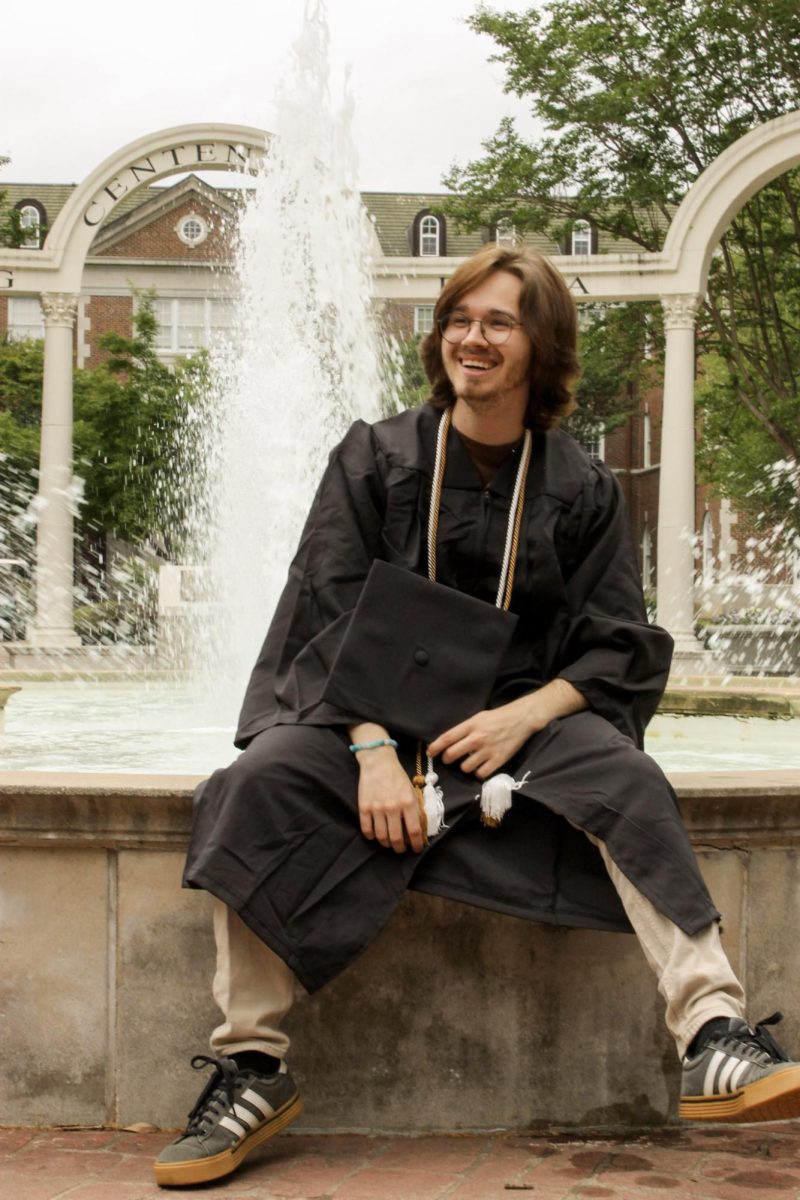



Jerry Mitchell’s investigative reporting has taken him out for catfish with a Klansman and to the trailer of a serial killer.
These stories, along with many others, were told during Mitchell’s artist in residence visit to UCA on April 1.
“If somebody tells me I can’t have something, then I want it a million times more,” Mitchell said.
When Teddy Roosevelt coined the term “muckracker,” reporters like Mitchell must’ve been what he had in mind.
Mitchell has dug into decades-old cases, mainly revolving around the Civil Rights-era Mississippi – where institutional racism led to justice for African-Americans being essentially nonexistent.
One of Mitchell’s prominent cases is his investigation of the Medgar Evers murder in 1963.
Evers, a civil rights and voting activist, was murdered outside of his home in Jackson, Mississippi.
The case, decades old, was at a dead end.
Byron De La Beckwith, the primary suspect, was tried twice with both cases ending in a hung jury.
Years later, Mitchell wrote an article which got the case reopened in Mississippi and tracked down De La Beckwith at his home in Signal Mountain, Tennessee.
“You can guess how I found his house,” Mitchell said, pointing to a picture of De La Beckwith on his front porch, Rebel flag hanging in the background.
Mitchell called De La Beckwith the most racist person he’d ever met, pointing out how he, in 1994, brought up topics such as fluoridated water which have become more mainstream right-wing talking points.
“This pre-internet, so he didn’t know I was the one who had written the story that got the case reopened,” Mitchell said.
De La Beckwith was extradited back to Mississippi where he was tried for the murder of Medgar Evers.
During the trial, Mitchell said De La Beckwith – who had figured out that he had written the original story – pointed at him and said “when he dies, he’s going to Africa.”
De La Beckwith was convicted on Feb. 5, 1994.
“You could literally hear waves of joy as they cascaded down the hall until it reached a foyer full of people, black and white, who just erupted in cheers,” Mitchell said.
Another case Mitchell investigated was the murder of Vernon Dahmer.
Dahmer, like Evers, was a civil rights advocate who worked to secure voting rights for African-Americans.
His house was firebombed by the Ku Klux Klan on the night of Jan. 10, 1966.
While Dahmer was able to save his family, he died the next day – the smoke from the fire having seared his lungs.
“A few weeks later, in the mail came his voter registration card,” Mitchell said. “He had fought his whole life for the right of all Americans to vote, but had never been able to cast a ballot himself.”
Mitchell said six of Dahmer’s sons served in the armed forces and returned home, in uniform, to find their home destroyed and their father murdered.
The man who had ordered the attack was a prominent Klan leader named Sam Bowers, who Mitchell said had ordered at least ten race-related killings.
Similar to the Evers case, the prospect of justice seemed impossible.
“So I’m up at Ohio State working on my masters and I get a phone call from this guy saying he’s got information on the Vernon Dahmer case, but he wouldn’t give me his name,” Mitchell said.
Mitchell flew back to Mississippi and found out the man’s name was Bobby Stringer.
Stringer, a recovering gambling addict, was attempting to make amends for the bad things he had done in the past.
“When he was a kid, he had worked for Sam Bowers,” Mitchell said. “In fact, he actually overheard Bowers give the order to kill Vernon Dahmer.”
The case was eventually reopened, with Bowers and another Klansman – Billy Roy Pitt – being convicted.
Mitchell also worked in investigating the murder of three civil rights workers — known as the “Mississippi Burning” case – and the Birmingham church bombing, which killed five young girls in 1963.
While investigating the bombing, Mitchell tracked down the last living suspect, Bobby Frank Cherry.
After finding holes in Cherry’s alibi, Mitchell was able to connect him to the bombing through a video of the beating of Frank Shuttlesworth – a civil rights advocate who was attacked by a white mob shortly before the bombing.
Cherry, who appears in a video of the beating, was identified by his estranged son.
“He’s the one who gave Frank Shuttlesworth a concussion that day,” Mitchell said.
Cherry, like the other Klansman before him, was put on trial and convicted on four counts of murder – one for each of the victims.
“Sometimes, people will see these guys go on trial and go off to prison and they’ll say to me ‘Jerry, why don’t you leave these old men alone?’ and you what I tell them – these were young killers. They just got old,” Mitchell said.
Mitchell has written the book “Race Against Time” describing his experiences in reopening old Civil Rights era murder cases.
He said he is planning on writing his next book on Felix Vale, a man who murdered three of his wives across 20 years.
“Jerry Mitchell is a hero in journalism,” School of Communications director Dr. Donna Stephens said. “We can talk with our students about that, but I think to hear it from someone besides their professors is always important.”
Stephens said Mitchell represents “all the good that journalism can do.”
“Our field is attacked on all sides – sometimes deservedly so – but we can do so much good and I want people to know that and I want people to aspire to that,” Stephens said. “Because it is a calling.”
Jerry Mitchell comes to UCA
Story continues below advertisement
About the Contributor
Grahl Pruitt, Associate and Web Editor
Grahl Pruitt is a senior majoring in journalism and minoring in public relations. He is originally from Morrilton, Arkansas. Outside of the Echo, he enjoys films, reading and exercising.