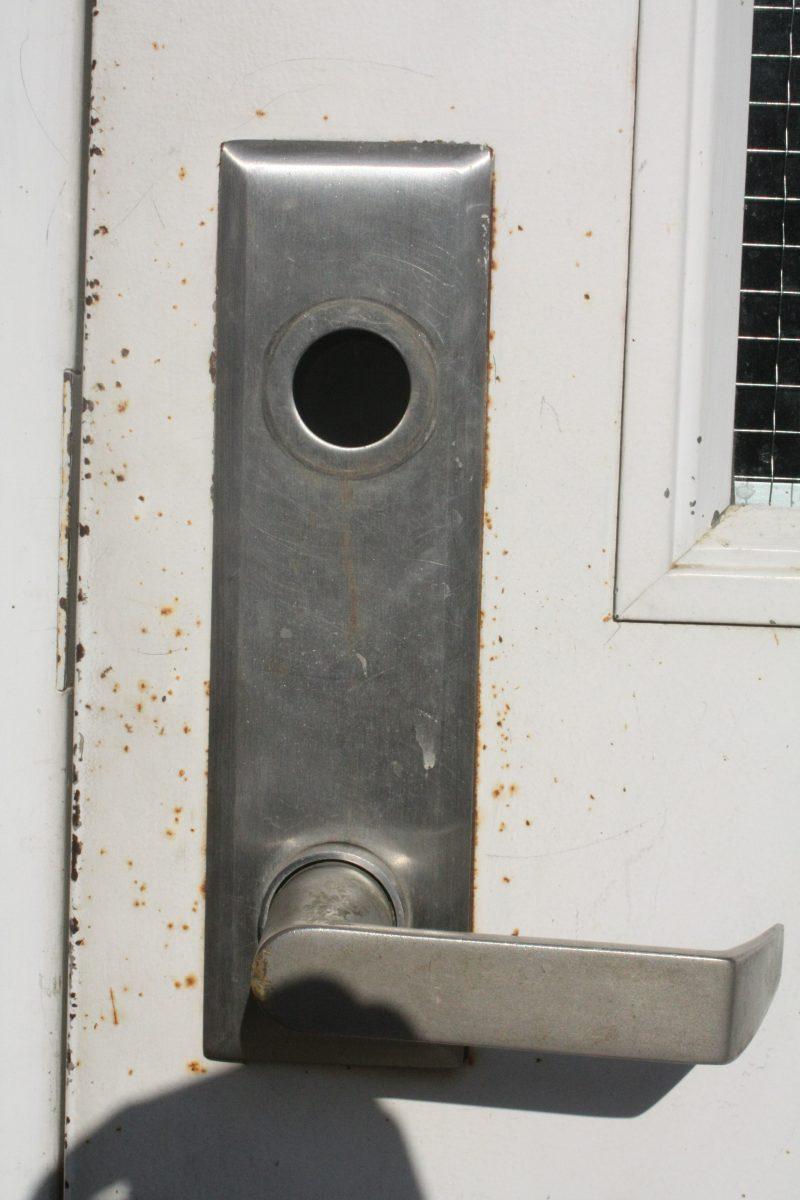



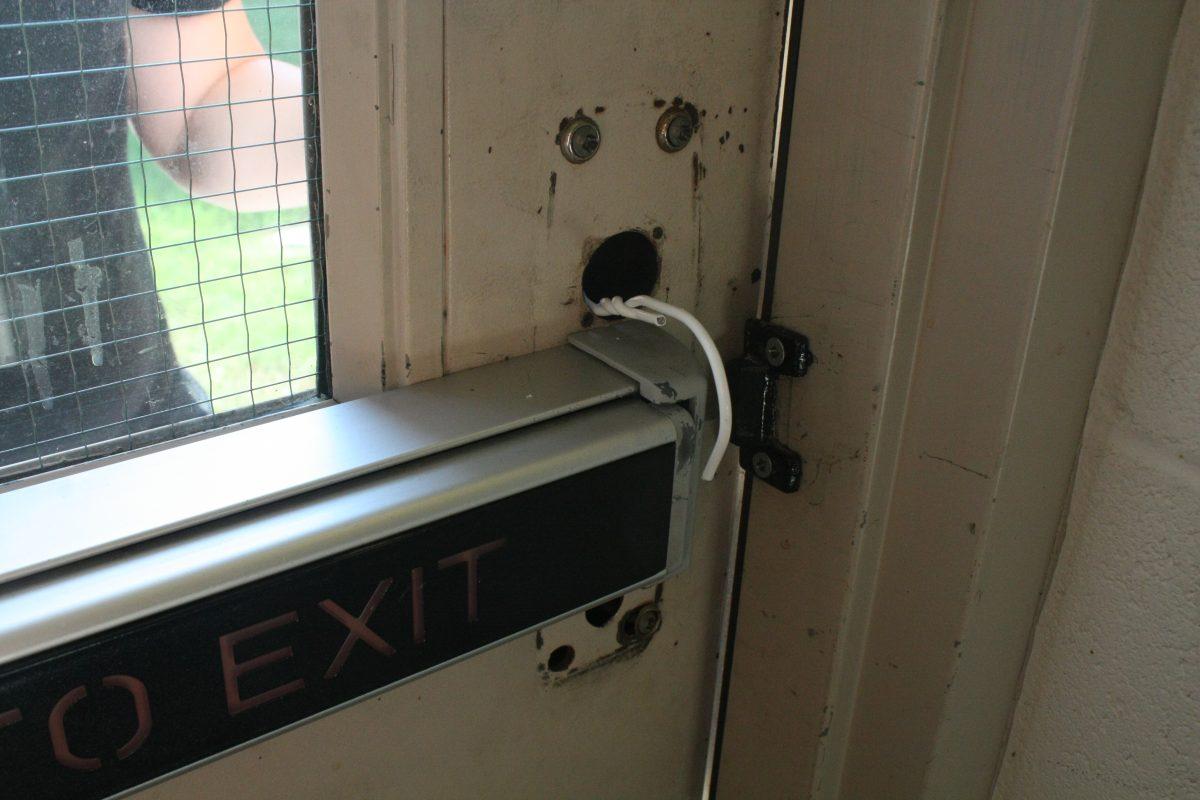
In April, students from Journalism Lecturer David Keith’s in-depth reporting class surveyed dorm security on campus. A wire hanger is used to gain access to the back left exterior door of New Hall without an escort or a swipe card. | PHOTO BY DANIEL BECKER
Students in UCA housing regularly let people they do not know into dormitories, and at least two halls have exterior doors that can be opened without a key card.
Six nonresident journalism students over a course of two days in April 2013 were allowed in residence halls 88 times.
One student was shown a “trick” to gain access to New Hall without assistance: the keyhole to the right back access door was missing and could be easily opened with a wire hanger or other slender object. The journalism student tested the theory with a wire hanger and opened the door in seconds. Senior Jennifer Hicks, New Hall resident, said someone showed her the trick when she was a freshman four years ago and it worked ever since. As of Aug. 26, the dorm could still be accessed by sticking a wire hanger through the missing keyhole.
Upon further investigation, reporters found Denney Hall could be accessed through a partially uncovered keyhole that could also be opened with a wire hanger and the front door leading to the lobby could be pulled open without using a swipe card.
UCA’s housing department assures that its dorm security policy measures are effective and meet the needs of students in all residence halls on campus.
Stephanie McBrayer, housing director, said exterior doors are locked 24/7 with guests being escorted in the dorms by residents.
When it comes to enforcing the policy, McBrayer said resident assistants and residents are responsible for following procedure.
“This is your community; this is how you keep each other safe. You don’t prop doors or let people piggy back in,” McBrayer said.
Freshman Frank Benton, an 18-year-old nonresident of State Hall, let one of the journalism students into the residence hall “because I heard someone banging” on the door.
He said he walked out of his Academic Writing and Research class and opened the door for the student when he heard the student banging on the door. He said he was unaware of the policy against letting other students into the dorms.
“I’m in class right now, so I thought you needed in for class,” Benton said.
State Hall resident freshman Mariah Henderson, 19, also let the student in the dorm. She said she let the student into the dorm because she thought the student had class in State Hall.
“I was just being polite,” she said. “I thought you had class.”
Henderson said several students have classes in State Hall but don’t have swipe card access to the residence hall, so they rely on other students to let them in the building.
Assistant Vice President of Housing and Contract Services Rick McCollum said a few security updates were installed over summer, including peepholes to the individual doors at Bear Hall to increase dorm security.
Emergency call boxes were installed at Bear Village and along the north side of Torreyson Street by the Torreyson and Erbach apartments.
Sophomore Jordan Reeves, Carmichael Hall RA, said all RAs and resident coordinators are responsible for making sure the rules are followed.
“Whoever is on duty will monitor the dorm,” she said. “However, even if an RA is not on duty, they are still authorized to confront activity.”
Reeves said all guests in residential halls must have a resident escort at all times. She said if rules are broken, the RA writes up the incident and, depending on the severity of the infraction, the student could face disciplinary action.
“Residents on the inside are strongly advised not to let anyone in,” she said.
She said that while she may not have let anyone in because it’s “very dangerous,” she has witnessed several students letting people into the building.
“This is mainly because Carmichael has sorority chapter rooms and all the sorority girls do not have access cards,” she said.
Reeves said she has never done a safety program to go over the rules, but she plans to do one in the future.
“That is a great idea. I will definitely plan one for the residents” in the fall, she said.
Senior Zach Barnes, Bernard Hall RA, said Bernard has a problem with people being in the dorms who aren’t supposed to be.
He said the RAs have discussed the issue, including why it’s a problem and possible solutions, at floor meetings at the start of each semester.
He said rule enforcement starts with the RAs.
“We are there to monitor our floor and make sure everything is going well for the residents,” he said. “We are seen as rule enforcers, but we do more than that.”
Barnes said a way to recognize people who aren’t supposed to be in the hall is by being familiar with who lives there.
“As an RA, we should know just about everyone in the hall and be able to recognize if there is an unauthorized person there without an escort,” he said. “Upper housing can monitor ID usage to see when residents come and go, if needed.”
Barnes said RAs encourage residents not to let people into the building without an escort.
“If we are consistent in how we enforce rules, we end up having to enforce them less often because people know what to expect from the RA on duty,” he said. “We make rounds and monitor our own floors to make sure rules are being followed.”
Graduate student Alexa Triantis, State Hall RC, said RCs depend on RAs and residents to ensure only authorized people are inside the dorms. She said students are issued swipe cards to access their respective dorms.
For example, in a co-ed dorm, swipe cards for female residents give them access only to the female side of the dorm once past the lobby. All UCA dorms other than Carmichael Hall are listed as co-ed.
She said State Hall has issues with its residents letting other students in the building.
“Students sneaking into the building behind residents is not really an issue at State Hall,” she said. “Rather, they [residents]hold the door open for someone they know.”
When there is an issue over whether a student was rightfully allowed in the building, Triantis said she can refer to a camera in the lobby.
McCollum said every residence hall has a security camera set up in the entry way.
For the most part, she said dorm security is more of an “honor system” between its residents and the RAs in not letting nonresidents in the building and documenting those who do not follow the policy.
If a student who is not a resident of Bernard Hall is wandering around the building, Bernard Hall RC and graduate student Stephanie Sanders said the student is asked to leave the building.
A student or nonstudent’s first offense results in a verbal warning. If the individual is caught wandering the building later, he will be referred to the university’s judicial board.
“Everything is enforced through Housing and Residence Life,” Triantis said.
If a resident were to violate the entry policy, Thomas Bruick, area coordinator for cluster 1, said the incident would be reported to an assigned resident coordinator. An informal meeting would look into possible punishments based on the number of offenses.
The 116-member housing staff is trained for two weeks on how to handle every situation thrown at them, McBrayer said.
Bruick said if a staff member catches fellow staff or a student not following policy, the violator will be documented through the housing judicial process.
“As a case gets more severe, it will actually go to the dean of students’ office instead of being handled by our staff,” Bruick said.
In severe instances, Bruick said violations might result in a resident losing his ability to have visitors or being required to relocate.
Triantis said State Hall has six RAs, three female and three male. Each RA has a particular day to be on duty, which includes walking the floors and making rounds throughout the building at least four times.
Triantis said that because State Hall acts as EDGE residential college, residents are more susceptible to letting other students in the building. She said many students who have classes in the building don’t have swipe-card access.
According to Housing and Residence Life policies, students are not allowed to give other students or nonstudents their BearCards for access into the dorms.
“You cannot be in possession of someone else’s card,” Sanders said. “If I catch someone in possession of another person’s card, I will take it away.”
She said there have been more violations to this policy from males taking females’ cards to access the female side of the dorm than from female students using male students’ cards to access the male side of the dorm.
Sanders said students should be reminded more often of housing policies, especially the policy that states residents are not allowed to let other students into the building without escorting them.
Residents are given student handbooks on move-in day and are told what they can and cannot do.
“It’s a lot to take in all at once,” she said. “I’m sure students don’t retain most of what we tell them and it’s entirely their responsibility as to whether or not they read their handbooks.”
To ensure the effectiveness of security measures in all residence halls, card access is monitored through periodic staff checks in buildings and security cameras in lobby areas. There are no major differences in how curfew is regulated based on gender, McBrayer said.
Guests are permitted between 10 a.m. and 2 a.m. and each residence hall can develop its own policy for more restrictive hours or tougher entrance procedures. She said there is no curfew for when residents have to be back in the building.
McBrayer said it is important for residents to be informed about the policy to be aware of the reasoning behind it and to prevent criminal activity.
Seventy security cameras are installed in 11 residence halls: eight in Arkansas Hall, six in Baridon Hall, 10 in Bear Hall, six in Bernard Hall residence areas, six in Carmichael Hall, seven in Conway Hall, four in Farris Hall, six in Hughes Hall, seven in New Hall, four in Short Hall and six in State Hall.
The security cameras monitor the activities of residents in each public space within the residence halls.
Bruick said some residence halls have front- and rear- entrance cameras, including Bear Hall and Farris Hall. Peepholes are installed on individual room doors.
McBrayer said the housing department tries to stay ahead of trends in security and constantly evaluates security measures. She said there are no plans to install additional cameras in residence halls.
“When things occur, we are able to go back and check footage,” she said. “Anytime you’re able to address a student, your learning usually happens.”
The dorm security policy is reviewed annually through the student handbook and during times of construction.
“Whenever we do new construction or go into a building and make improvements, we look at the building as a whole and what it might need,” Bruick said.
McBrayer said housing evaluates visitation policies and overnight procedures at least once a year.
Housing department key audits are used to confirm that all residence-hall keys are accounted for. Temporary ID cards are made in the event of security concerns.
UCAPD is responsible for policing dorms. UCAPD Project Manager Arch Jones said offenders may receive a criminal trespass citation based on their behavior and the officer’s discretion. He said these citations are rare. He said UCAPD monitors dorm with random walkthroughs and by communicating with the housing department.
Custodians have strict guidelines about allowing people into buildings they are cleaning.
Theresa White and Angela Strain are institutional services supervisors at UCA, which means they schedule who cleans what building and when.
Strain said she and White take shifts for workers almost every day, because at least one person cannot make it to work.
“[The custodians] are there Monday through Friday and we make walkthroughs when they are done,” she said.
“Nobody works in the dorms on the weekends,” she said. “Once a month, we work 8-10 [a.m.] on Bear Facts Day to tidy up floors.”
White said the jobs the custodians do vary depending on the building’s features. When it comes to actual security of the buildings, Strain said housing does not require the Physical Plant or custodians to give notice of violations, including residents letting other students in the dorms.
“[The custodians] recognize students who are supposed to be in there. They don’t let people in,” she said.
She said she often overlooks “petty” issues.
“If we reported guys coming out of girls’ dorms every time, they would tell us to stop,” she said. “Doors not working or people acting [suspiciously]is immediately reported.”
She said when they report a situation, a series of decisions is made.
“[The custodians] call us and we make a decision,” she said. “Usually, we would go ourselves, but if it’s bad enough we would call UCAPD.”
Editor’s note: Interviews were conducted in spring 2013. Some of the titles may have changed and some students may have graduated. In-depth reporting students Marisa Ketchum, Brandon Riddle, Spencer Griffin, Hilary Dixon, Kathy Kelly and Jeanette Anderton contributed to this story.