




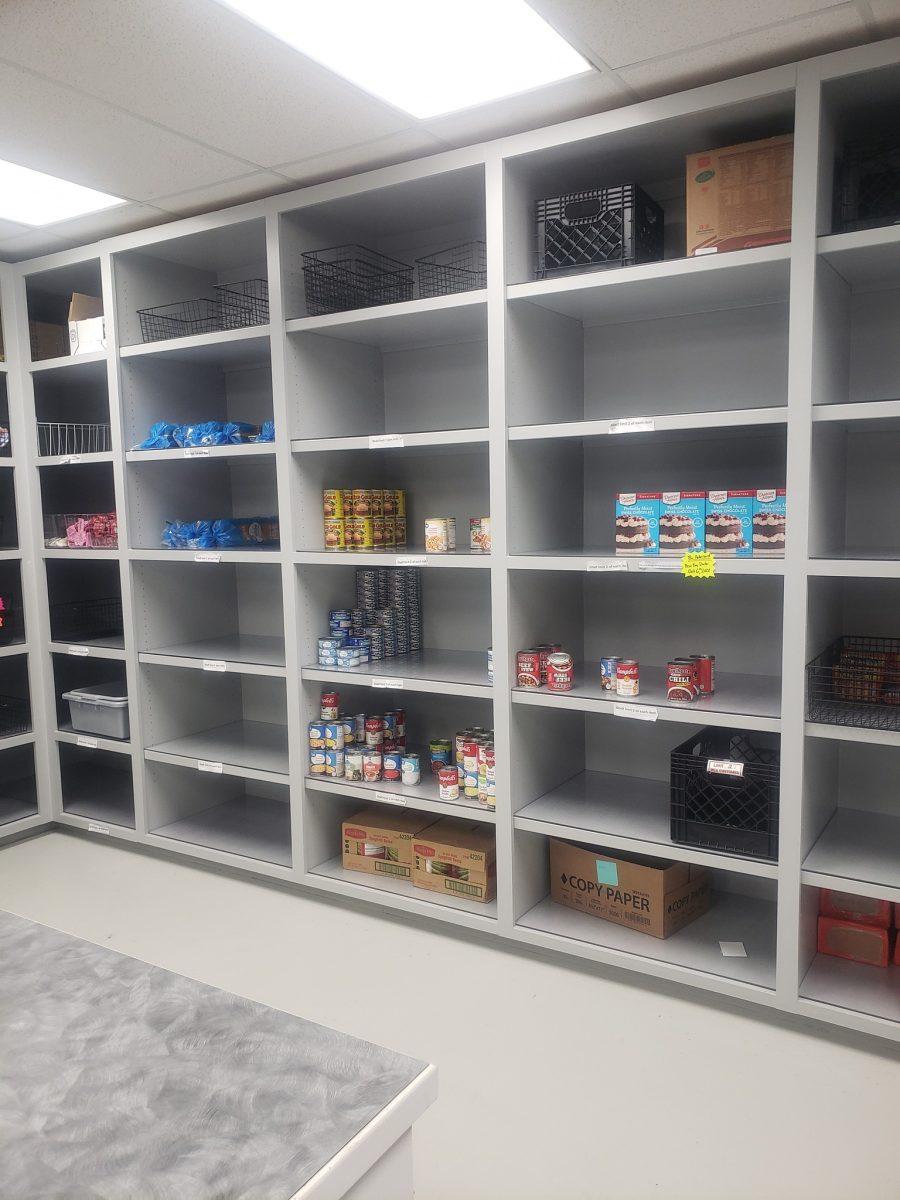
An image of bare shelves at the UCA Bear Essentials Food Pantry appeared on many students’ Instagram and Facebook feeds just weeks before Thanksgiving with the message “Please help! Our shelves are almost bare. We had 40 clients yesterday and this is what our shelves look like this morning.”
William Baker, food pantry coordinator, said that — while visits are up — donations are down.
In October 2021, the pantry had “356 visits, 31 new clients and 2,303.2 pounds of food were donated,” Baker said.
A year later, in October 2022, the pantry saw “576 visits, 70 new clients and 1,588.5 pounds of food were donated,” Baker said.
That’s a 61.8% increase in visits and a 31.% decrease in pounds of food donated.
The image, posted on Nov. 8, sparked questions about what the pantry needs and increased the drive to collect donations.
Jayme Millsap Stone, director of learning communities, commented that residential college HPaW “is currently hosting a friendly departmental competition for the College of Health and Behavioral Sciences to help fill those shelves!”
Commenters asked what the pantry needs and where they can donate.
Baker said the most needed items are “Peanut butter, ramen, cereal, ravioli, mac and cheese and pancake mix. Any food is always helpful.”
Donations can be dropped off at the pantry, located in room 40 of the Physical Plant. Street signs point to the building. Monetary donations can be given online at uca.edu/foodpantry/monetary-donations.
The pantry serves UCA students, faculty and staff. Many food banks see an increase in demand during the holiday season, according to Feeding America, a nonprofit organization of over 200 foodbanks across the country.
Baker said the increase in demand is due to something else.
“I would say we are seeing an increase because of inflation, not the holidays, but I could be wrong.”
As prices rise across the country, many organizations such as UCA’s pantry are feeling the impact.
Laura King, chair of Toad Suck Homeless Coalition and assistant director of United Way of Central Arkansas said the nonprofits she works with are seeing large demand increases.
“People are having more job loss. They work hourly jobs so if a kid gets sick, they get sick, if they miss a day of work — finances are so strained because of an increase in the cost of food, the cost of everything. The dollars aren’t stretching,” King said.
Although King’s organizations serve Conway and Faulkner County as a whole, the Bear Essentials Food pantry only serves UCA students and employees.
In addition to monetary gifts, some UCA employees participate in a payroll deduction program, which takes a chosen amount of money from their checks and places it into the pantry’s fund.
Baker said this is helpful for the pantry.
“The pantry does not receive money from UCA because of all the red tape that comes with state money. We do get support from our UCA community that helps keep the doors open and allows us to do what we do,” Baker said. “ People give money out of their check each pay period and we have a lot of people that bring food items directly to the pantry.”
These donations make up the majority of the pantry’s stock.
“We do have money in our foundation account to go buy food from the Arkansas Food Bank, Walmart or Sams. I would still say the majority of our food comes from our cheerful givers,” Baker said.
Food insecurity on campus is garnering more attention, especially from a newly registered student organization aimed at increasing food access.
Bears Against Student Hunger hope to create a program that would allow students to donate leftover meal swipes, in addition to giving every student $100 in dining dollars.
BASH has three demands for change, as stated on their Instagram page @uca_B.A.S.H.
“Fund: creating a need-based fund that enables students to use leftover meal swipes and donations to fight food insecurity, Food Access: Providing at least $100 in funds to students in the form of dining dollars on their Bear Cards to be used in the Ronnie Williams Student Center and the UCA Christian Cafeteria, and Implementation: Implementing a table on the UCA Day of Giving for fundraising purposes.”
When dining dollars go unused at UCA, that money does not roll over and is nonrefundable and nontransferable. All 11 meal plans UCA offers — excluding the commuter 75 Block Plan and summer 2022 75 Meals Cafeteria Only Plan — have a built-in dining dollar amount ranging from $50 to $1,050.
Residents are required to pay for a meal plan. In February 2022, UCA’s Board of Trustees raised the price of room and board — which includes meal plans — by 4.48%
Room and board, based on a double-occupancy room with a total access meal plan are $7,896 per year. The increase raised rates to $8250 per year, a 4.48% increase.
The Arkansas Department of Higher Education recommends a 4.00% increase in room rates, and a 5.00% increase in the total access meal plan, placing UCA’s increase on par with ADHE guidance.
Terry Fiddler, chair of the board, said, “It’s always a troubling thing, it costs more for the students, it costs more for the parents, but it’s the cost of doing business.”
Inflation, increases in costs for students and increased demand at food pantries and nonprofits across Faulkner County demonstrate the Bear Essentials Pantry’s need for donations.
According to Baker, the Instagram post has helped.
“We have had different departments and people bringing in donations. So to answer the questions, yes the post has helped us out tremendously,” Baker said. “The shelves look pretty good at the moment, we would like to encourage everyone to keep bringing in donations so that they stay this way.”
The pantry regularly updates its Instagram @bearessentialsfoodpantry and its Facebook “Bear Essentials Food Pantry.”
For the Fall 2022 semester, the pantry is open 11 a.m. to 5 p.m. Monday and Tuesday and 11 a.m. to 7 p.m. Wednesday and Thursday.