




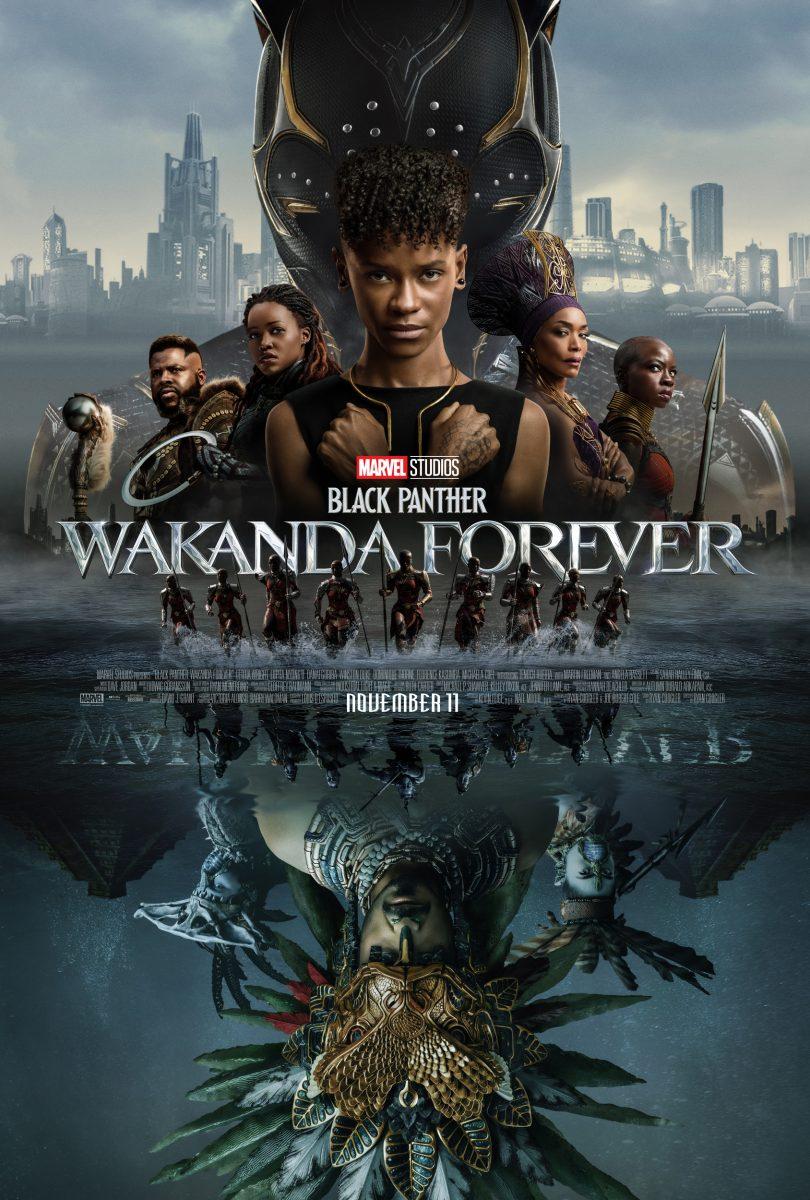
“Black Panther: Wakanda Forever” may not be superb, but director Ryan Coogler finds a way to juggle an enthralling war epic with the death of Chadwick Boseman, gracefully crafting a Marvel story we had yet to experience on screen.
The superhero flick stars Letitia Wright as Shuri, Tenoch Huerta as Namor, Angela Bassett as Ramonda and Dominique Thorne as Riri Williams.
Following the death of King T’Challa to sudden illness, the nation of Wakanda is left in disarray without a leader, as other nations begin to attack in hopes of securing their sacred metallic ore, vibranium.
With the enemy drawing closer, using a vibranium detector built by college student Riri Williams, the hidden underwater city of Talokan finds itself in danger of destruction.
In hopes of protecting his ocean utopia, King Namor looks to Wakanda for collaboration, planning to murder the creator of the machine.
When Shuri and Ramonda come to the defense of the young scientist, a war erupts between Wakanda and Talokan as beliefs, cultures and warriors are pushed to their breaking point.
Considering the film’s troubled production, it’s somewhat of a miracle that it works as well as it does.
Coogler has already proven himself to be one of the greatest up-and-coming directors, helming films such as “Fruitvale Station,” “Creed” and “Black Panther.”
Although the movie is Coogler’s least refined due to the pandemic and the passing of Boseman, he still delivers an emotionally resonant, gripping tale within the Marvel Cinematic Universe.
Everything exceptional in the original “Black Panther” is carried over to its sequel, from its intricate costuming to its dynamic musical score.
Coogler improves the world he constructed in the first film by introducing new technologies such as the kimoyo beads, as well as digging deeper into Wakanda’s cultural ideologies and rituals.
The African inspirations and Aztec-influenced Talokan designs vibrantly blend in both music and atmosphere, helping the hand-to-hand action scenes display a unique flavor not found in any other Marvel film.
Having won an Academy Award for the first film’s score, composer Ludwig Göransson continues to provide modernized African beats with the epic sounds of superhero themes, serving yet another lively and fantastic soundtrack.
Outside of being gorgeous in technicalities, “Black Panther: Wakanda Forever” thrives in its unbridled, riveting performances.
Wright is promoted to the leading role after being a supporting character in the original film.
While she still pertains her witty humor and intellect as Shuri, Wright injects a realistic sense of grief into her performance.
As she painfully deals with the death of her brother T’Challa, Shuri can also be found testing both her spiritual faith and urges of violence, layers that — while not needed — Wright brilliantly brings to the table.
Even with Wright’s energetic performance, it’s Bassett’s supporting role that flows with Academy Award potential.
Having gone through the death of her husband and son, Basset’s Ramonda is weak but headstrong toward her enemies, defiant as she is dejected.
While dealing with both the pandemic and the passing of Boseman, the superhero film was bound to take a misstep somewhere.
Clocking in at two hours and 41 minutes, “Black Panther: Wakanda Forever” is the second-longest film in the Marvel Cinematic Universe.
With a nearly three-hour-long runtime, it makes almost no sense why the pacing of the film still feels lackluster.
As if addressing the passing of T’Challa and the rise of Talokan wasn’t enough, the sequel also tackles the introduction of Riri Williams and the political landscape of Wakanda in the world.
The film is overstuffed with far too many storylines, making it feel disjointed and dull.
Nearly 20 minutes of this film should have been cut as Riri’s storyline could have been far more simplified.
The character of Everett, played by Martin Freeman, virtually has no significance to the film’s plot, only being added to lazily set up plot points for future movies down the road.
It’s scenes like his that are a chore to get through.
The film can feel far too crowded for its own good, but when Coogler moves the film’s focus to his emotionally distraught central characters, it becomes Marvel’s best outing of 2022.
“Black Panther: Wakanda Forever” was released in theaters on November 11.