


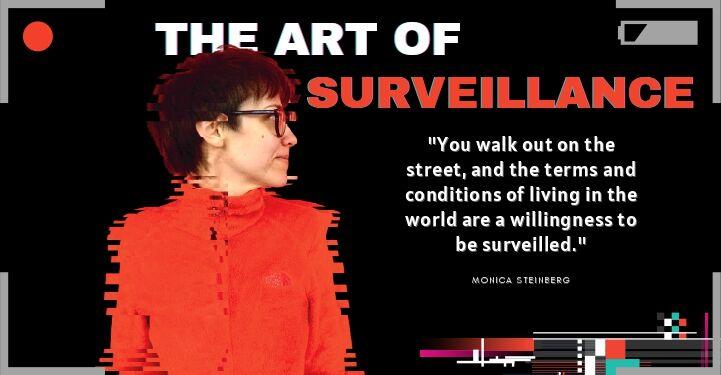
Students and faculty explored and debated the ethics of surveillance art in a special lecture by 2022 UCA Young Alumni Award recipient Monica Steinberg.
Eager to hear about Steinberg’s postgraduate work in art history, students and faculty gathered around Steinberg in the Farris Hall presentation room.
The lecture, held Oct. 28, focused primarily on surveillance, such as through security cameras and the data mining of online posts. Art, such as Italian artist Paolo Cirio’s, highlights the reimagining and repossession of one’s image.
Steinberg highlighted Cirio’s Street Ghost exhibition, where stills from Google maps were taken and projected onto the sides of buildings. The prints were also shown in museums and a documentary was made about the project.
“These figures were installed in the same locations where the original image was generated. In other words, real life, a real-world presence was transformed into a virtual one,” Steinberg said. “They’re grainy urban citizens, and they’re the product of this panopticon-like architecture of a society we live in that essentially, you walk out on the street, and the terms and conditions of living in the world are a willingness to be surveilled.”
Steinberg called the premise of constant surveillance voluntary servitude.
“If you want to be part of the world, you have to be willing to be surveilled. Being in public, there is an implicit form of consent implied in all of this. You will be recorded by private corporations and government entities. This level of surveillance is just intrinsic to our contemporary life,” Steinberg said.
Steinberg highlighted artists who are actively working against surveillance, such as those who propose modifying one’s self to be unrecognizable or traceable.
Adam Harvey exhibited CV Dazzle, which Steinberg said “advocates for asymmetrical makeup and hair to kind of trick facial recognition.”
Harvey was commissioned in 2014 to create a lookbook of sorts for the New York Times in an article entitled “Face to Anti-Face.” The publication detailed the look and how each component, such as hair covering the face, could thwart facial recognition and potentially respond to invasions of privacy through surveillance.
Harvey’s website, ahprojects.com, said, “There has been a surprisingly positive response to the CV Dazzle project since first publishing it in 2010. Activists and art groups have done workshops to explore and expose the vulnerabilities of biometric recognition systems.”
The liveliest discussion of the lecture was about invasions of privacy through photography and the loose privacy laws in the United States specifically. Steinberg said U.S. citizens have “negative rights” compared to those in countries like Germany.
Steinberg also touched on the collection of data through genetic testing companies such as 23andMe through the art of Heather Dewey-Hagborg who created 3D printed faces through DNA collected on discarded cigarette butts.
Some attendees commented on having participated in DNA testing to learn more about their health and look for genetic diseases. Likewise, Hagborg used commercial DNA testing labs to create her masks.
Steinberg said of the masks, “These are called Stranger Visions because to her they are strangers. But yet she knows more about them than they likely know about themselves.”
Steinberg graduated with a bachelor of art in art history in 2004 and is now an associate professor of American studies at the University of Hong Kong.
In addition to being named young alumni of the year, Steinberg has also received awards for her research work; such as the Frost Essay Award from the Smithsonian American Art Museum journal.
Steinberg was honored at a dinner later in the evening in the McCastlain Hall Ballroom. In a press release on uca.edu/news, Steinberg said, “I am surprised and flattered to have won this award. The incredible support of the UCA faculty made all the difference. While I was an undergraduate, Dr. Gayle Seymour drove me to and from conferences and the airport, wrote countless letters of recommendation, and went above and beyond as an academic mentor. And the support of the Honors College was truly amazing: the classes, the community and the study-abroad and internship experiences.”