




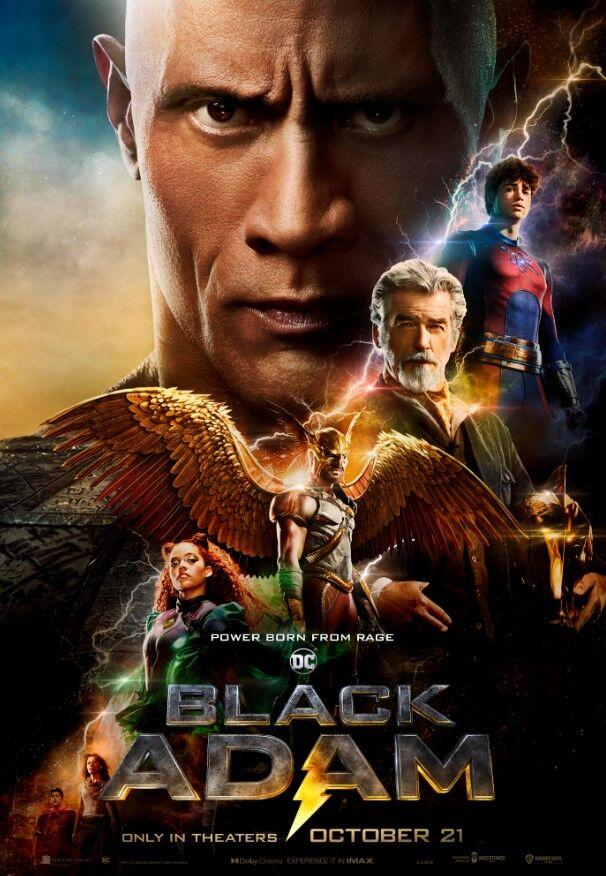
“Black Adam” is visually appealing but, ultimately, too big for its britches.
This DC comic-book movie about the anti-hero Black Adam tries to tell an origin story, introduce four new superheroes, build a villain and create real stakes during long, CGI-packed action sequences — emphasis on “tries.” If the movie focused more on one of these goals instead of trying to do it all, then I wouldn’t wonder why half of the characters were even in the movie.
A whole lot is crammed, forced even, into the movie’s two-hour and four-minute run time. I understand that origin movies can present the difficult challenge of introducing a new character that has never been on-screen before, but there are ways to do that without loading up the plot with other new heroes. That challenge becomes even more impossible when you have a cinematic universe that has a small roster of developed heroes to pull from.
Dwayne Johnson plays himself in the movie. Oh, I mean, Dwayne Johnson plays Black Adam in the movie, and it’s pretty much the single-flavored performance you’d expect from The Rock. The script actually adds to his performance in that he doesn’t have many lines, but before I get into the script let me address some things in the movie that were cool.
The CGI was crisp during the fight scenes, and there were a couple of well-timed and delivered jokes. The music composed by Lorne Balfe — composer for movies such as “Megamind,” “Top Gun: Maverick” and “Mission Impossible: Fallout” — was truly epic. That’s about all I can say.
Yes, the score is superhero worthy. However, it was definitely overplayed throughout the film. And because of the way the film is edited, the epic music shoves some important dialogue into the background.
The script gives Johnson very few lines. In my opinion, this is a good thing that adds to the characterization of Black Adam as a cold, no-nonsense character. The fewer lines given to Johnson means fewer places for the audience to spot that he’s playing himself again.
The script forces relationships between certain characters after very little screen time, and the relationships feel even more forced due to the lack of chemistry between the actors.
Some of the “twists” are actually just the vague script leading viewers to believe one thing and then dro in a completely new idea out of left field. One can imagine that when writing, the writers came back and said, “We never fully explained that piece of exposition did we? We didn’t? Great! Then we can change it now and it’ll be a big twist!”
In a movie so action-packed, it is crucial that some of the fights feel tough or consequential for the main character. However, Black Adam is so overpowered that the movie literally has to sideline him for half of the third act so that the ending has stakes … and, yes, the movie followed the stereotypical three-act formula like so many other comic-book movies.
Black Adam is so overpowered that the big fights don’t even seem like fights — they are more of a relentless beatdown. City blocks are leveled and nobody reacts. The fights are emotionless and one-sided.
In conclusion, the whole movie feels inconsequential, and I would only recommend watching it in theaters if you want to see some superhero-level destruction. If not, just wait until you can stream it. If you are hoping for something different or new from “Black Adam,” don’t get your hopes up.
“Black Adam” is available for viewing in theaters.