

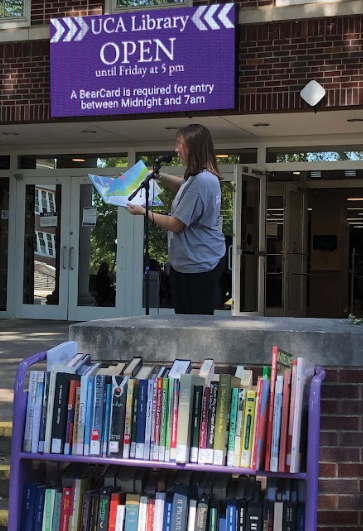
Banned Books Week is an annual celebration of the freedom to read. The Torreyson Library celebrated by hosting an outdoor reading of some challenged literature from Monday, Sep. 19 to Friday, Sep. 23 in front of the library.
Students were encouraged to take free bookmarks and bracelets. A giveaway was held to win prizes like a Banned Books Week mug, a copy of the second most challenged book of the year, “Lawn Boy” by Jonathan Evison, and a copy of the third most challenged book of the year, “All Boys Aren’t Blue: A Memoir-Manifesto” by George M. Johnson. A library cart full of challenged books was next to the table, and students were encouraged to read aloud.
Freshman Olivia Smith read the children’s books “The Giving Tree” and “The Lorax” aloud, “I read ‘The Giving Tree’ because that’s a book that my mom used to read to me a lot when I was little. I feel like it has a lot of sentimental value to me, and to hear that it was banned, it caught me off guard.” Smith said.
“The Giving Tree” has been challenged in libraries across America by those who claim it promotes sexist ideas. Others say it challenges capitalism. Challenges against “The Lorax” claim it harms the logging industry.
“The Lorax was banned before because the American Forestry Association thought that it would turn people against them because it supports the idea of tree-huggers. You know, I could see that, but I just think it’s crazy that they would want to ban something like that,” Smith said. Students read excerpts from other challenged books like “The Hunger Games,” “Gone with the Wind” and “Charlie and the Chocolate Factory.”
Sophomore Linden Cates — who read an excerpt from “Charlie and the Chocolate Factory” by Roald Dahl — said, “I read it because I really enjoy the book. I really love Dahl’s style and writing and it’s fun to read aloud. I’m not sure the exact reason why it would [get banned], but its got some parts that are kind of weird and scary. Its got some parts that are a little intense for a kids book, so that may be why people are trying to ban it.”
Associate professor of English Katherine Conley, the organizer of the event, talked about the nature of Banned Books Week. “[Banned books week] is happening nationwide. We think that book bans are things that happen in authoritarian countries or way back in the past when people burned witches, but just last week the Conway school district was talking about removing books from the school curriculum for things like LGBTQ content,” Conley said. “So, celebrating the fact that we have a constitutionally protected right to read is a great way to make a statement about having access to all the kinds of material we want, ” Conley said.
According to the American Library Association, in 2021, 1,597 books were affected by censorship attempts and 44 percent of those attempts took place in school libraries. There has been an upward trend in censorship attempts and 1,651 books have already been affected in 2022.
“I think [more challenges] have to do with the fact that there’s been an explosion in the publishing of things like young adult fiction that features stories about coming of age and discovering your sexuality and books that are about systemic and structural racism. There is more access to that kind of stuff, and it can make people anxious who don’t feel comfortable with those things being in a school curriculum or library,” Conley said.
This years top ten most challenged books in America features books like “Gender Queer,” an illustrated memoirs by Maia Kobabe about Kobabe’s exploration of gender identity and sexuality, and “This Book is Gay,” a nonfiction book on sexuality and gender by Juno Dawson.
“This year’s top ten most challenged books are all on the list for LGBTQ content or for reasons related to race and ethnicity. All of those cultural anxieties percolate to the top and people want to protect what their kids can and can’t read,” Conley said. “If you’ve got a teenage kid who wants to read a story about a character and their coming out experience, they’re gonna find that, right. So, partly, book bans are kind of futile and pointless.”
“If we’re limiting what people have access to, we’re also limiting whose stories can be told. We should encourage people to share their stories and embrace some of the best parts of diversity that make us stronger,” Conley said.
A display of challenged books are featured at the Torreyson Library.