




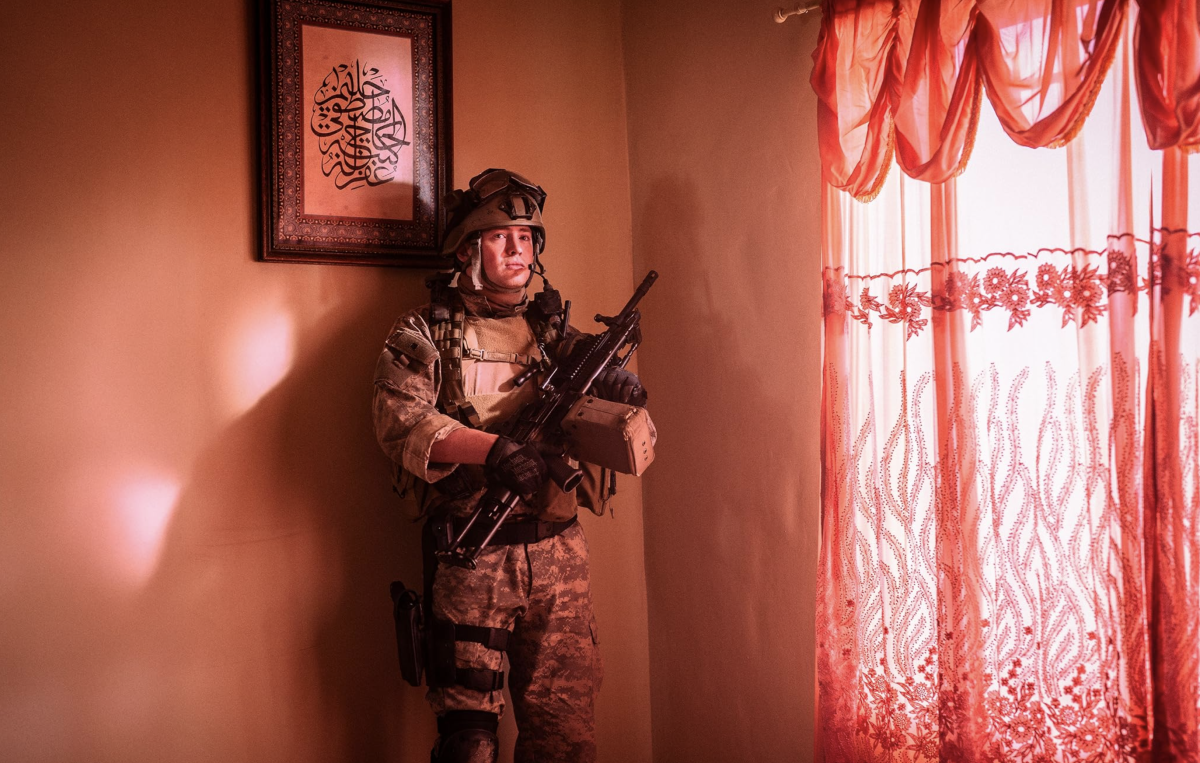
Coming off of 2024’s “Civil War,” director Alex Garland returns to the battlefield with “Warfare,” a boots-on-the-ground, gritty snapshot of the Iraq War.
Following a team of Navy SEALs in 2006, the platoon’s surveillance mission is turned upside down when its cover is blown, resulting in a deadly skirmish as the soldiers look for a means of escape.
Co-directed by veteran Ray Mendoza, the film offers a realistic lens into Iraqi warfare, going as far as to feature in-depth codenames and codewords. Although some of it may go over viewers’ heads, character conversations always keep the audience in the loop on what the platoon’s objective is.
While Mendoza’s time in the field gives “Warfare” an authentic edge, it’s Garland’s directing prowess that makes the film an immersive experience.
Switching from over-the-shoulder cinematography to in-the-sky, infrared drone footage, the film never feels like the average war genre. Similarly to “Civil War,” “Warfare” features an incredible soundscape. While the action sequences are spaced out in its hour-and-a-half runtime, the zipping of bullets, rushing of blood and ear-splitting explosions make every moment of life or death a brutal watch. And that’s without pointing out the film’s graphic visual effects. The film dodges using massive amounts of CGI, resulting in practical body parts flying across the desert terrain. Whether it be mangled legs or exposed lungs, Garland and Mendoza show audiences every horrible wound that can come from the battlefield.
Like “Civil War,” “Warfare” also manages to keep away from sprouting propaganda, solely focusing on the lived-in experiences of these soldiers and the people around them. In fact, “Warfare” manages to improve on this aspect. Due to “Civil War”’s story revolving around war photographers and journalists, its objective look at the bloodshed comes off unremarkable, with its final message of “war is bad” having no teeth because of it. However, since “Warfare” follows the men carrying these killing devices, making every moment they take a life weighty and regretful. For all of the characters in the film, this is merely a battle for survival, not dominance.
Due to strong performances from the stacked cast — starring Will Poulter, Charles Melton, Joseph Quinn and Kit Connor — the raw emotions that these soldiers face feel more than justified. Whether they’re screaming from pain or stressed from the situation at hand, everyone turns the hurricane of emotions palpable.
Even with Garland’s improvement in objectivity, “Warfare” doesn’t manage to stand toe-to-toe with “Civil War”’s memorable cast. Whether it’s the hardened Lee Smith (Kirsten Dunst) or the smart-mouth Jessie (Cailee Spaeny), the likable characters add a new layer of emotion and care for the material. This can’t be found in “Warfare.” Aside from the platoons’ teasing nature, brotherhood and shared love for a fiery aerobics video, we never learn much about them aside from their names. Because of this, the film’s graphic moments only come off as visceral. While this seems to be what Garland and Mendoza were going for, getting to know the crew would have given the film a much-needed emotional undercurrent. “Warfare” takes its time getting into its titular action, focusing on setting up parameters and staking out during the first act. Without likable characters, this section of the film is a bit of a slog, even if the tension-building is well crafted.
The film’s use of one-location storytelling, immersive sound design and graphic visuals puts “Warfare” above many of its contemporaries, serving audiences one of, if not, the most realistic war film in years.
“Warfare” released April 11 and is in theaters now.