


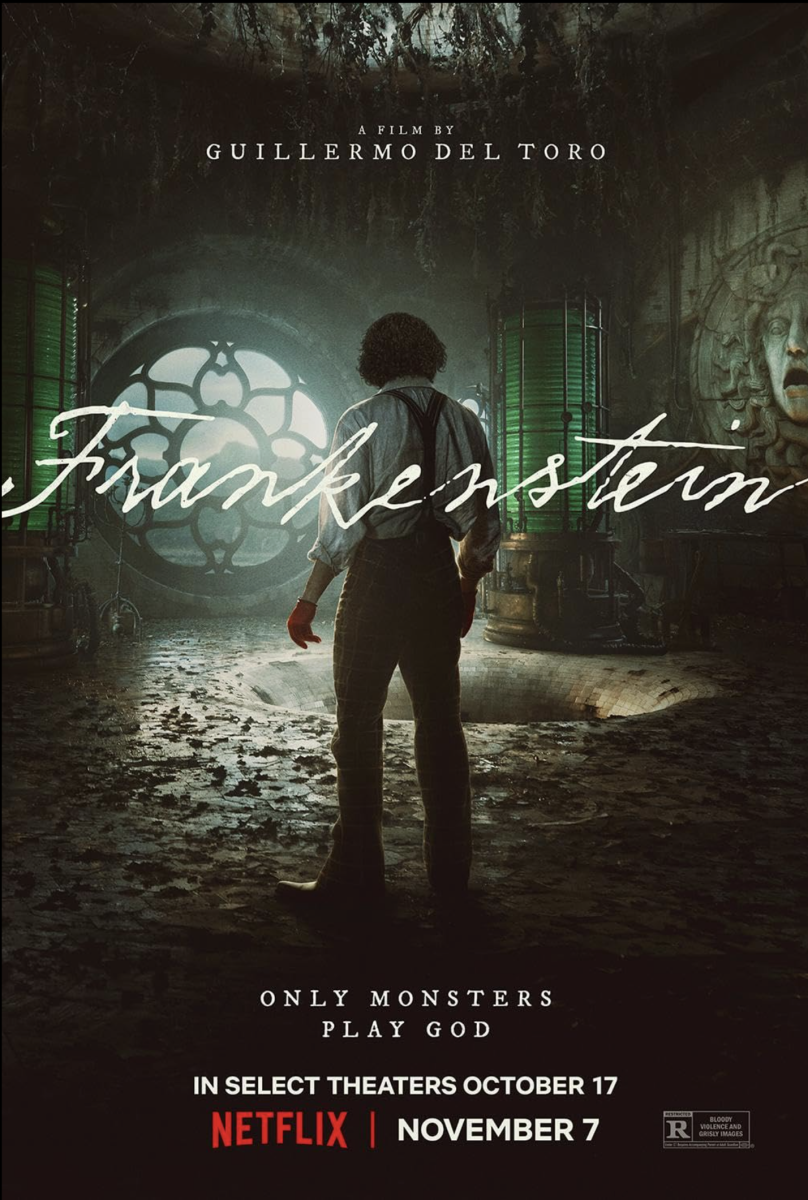
In a riveting reimagining of Mary Shelley’s classic novel, Guillermo del Toro’s “Frankenstein” brings a new angel to the beloved novel, while still characterizing the true villain of the gothic tale.
Originally published in 1818, we’ve seen a variety of retellings, either loosely basing key plotlines or sparingly referencing Shelley’s novel; however, this variation offers not only the viewpoint of Doctor Victor Frankenstein, played by Oscar Isaac, but also includes the viewpoint of ‘the Creature’, played by Jacob Elordi.
Although this would’ve been the perfect Halloween screening, it’s Nov. 7 premiere forbade any chance of such, yet the film lacks horror, one of the best twists in the film.
Through each cohesive part of the film, the audience sees all perspectives of the creation – why the doctor is in such a pursuit, and why the Creature is looking for him – ultimately leading the audience to the understated conclusion that the Creature isn’t the true monster, and instead, Frankenstein is the culprit of all of his misfortunes.
Most movies that retell this cult classic place the blame on the so-called monster and its grisly, gory nature, but this film blatantly disregards any such thought. It’s a refreshing plot we don’t see often enough, and by doing so, del Toro’s take on the romanticist writer’s novel not only showcases the tale’s true message but also accentuates the devilish nature of what Frankenstein creates.
Playing into themes like nature versus nurture, and romanticist themes that literary enthusiasts live and die by, the film tackles most, if not all, of the novel’s overarching messages and meanings.
Speaking of literary enthusiasts, if one’s idea is to watch this and believe that this is a spot-on recreation of Shelley’s original novel, prepare to be disappointed. While I consider myself a bibliophile in part, this is barely similar to the novel, but it should be considered one of the best adaptations ever produced.
Alongside the almost tear-jerking plotline, the film’s underlying symbols are what propel the movie to such a high rating. One notable plotline choice is the switch between Frankenstein and the Creature. As the story continues, we see Frankenstein become unglued while the Creature becomes more humanlike.
This switchoff is one of the many twists and turns this film offers, yet one disparaging factor of this film is the quasi-romance between Frankenstein, Frankenstein’s brother and his betrothed.
Played by Mia Goth, Elizabeth is no simple creature either, and her plotline is vastly different from that of the book. While she meets a similar end, the disgruntled love triangle – if you can call it that – sullied the meaning of the story entirely.
Shelley portrayed Elizabeth very differently in the book, and by ignorantly changing this due to creative liberty, del Toro undermines her character’s significance.
This was by far the most irritating aspect of the film, but the duel points of view make up for this monumental misstep.
Del Toro’s “Frankenstein” is a breathtakingly bold interpretation that honors the heart of Mary Shelley’s classic while daring to reinvent its spirit. Despite a few creative choices that may frustrate literary purists, most notably the altered dynamics surrounding Elizabeth, the film’s emotional depth, symbolic richness and dual perspectives breathe new life into a story that has endured for over two centuries.
Del Toro’s vision reminds audiences that monstrosity is not born from appearance but from obsession, and that humanity, in all its beauty and cruelty, lies at the core of both creator and creation.
It’s a haunting, visually stunning reimagining that will linger in the minds of viewers long after the credits roll.
To watch del Toro’s adaptation of “Frankenstein,” it can be streamed on Netflix or viewed in select theatres.