



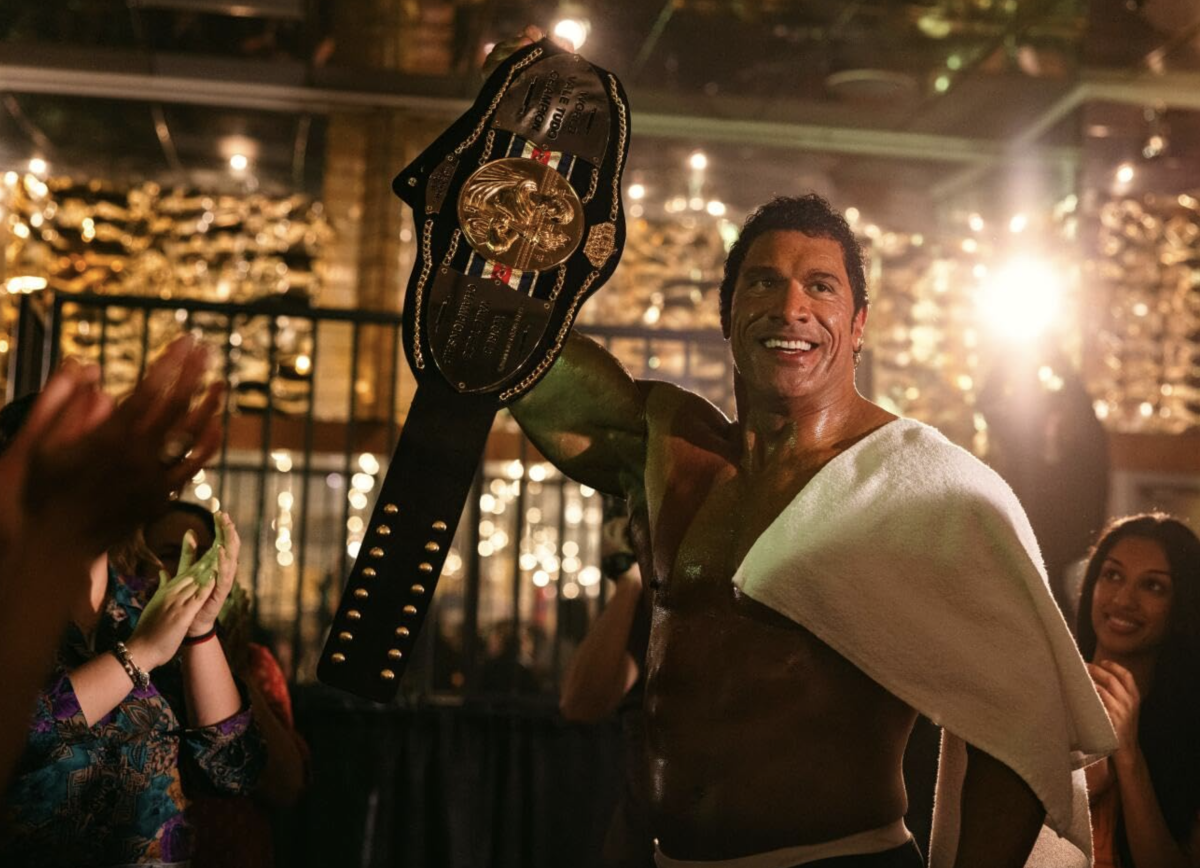
Dwayne “The Rock” Johnson breaks out of his action-comedy mold in “The Smashing Machine,” delivering a subdued, yet magnetic, career-defining performance, even if the film surrounding him is far from special.
The movie follows mixed martial arts pioneer Mark Kerr during the peak of his sports career in the 90s, reflecting on his opioid addiction, faltering relationships and harmful self-image.
Although the muscular MMA fighter is still a character that fits into Johnson’s wheelhouse on paper, the role is unlike anything that the Hollywood star has done.
Kerr is a soft-spoken giant for most of the film’s runtime, featuring several scenes of quiet, tranquil discussions between a variety of characters. However, in the select few scenes where he breaks down into fits of anguish, Johnson shines like he never has before. Filmed with long-lasting, lingering shots, director Benny Safdie allows Johnson to delve into the uncomfortable depths of the character. There’s no doubt in saying that Johnson’s performance is the strongest aspect of “The Smashing Machine,” and despite it clearly being an Oscar-vehicle film, he still stands out among other performers this year.
Luckily, Johnson isn’t the only notable performance in the flick. While Emily Blunt’s character is a bit hard to sympathize with at times, she does an incredible job throughout. Blunt’s performance here, as well as her roles in both “Oppenheimer” and “The Quiet Place” franchise, prove that she’s only just now entering her prime on the silver screen. Real-life mixed martial artist Ryan Bader also turns in a great performance as Kerr’s best friend and fellow fighter Mark Coleman.
Kerr’s slow spiral into self-loathing is only exemplified by Safdie’s sharp editing in “The Smashing Machine.” While much of the movie’s tone features a sense of tranquility, there are several moments where this peace is broken by intense hand-to-hand combat, music and imagery. It isn’t the best editing of the year by any means, but it’s a commendable job.
The film’s score — composed by Nala Sinephro — features a healthy amount of elevator-jazz and intense percussion, akin to the 2015 best picture winner “Birdman.” Although it’s a beautifully crafted score and does have its moments in the film, it doesn’t always work with what’s happening on screen. Scenes involving in-depth conversations between Kerr and his girlfriend, Dawn Staples, can come to a screeching halt at times due to the jazz-centered score giving these emotional moments a melodramatic flavor.
Although Safdie directs the film competently, his work on the screenplay isn’t nearly as clean. There are more than a few lines that feel incredibly unhuman or, like the score, overly melodramatic. This also extends to the film’s overall story. It’s the definition of a by-the-beat biopic. Nothing in the narrative is surprising; Kerr faces every pitfall you’d imagine and rises back to the challenge just as you’d expect him to.
Other biopic films such as “A Complete Unknown” also feature fairly generic plot points, yet are able to become more through their thematic meanings. Sadly, “The Smashing Machine” lacks this as well, leading the movie to feel rather pointless by the time the credits roll.
The Safdie-directed film might follow a by-the-numbers narrative structure to a fault, yet it manages to provide viewers with a raw, potent performance from Johnson, one that makes the film more than worth the watch.
“The Smashing Machine” was released Oct. 3 and is in theaters now.