

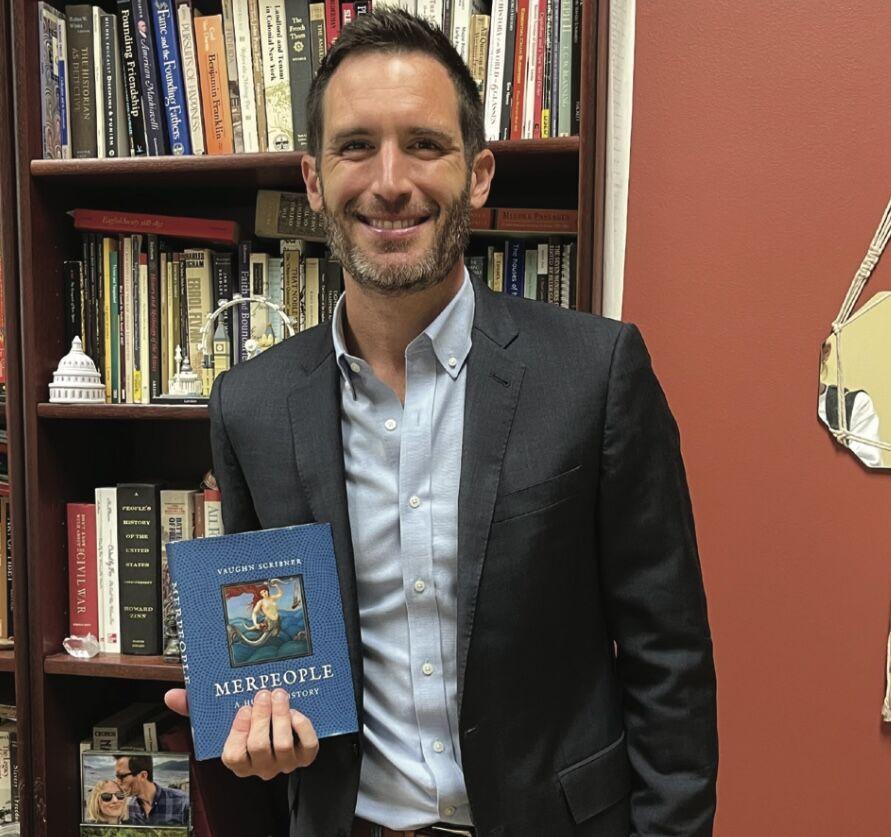
Associate professor Vaughn Scribner is no stranger to writing books; however, in recent years his newest publication and research have splashed into the limelight because of the captivating nature of his favorite mysterious topic: merpeople.
“Merpeople: A Human History,” originally published in 2020, engrosses readers by introducing the history of mermaids through the eyes of human accounts.
During Scribner’s research for his previous book, “Inn Civility: Urban Taverns and Early American Civil Society,” he discovered human accounts of several men who came in close contact with these creatures.
“I had to read a lot of travel diaries and newspaper articles because there’s not exactly a section in the library or the archives like taverns,” Scribner said.
“As a result, I read a lot of random stuff. I came across this instance of a guy claiming that while he was in Virginia, he’d been on a canoe and this merman climbed over the side of his canoe. Then he chopped its arm off, and it receded in blood. I was like, ‘What is this?’”
After several accounts piqued his interest in the topic, he published an article in 2017 called “‘Such Monsters Do Exist in Nature’: Mermaids, Tritons, and the Science of Wonder in Eighteenth-Century Europe,” followed by an article in History Today in 2018, which made the cover.
After the exposure Scribner’s articles received, a publisher approached him, and “Merpeople: A Human History” got its start.
Scribner said he did a majority of his research in the comfort of his office, which he appreciated.
“It just came together really well. A lot of that is because with the internet now, and with all these digitized sources, I was able to have access to so much,” Scribner said.
His research process spanned over nine months, and the rest “wrote itself.”
Scribner describes the book as a “grand tour” with a broad-ranging topic that opens the door to the mystical beings and their beginnings.
“Whenever or wherever you go, you find mermaids. All these cultures around the world have always had these. They’ve all had these flood narratives. In the Christian tradition, there’s Noah’s Ark, but every religion has a flood narrative. Oftentimes, around these floods, they have these half-human, half-fish creatures.
“They start bringing their conceptions of the mermaid with them because our modern conception of what a mermaid looks like comes out of the early Catholic Church,” Scribner said.
Scribner also explains the deeply rooted curiosity in mermaids in his book.
“There’s something about mermaids that keeps drawing us back in. No matter where I go, or who I chat with, people are always interested and have their own stories. This subject lends itself to this broad — not just interest — but kind of introspection,” Scribner said.
“Mermaids serve as mirrors for us, and these are ways for us to project ourselves. I think it has come back from this kind of like, deep fear, curiosity and fascination with the ocean and water.”
Since Scribner’s publication of “Merpeople: A Human History,” he has been a guest on Sky News and has written two more articles on the topic.
Readers applaud his work. One review from Scribner’s Amazon listing said, “It was brilliant — very well researched, and it gave a fascinating overview of mermaids and mermen throughout history and with a global perspective. I thoroughly recommend it to anyone with an interest in merpeople.”
His articles can be found on his website at vaughnscribner.com, and both of his books can be purchased through Amazon Prime, Walmart, Blackwell’s and more.