


Students and faculty gained insight on Native American Caddo culture from UCA’s artist-in-residence Chase Kahwinhut Earles during a presentation Tuesday afternoon, March 8, in McCastlain’s art lecture hall.
Chase Kahwinhut Earles is an ambassador of Caddo heritage and tradition and a Native American traditional potter. The purpose of his residency was to educate students on Caddo history and showcase his contemporary art through workshops and demonstrations.
“The Caddo, who — prior to removal — once occupied portions of Arkansas, are a vibrant and active Native group, although many are not familiar with their traditions and expressions, ” Duncan McKinnon, director of the Jamie C. Brandon Center for Archaeological Research, said. “Students and the community will have an opportunity to learn about Caddo culture and the distinctive types of pottery designs, styles and forms that define this culture.”
He added that participants will explore and learn how Caddo traditional pottery-making represents continuity in tribal identity and heritage, linking contemporary Caddo with its ancestral past.
As Earles’ residency was in collaboration with UCA’s Jamie C. Brandon Center for Archaeological Research Annual Spring Lecture Series over Caddo culture, Earles tuned in on the agricultural achievements that his ancestors accomplished.
“We were an agricultural tribe. We would create farmlands that would stretch miles where you could not see the end in any direction,” Earles said. “Land was managed heavily as we grew crops and other things, like sunflowers, that people would now consider weeds.”
On that land, the Caddo tribe would create the Turkey Dance that sings the tales of its people is still sung today, 100 years later, with add-on verses and steps across many generations.
The same thing applied to the Caddo’s pottery, which the tribe is known for, as they would travel vast distances to trade and interchange ideas when it came to the artwork.
This is how Caddo culture adopted the different artworks of clay, wood, copper and stone.
Despite the number of generations the tribe has circulated through, Earles emphasized how the Caddo people have always been the welcoming kind.
“Our history is that we are a very diplomatic tribe. One thing about Caddo is we have always tried to get along with everyone, even if it was difficult, we would try to make peace among all neighboring tribes,” Earles said. “If you lived by us, you would become a part of us. This is how we would form our sister/brother tribes.”
However, those extended tribes are almost nonexistent today as the number of Caddo tribes left is scarce. This has to do with the remaining tribes being split between the idea of wanting to leave their homelands to get outside education or stay connected with their people and help implement tradition into the young children of Caddo.
It is because of this that the Caddo identity is unclear in today’s generation.
With determination like Earles’, others come together in an attempt to reimplement the Caddo Identity.
“A lot of us come back and reconnect our family to our tribes and identities and teach our young Caddo children our Caddo identity,” Earles said.
Reuniting with his heritage allowed Earles to spread Caddo culture throughout communities like UCA.
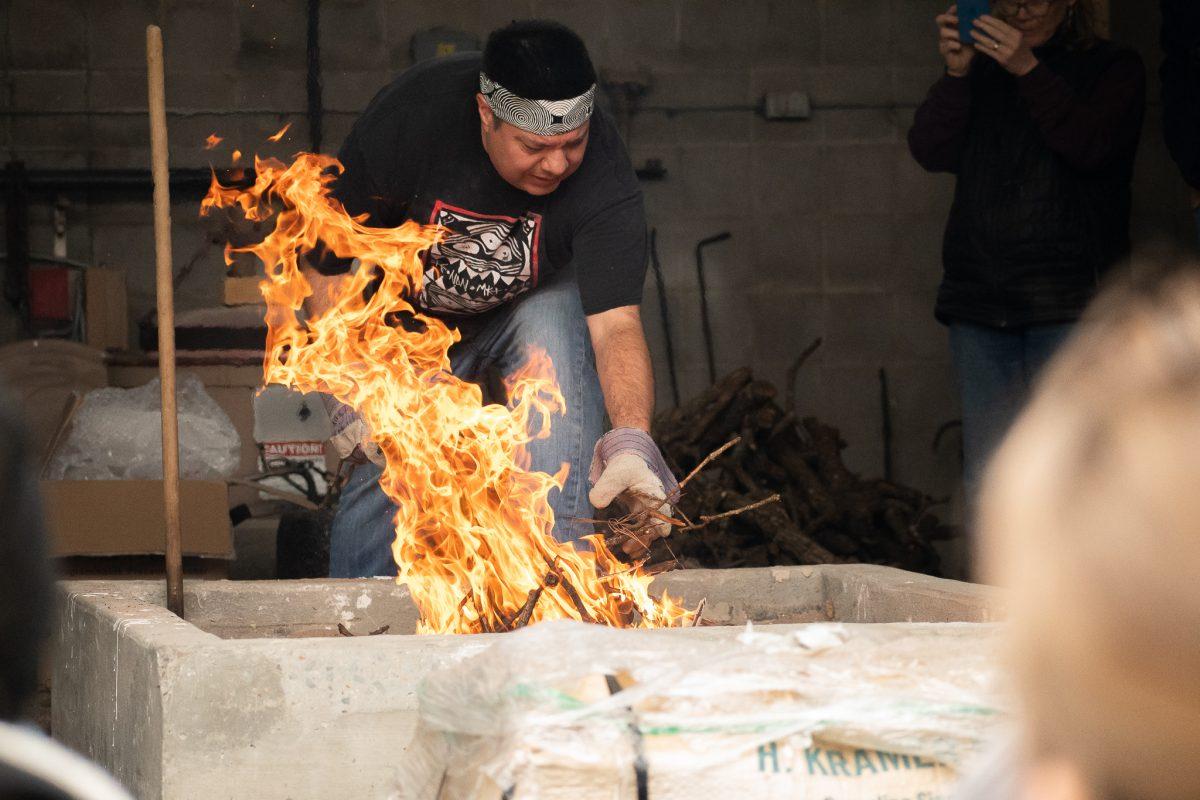
To further this education, Earles showcased the Caddo process of making pottery on March 11, 2022. At UCA’s Schichstl Art Studio, Earles spoke on the process of pit firing the pottery. Students of one of UCA’s ceramics classes were able to have their own pottery fired by Earles, after constructing the pieces during a class earlier that week.