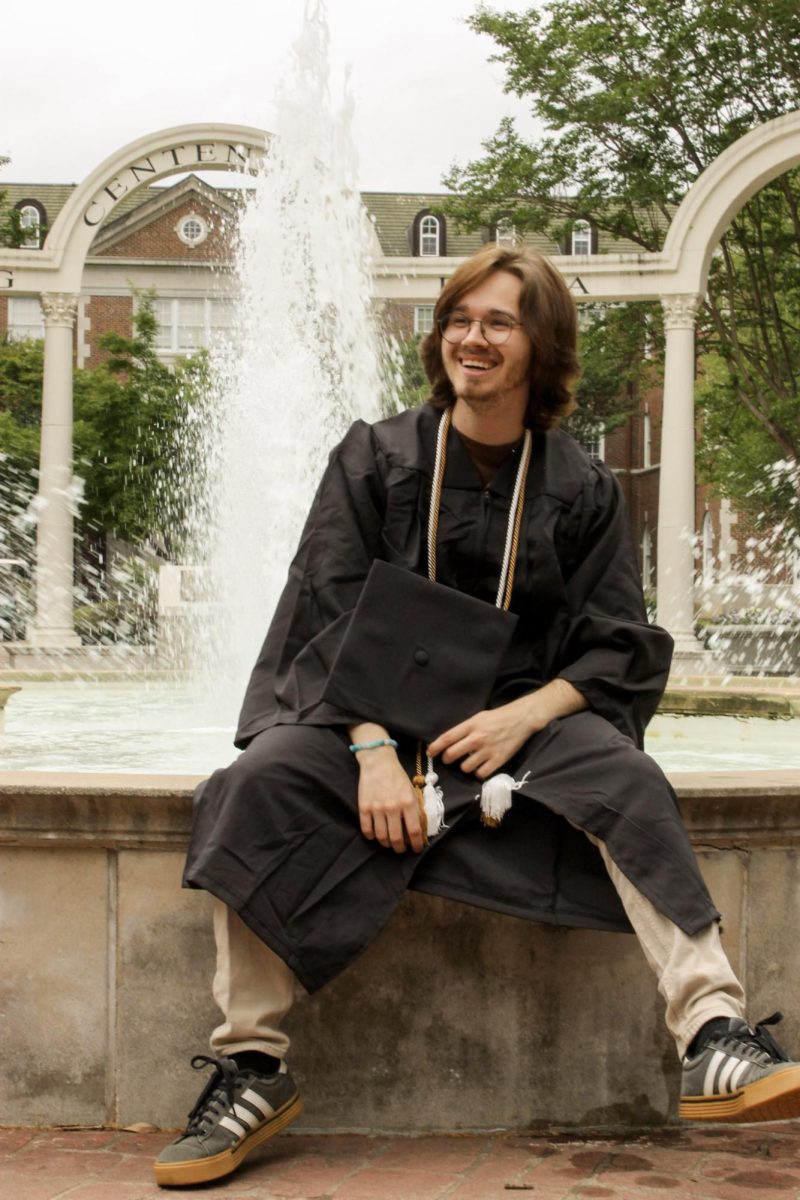




Freshman Lauren Turnage works hard caring for ER patients despite having medical hardships of her own.
Working as a Patient Care Tech at Conway Regional Medical Center in the emergency department, she balances working as well as being a full-time student.
“I took a year off school when I graduated so that I could work my way up to a full-time position at that job, which I did,” Turnage said. “And then, I decided I wanted to come back to school. It’s my life right now.”
Turnage is a nursing major and started her job the same month that she graduated high school. She works three days a week from 12 p.m. to 12 a.m., all while going to school.
“I don’t have very much free time,” Turnage said.
Turnage said she wants to become either a pediatric intensive care unit nurse or a labor and delivery nurse.
“My grandma was a nurse,” Turnage said. “My mom was a nurse and I actually work in the same emergency department she did when she was a tech, graduated and then became a nurse in the same ER.”
Turnage said that she had previously considered other forms of health care.
“I’ve always wanted to be in the medical field,” Turnage said. “I used to want to be a surgeon, but then I decided that having a family was a little bit more important than that, so that’s why I kind of switched to nursing.”
In the emergency room, Turnage works with everything that can possibly walk through the door. She also works to care for the people who are waiting to be assisted by other staff.
“I draw blood to do EKG, transport patients, I’m also there if you need a blanket or water, I got it for you,” Turnage said. “I do COVID swabs, strep swabs, things like that. But the main part is that I draw their blood and I’m kind of there if they need something.”
Turnage said she has a lot of tasks similar to other staff members of the hospital.
“I can do a lot of things nurses can besides giving IVs, putting IVs and giving meds, things that only nurses can do,” Turnage said.
Turnage suffers from a syndrome called postural orthostatic tachycardia syndrome, commonly known as POTS, where she can easily pass out.
“Basically, I stand up or I stand for too long, or I walk for too long, I get super nauseous,” Turnage said.
Turnage also has a heart arrhythmia, called supraventricular tachycardia.
“My heart rate increases over 160 [BPM] and my heart beats irregularly, or just beats super, super fast,” Turnage said. “POTS and STV kind of go hand in hand. POTS increases your heart rate, but it could increase it to the point where you go into SVT if your heart rate increases over 160.”
“Without this medicine I’m taking right now, it normally would [happen] every day, so I would have [an] SVT episode and a POTS episode at least once a day,” Turnage said.
These conditions have given Turnage a new challenge to juggle all while managing her lifestyle.
“I just so happened to get it from COVID in February, so I got it this year,” Turnage said. “I’ve been kind of dealing with that. I’ve had to skip school because I had to go to cardiologist appointments or [when I] had a procedure done a couple of weeks ago. I’ve had to skip a week of class and so it’s kind of hard, but it’s OK.”
Turnage said one of her biggest challenges currently with her schedule is finding time for herself.
“I feel like I can’t plan that out,” Turnage said. “[I use] my agenda, and I have the marker board that’s a calendar stuck to the wall in my house. I use it and look at it every single day.”
Turnage spends a lot of her free time shopping for herself. She said she is a shopping addict, browsing for clothes and other items often.
“My absolute favorite part of the entire day is taking a shower,” Turnage said. “I don’t know why, but I love it. So, I’ll always be getting new things for my shower.”
Even through the constant grind of work that Turnage encounters, she still remains optimistic about her future with her degree and progress toward her dream.
“It’ll be [all] worth it when I graduate,” Turnage said.