



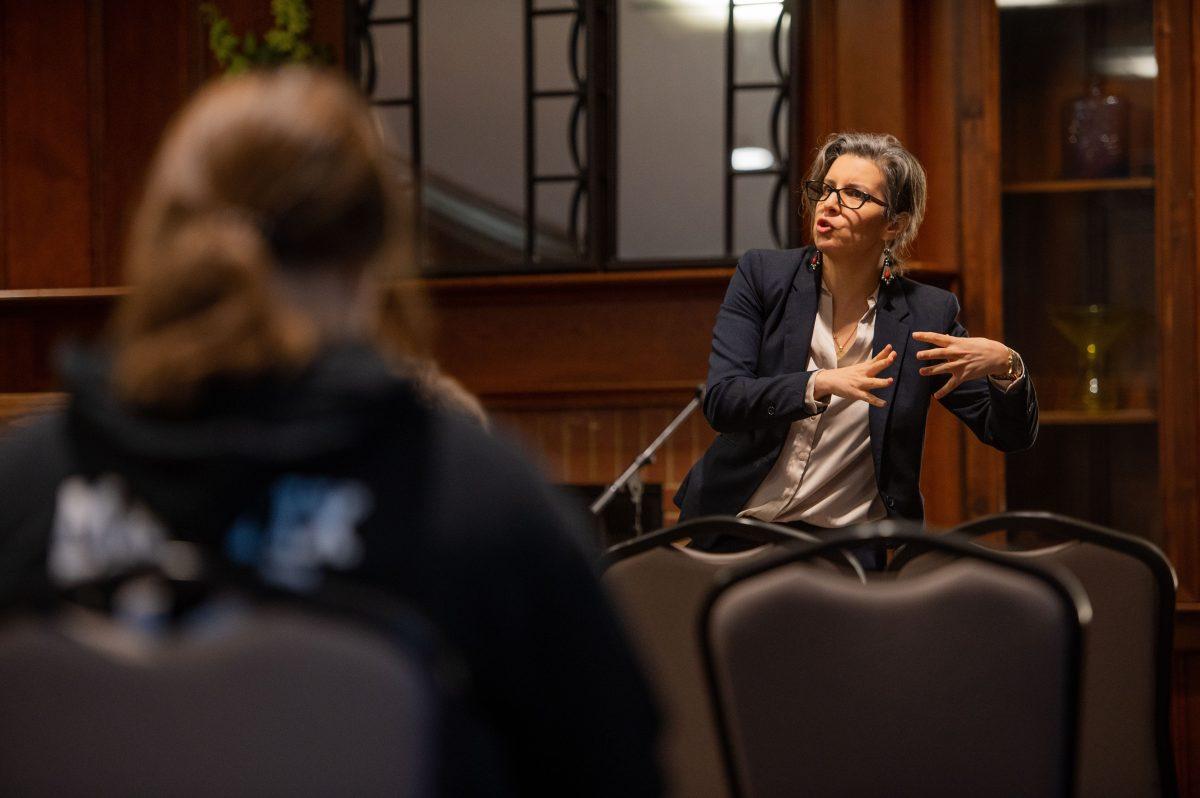
A public seminar led by associate professor Sonia Toudji gave students and faculty a greater look at Native American history, particularly the journey made by Cherokee, Quapaw, Caddo and Osage tribes from Arkansas to Oklahoma.
Held Nov. 29, the event came at the end of National Native American Heritage Month but was no less important to Toudji.
According to UCA’s website, Toudji specializes in fields concerning Arkansas and Southern history, frontier and American Indians and the early U.S. and Latin America.
“You could say 18th century U.S. history, but then within the 18th century I focus mostly on Native Americans and the frontier, the history of the frontier and the westward movement,” Toudji said.
Toudji’s work on Native American heritage goes back to 2006 and continues to spark discussion in 2022, over what she said is an underrepresented portion of history.
“When I talk about this in my classes and when I talk about Arkansas history in my classes too, I start with the Natives and I spend a big chunk [on it] unlike my colleagues who just don’t have that expertise,” Toudji said. “You can take a book about Arkansas history back in the day and maybe you would find a line or two about Native American history in there.”
The initial Native Americans based in Arkansas faced encounters with Spaniards and the French before the Louisiana Purchase in 1803. Toudji said that Spaniards failed to find success in forming relationships, falling to the French during an overarching pursuit of North American conquest.
After the Louisiana Purchase, people of the Cherokee Nation began entering Arkansas in 1803 through 1805 after other settlements pushed them from their land. Because of the Louisiana Purchase, Native tribes were now effectively placed under influence of the American government.
By 1820, Arkansas was on the road to statehood. This meant a focus on settling conflicts with the Cherokee people and bringing in new settlements — two pursuits that Toudji said were dependent on each other.
A push for the existing tribes to assimilate was followed by pressure from Andrew Jackson to move the nations out of Arkansas. Treaties were later signed first with the Cherokee in 1823, then the Quapaw in 1824 and finally the Osage in 1825.
For Toudji, emphasizing the unhappiness Natives felt during this decision is something often overlooked when recounting history.
“You talk about treaties and land and this and that. You think all of that happened in a fair sense, because that’s the narrative from the history book that you’re reading, maybe from your history class in high school,” Toudji said.
“So you’re saying ‘we signed treaties and they moved,’ but really what they don’t get is that movement was not ‘hey, I’m so happy we get to move again,” Toudji said.
Bringing awareness to Native American history begins with a gradual revision of pre-existing information, Toudji said. A greater focus on this approach is something that she’s grateful to see more of.
“The revival of Native American history and especially studying Native American history from [Native] perspective, that really started to pick up in the 1990s,” Toudji said. “This is the time we were like ‘OK, we’ve been saying this wrong.’”
Toudji said that from an eastern perspective, ideas of westward expansion and manifest destiny curated a reality that was far from the reality Native’s knew.
“You’re in the west, facing east, and all you see is invasions. All you see is people coming and pushing you further or trying to change you,” Toudji said. “That’s when historians understood this lack of presenting the Native American history from [Native] perspective.”
Toudji said correcting and improving upon textbooks is the first step in flipping the narrative.
“Once the book starts picking that up, then a professor or teacher would look at the new textbook and you would touch on Native American history,” Toudji said. “But if it’s not in the textbook, and you don’t have the expertise, it’s just hard for you to cover.”