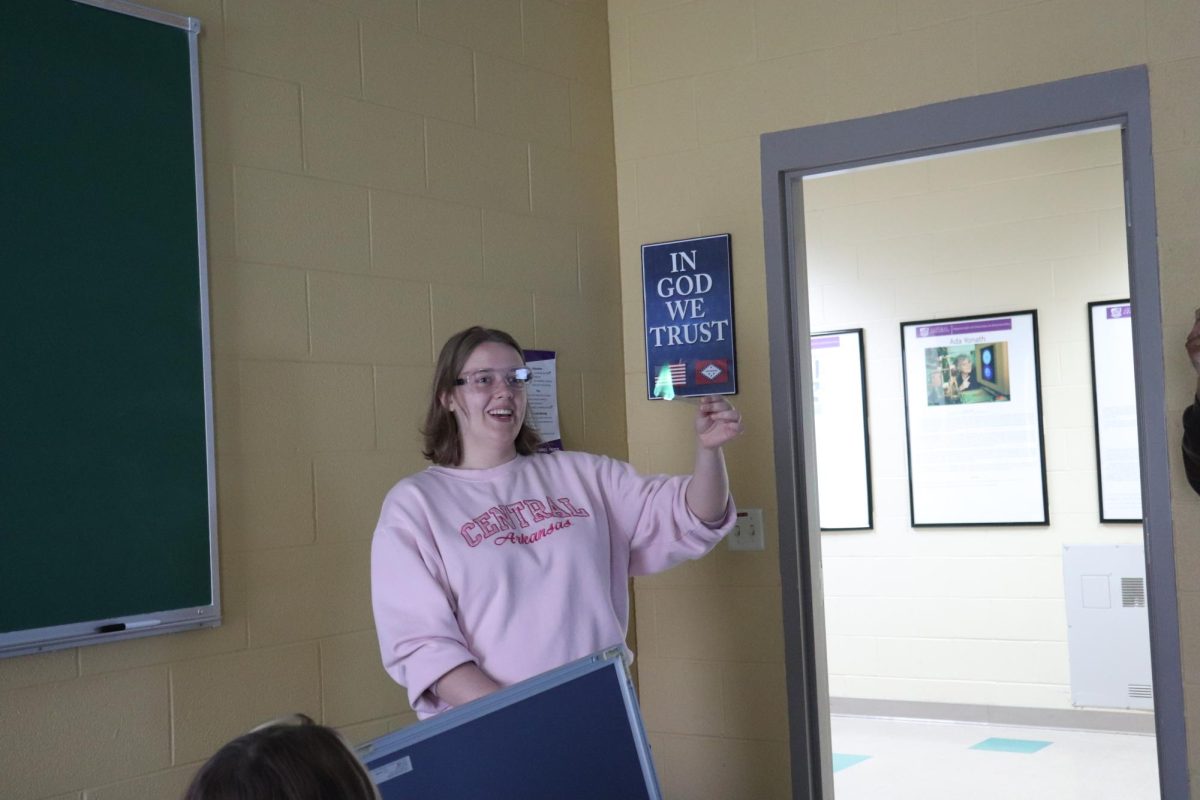


With the roaring wind beating on the windows as her backdrop, Jennie Case read excerpts from her book “We Are Animals: The Nature and Politics of Motherhood” at the Feminist Union meeting in Irby Hall on March 19.
“When I became a mother, suddenly, I started to experience a lot of conflicts between motherhood, what I thought of feminism, modern life and then evolutionary biology,” Case said. “So what’s happening in the body around pregnancy, in the postpartum period, and how does that affect who you are in the world?”
Case’s book came out in September 2024 and focuses on her own experiences with both the planned pregnancy of her first child and the unplanned pregnancy of her second child.
“The culture at large and changing politics around reproductive rights, it all became a big knot,” Case said.
On a wider scale, her work focuses on how motherhood fits both into societal and biological aspects of human existence.
“I started to have a lot of questions about motherhood and how motherhood fits into contemporary life and those conflicts between feminism and evolution and biology,” Case said.
Case read two excerpts from her work — the beginning and end.
The prologue of the work, called “Message for the Animal Mother” is a poetically written section that focuses on the fear and anxiety of impending motherhood.
“You don’t believe that the anger in you is part of being a mother. You don’t believe you will remain a mother just the same. You don’t believe that the eye flash pickup aching longing to elsewhere is one in the same with the hug so tight you feel your child’s bones,” Case said, reading from the prologue.
The prologue ends with more hope for motherhood and its eventual rewarding aspects.
“You have always made the choices you needed to make. You are not stupid and when the next choice comes, you will gather yourself with milk bones and bristle and you will go,” Case said.
Case’s second excerpt was titled “Additional Thoughts on Control” which discussed women and their control of their own bodies.
“I was thinking a lot about control — in terms of birth control, reproductive control — all those complexities and the gray areas and complications. All of the political messiness of it all,” Case said.
In the essay, Case read about her experiences with her second child, who was unexpected.
“When I found out I was pregnant a second time, I lost control of my body. My body was rebelling, doing things I did not tell it to do,” Case said.
Case went over her religious upbringing and how it affected her further decisions when it came to the pregnancy, along with her frustration with the new maternal responsibilities.
“This was the body I succumbed to. The ripping and blood and quivering and shaking, the small purple thumbprint left on the wall, birth uncontrolled, uncontrolled birth, birth requiring six dissolvable stitches,” Case said.
After reading her excerpts, Case discussed her thoughts about how motherhood and feminism work together, or if they do at all.
“I could achieve whatever I put my mind to and being female wasn’t going to limit me in that capacity,” Case said. “Yet, when I became a mother that no longer was true.”
“You can’t do it all. There are time restraints like when I couldn’t write for a year after my daughter was born,” Case said.
When asked about motherhood in an ideal world, Case said she would simply wish for less judgment.
“I think a lot of women feel a lot of judgment whether they decide to become mothers or whether they decide not to,” Case said.
“People make the choices they make based on their lives, their circumstances, their desires and we should just respect everyone’s choices beyond that,” Case said.
After Case’s reading, Feminist Union president Angelica Thomas read some of her poetry to close out the meeting.
Her poetry, which focused on webs as a metaphor for life and its responsibilities, described her life as both a student and a woman.
Thomas also promoted several of the Feminist Union’s upcoming events, including a resource expo and period products drive in April.