



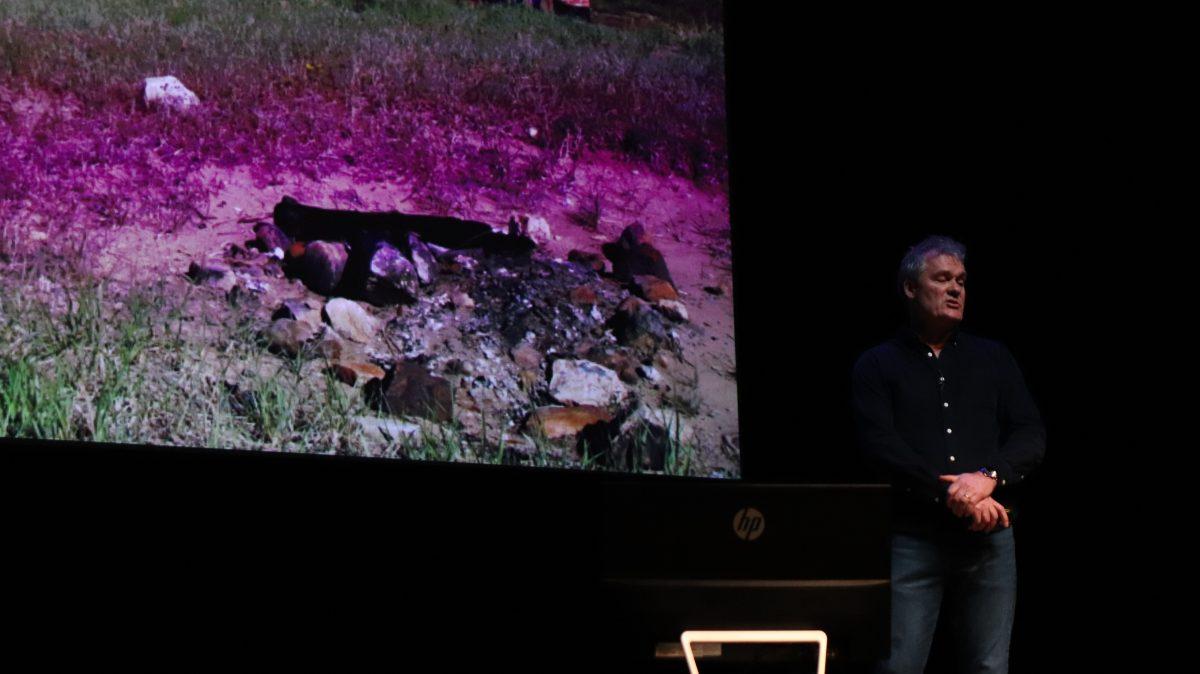
Gripping stories of wild animals captured the hearts of the audience in Huw Cordey’s documentary of documentaries April 3 in Reynolds Performance Hall.
Cordey, a wildlife photographer, director and filmmaker, showcased the behind-the-scenes footage and real stories from his time working on many nature documentaries, from “Planet Earth” to “Our Planet.”
UCA Executive Director of Public Appearances Amanda Horton said, “When I look at speakers, I look at how they can impact the campus holistically; we tried to reach not only science but the film industry.”
Cordey’s most recent work, the “Our Planet” series, and especially the “Frozen Worlds” episode, were made to raise awareness about climate change and how it is permanently affecting wildlife.
He continued this discussion through statistics, animal anecdotes and personal experiences, such as his team’s run-in with a polar bear far outside of its natural habitat.
“With the Arctic being the fastest-changing habitat, these unusual encounters may become commonplace,” Cordey said.
His mix of interesting, comedic and often dangerous stories were both moving and informative.
Horton said, “We never have a theme for the whole season, but a theme for our lecture series is education.”
Venturing into the frozen tundras of the poles is not all Cordey does, however; he and his team have traveled all over the world to capture the rarest of wildlife, sometimes even filming them for the first time.
Some examples include birds of paradise, narwhals and orangutans. Even non-animals were sought out — Cordey’s shots of the Cordyceps fungus, its first appearance on film, went on to inspire the video game “The Last of Us.”
These biodiverse places are already rare enough but they are continuing to become rarer due to climate change.
Cordey said, “We’ve lost 80% of orangutan habitat in the past forty years.”
These environmental changes affected him and his team while filming; many nearly lost their lives due to thin ice or uncommon animal encounters. The effects of climate change create danger all over the world, for animals and humans alike.
Cordey said, “The weather is even more unpredictable than the animals, and is becoming more so due to climate change.”
While the team could simply go home after they finished filming, the animals were not so lucky — footage showed hordes of walruses forced to rest on cliff faces instead of ice floes, an area they were not adapted to.
In fact, they were so maladapted that they simply stepped off the cliff. The chilling video showed hundreds of walruses plummeting to their deaths.
“This footage is truly harrowing,” Cordey said.
After concluding his lecture, Cordey took some time to answer questions from the audience, from what his favorite animal was to how to fight climate change.
“To be honest, we need a global response. It’s just moving away from fossil fuels and toward electric sources,” Cordey said.
As grim as some of the tales were, he made sure to show hope for the future, as well as ways for people to help.
Cordey said, “New science constantly throws new light on our situation.”
The Reynolds Performance Hall will soon prepare for new speakers and events to come to its stage.
Horton said, “We’re getting ready, May 13th, to announce our new season for next year. You may not like everything on it but I guarantee you’re going to find something that you love.”