
Playwright Lauren Gunderson emphasized the importance and universality of communal storytelling in her lecture “Crafting Stories for Now and Next.”
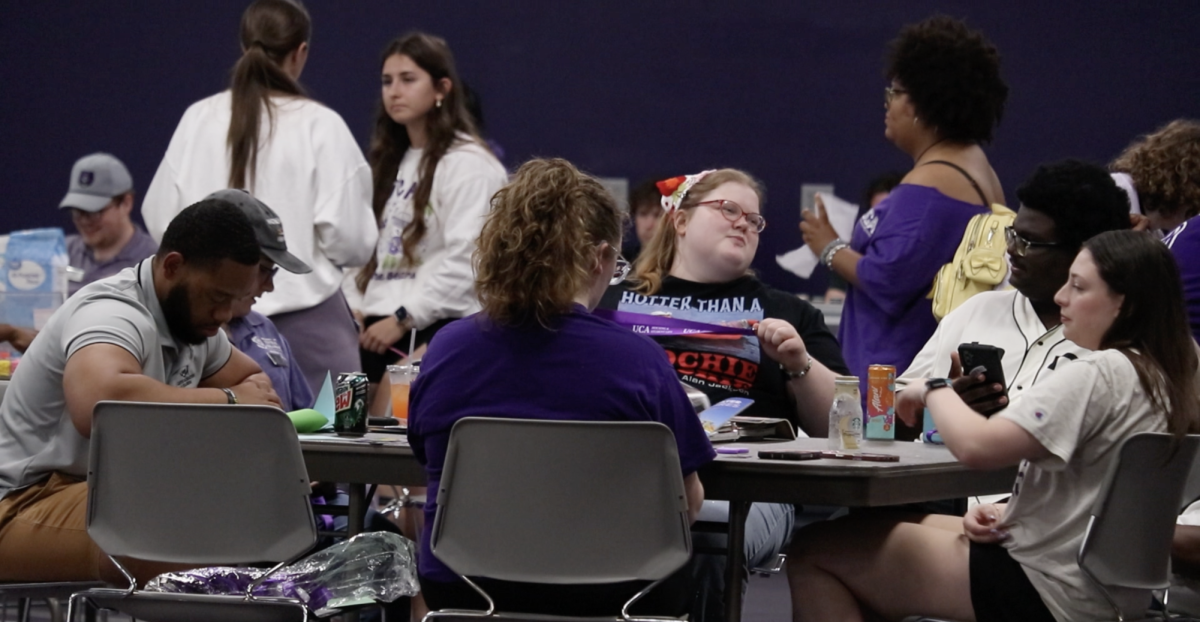
As a part of UCA’s Artist in Residence series, students, faculty, alumni and others gathered in McCastlain Hall on Feb. 10.
Gunderson is one of the most produced playwrights in America since 2015, a two-time winner of the Steinberg/ATCA New Play Award, the winner of the Lanford Wilson Award and a finalist for the Susan Smith Blackburn Prize and L. Arthur Weissberger Award.
Her work is best known for its focus on female figures of history, science and literature. Many of her plays such as “Silent Sky,” “The Book of Will” and “Revolutionists” explore and subvert historical notions of oppression and intersectionality, giving underrepresented characters a stage upon which to be heard.
“One thing I think about in theatricality is making plays that you need in your life. I do this all the time. If I’m scared of something, if I’m hopeful for something, if I’m desperate for some meaning or belief or truth or connection, you write it as a way to test that idea,” Gunderson said. “I think of theater as a thought experiment. Every play is some sort of Einsteinian thought experiment that allows us to test something. We’re testing the idea. We’re testing it through characters. We’re also testing it through the creativity, the writing, the acting, and we’re testing it in front of an audience.”
Sophomore theater major Phoebe Grinder said she attended the event because she aspires to be a playwright and screenwriter just like Gunderson.
“I think it’s a great medium for exploration, especially if you like emotions and different individual experiences. I think it’s a great way to share those experiences. And I guess seeing from somebody who’s made that their living, it’s a great emotional outlet for me. It’s just inspiring,” Grinder said.
Grinder said her favorite Gunderson play is “The Revolutionists.”
Graduate student Charles Quaas said he was inspired by Gunderson’s take on the writing process.
“It’s the idea of writing to solve a puzzle. That appealed to me more than people that say ‘Oh, I love writing this story that dreams me so much,” Quaas said. “You don’t have to always put yourself in the wringer to write something good. You can just write something good.”
Gunderson also highlighted the power of empathy and connection through art.
“So much of what I believe theater is for is beyond just the art form itself and into the communities and the spaces between all of us that allow us to share who we are and what we specialize in,” Gunderson said. “That is one of theater’s greatest gifts, the congregating of different people with different interests.”
She encouraged the audience to write the stories they need.
“Theatricality is realizing that if something is meaningful and hopeful and beautiful or scary to you, it is that to somebody else. So yes, you should tell your story, because you are not alone in the thoughts and the feelings that you have. We are much more connected and united than we sometimes feel,” Gunderson said.
Gunderson emphasized the power of theater to foster connective, positive spaces to a benediction.
“So the benediction was what our pastor always did, and he’d walk through this center aisle and invite everyone to take what’s in their hearts and give it out to the community with a spirit of love and generosity. And I think that’s what theater does too,” Gunderson said. “I can create a space for feeling, and then what you feel is yours, but that space wouldn’t be there without the work of all of us making the play. So I think so much about the power of that from a sort of religious place. I mean, theater was a place for the gods and for science.”
After the public lecture, attendees were invited to stick around for some one-on-one time with Gunderson who answered questions, signed books and took photos.