



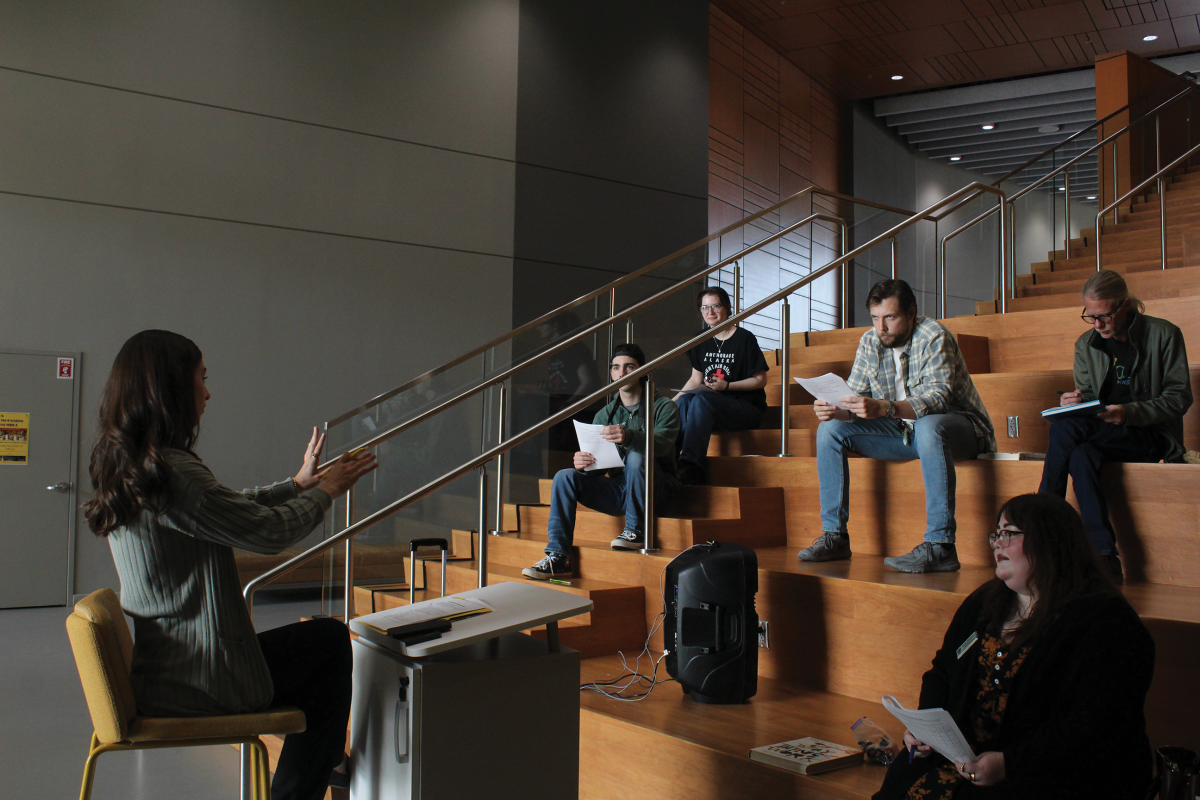
Marléne Sheehan, a senior psychology major and family and consumer sciences minor, led an interactive workshop Nov. 7 on curiosity at the Windgate Center for Fine and Performing Arts. Participants explored the five dimensions of curiosity, its neurological impact and strategies for nurturing a culture of inquiry.
The keystone conversation opened with Sheehan discussing the science behind curiosity.
“So what’s happening neurologically is because it’s part of our survival mechanism. It’s actually related to the brain’s reward system, and that’s pretty exciting,” she said. “So you get dopamine from being curious.”
She said, “This surge of dopamine is what encourages us to keep wanting to gain information.”
Sheehan said dopamine helps with memory by opening neural pathways that strengthen it.
“So, we’re more likely to remember information when we’re curious,” she said.
Sheehan handed out packets to participants, encouraging them to write down what they had been curious about lately.
The packet included Sheehan’s own questions, such as, “Why does cheese taste better melted?” and “How does technological facial recognition work?”
Gayle Seymour, associate dean of the College of Arts, Humanities and Social Sciences, said she was curious about face blindness.
Sheehan’s boyfriend, Jake Mills, said he was curious about daylight savings time.
He said, “I remember hearing a couple of years ago that they were doing away with the time change, and so I’m very curious about if and when that’s going to stop, and who’s in charge of that, and just everything surrounding it. What would happen if we did change it?”
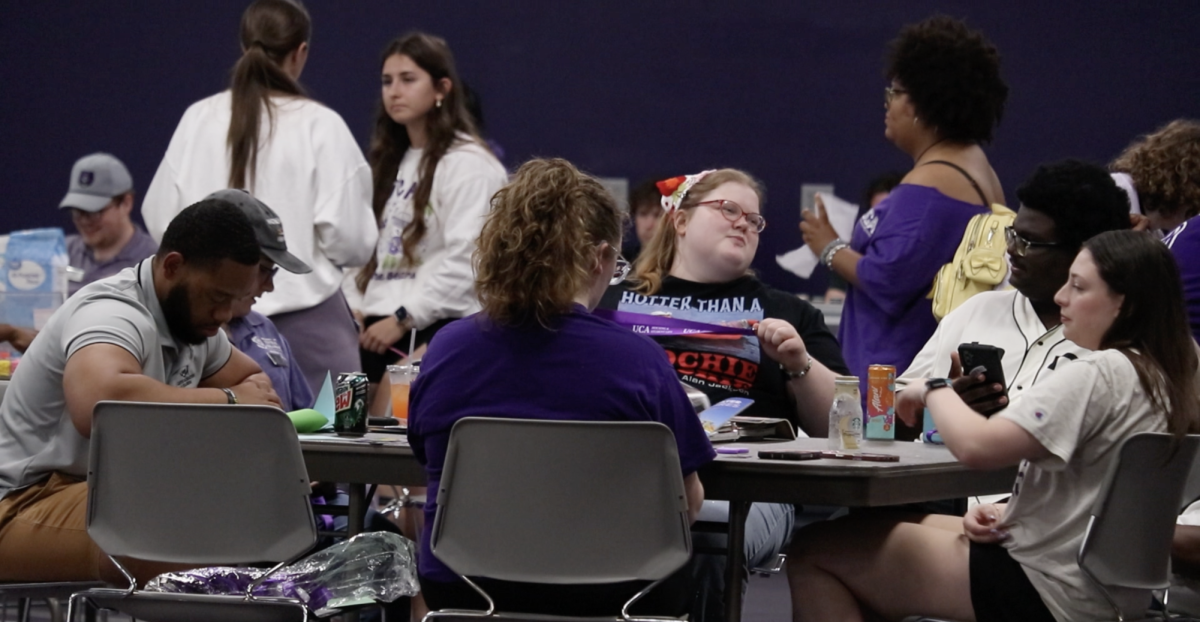
Participants also completed the five-dimensional curiosity scale, which Todd Kashdan, a professor of psychology at George Mason University, developed.
The scale measures joyous exploration, deprivation sensitivity, stress tolerance, social curiosity and thrill-seeking.
Based on their score, participants fell under four types: the fascinated, who are high on all dimensions of curiosity, particularly joyous exploration; the problem solvers, who are high on deprivation sensitivity and medium on other dimensions; the empathizers, high on social curiosity, medium on the others; and the avoiders, who are low on all, particularly stress tolerance.
“Personally, I am very socially curious,” Sheehan said. “I enjoy just learning about things in general, so sometimes I have a hard time narrowing down my interests.”
Sheehan concluded the keystone conversation by discussing the personal, social and professional benefits of curiosity and how to cultivate it.
“I would say curiosity, in a sense, has definitely changed my life,” she said. “It’s led me to a lot of different job opportunities and friendships and connections and generally, a better understanding of people.”
She said, “Don’t get stuck in the mindset of believing where you’re at now is all that you’ll ever know about a topic. There are endless opportunities for learning, and we learn every day, everywhere we’re at.”
Seymour said, “It was a fascinating conversation — so interesting that it’s about curiosity because that really is everything in terms of education.”
She said she learned that she “must have the risk-taking gene.”
“I love to do projects that are just on the edge of doable or impossible, depending on how you think about that edge,” she said. “I must get dopamine from those actions. I love to write grants because they are about dreaming about what’s possible and really trying to think through all of the components to figure out how you’re going to do something, and doing something that nobody’s ever done before — that is so me.”
Sheehan said her propensity for asking questions led her to create the keystone conversation.
“I was trying to think about what was in my wheelhouse that made sense for me to talk about,” she said. “A recurring theme in my life is people always tell you so many questions, almost to a fault. I drive people crazy sometimes.”
Sheehan said she learned a lot through her research for the keystone conversation, particularly about the neuroscience side of curiosity.
“I didn’t really know the depth of it. It gave me a broader appreciation,” she said. “In the past, I’ve just kind of appreciated it for the little things that I’ve noticed. But, I was able to make more connections in my life and for others.”
She said the biggest misconception people have about curiosity is that “it is only for children.”
“You can find ways to become more curious,” she said. “It doesn’t have to be about certain things. You literally just follow what you’re interested in. That’s the best part.”
To organize a keystone conversation, contact Seymour at [email protected].