

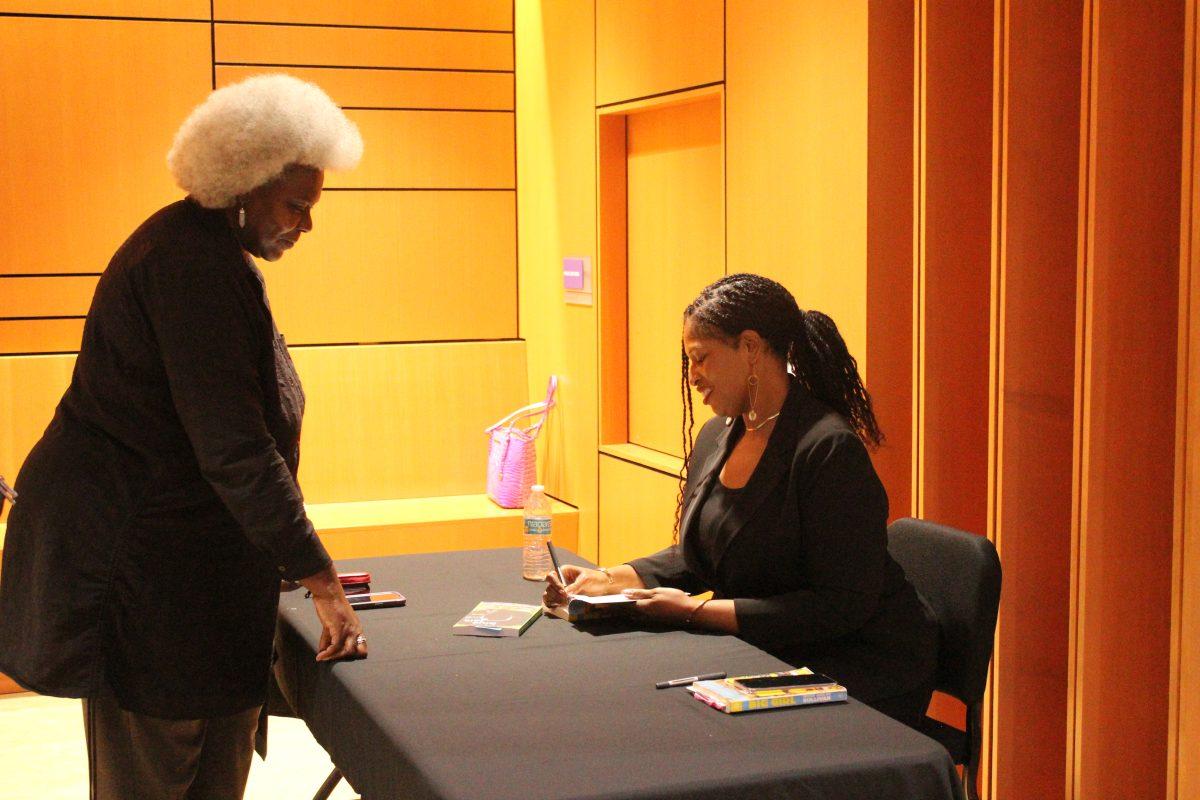
During her visit to UCA, author Mecca Jamilah Sullivan, hosted a public reading and book signing of her novel “Big Girl,” bringing in creative writing students and intrigued attendees.
Sullivan, originally from Harlem, New York, is a professor at Georgetown University and is the author of three books: “Big Girl,” “Blue Talk and Love” and “The Poetics of Difference: Queer Feminist Forms in the African Diaspora.”
At the beginning of her public reading, Sullivan said, “I think of ‘Big Girl’ as a novel about women, about bodies, about queer people, about Black women in particular, and the paths that we take, often across generations, to make space for ourselves and the world.”
Sullivan said her novel “Big Girl” is inspired by her experiences as an adolescent.
“I had a really interesting set of intersecting experiences where I was taking a class with a really fantastic English teacher,” Sullivan said. “She had us write in journals. We would journal every week. At the same time, my mom had a very small library with Black women’s literature and that same year I discovered Toni Morrison’s ‘The Bluest Eye,’ Ntozake Shange’s ‘For Colored Girls Who Have Considered Suicide / When the Rainbow Is Enuf.’
“All of these are books that are about Black girls and their experiences — young Black girls and their experiences. None of them are written for younger audiences, but they are about Black women,” she said, “To be around that age, experiencing my body in these interesting ways and knowing that, learning that this is something that you can write about. There’s this person named Toni Morrison and she does this. That was really profound for me.”
During Sullivan’s reading, she read excerpts from the beginning of the novel, portraying the relationship the main character, Malaya, and the women around her have with food and diet culture.
“In this section, Malaya is 8 years old, and we see her among the women who are having this complex relationship to food. I imagine it’s a relationship that’s probably familiar to some. On one hand, there’s this sense of food as dangerous, as bad, sort of something forbidden. Yet, at the same time, she’s noticing what we now call diet culture,” Sullivan said.
“The idea of forbidden desires of the body becomes really important to Malaya as she gets older, as she starts to experience her sexuality. Another place where she’s told that her body is not supposed to want what it wants, not supposed to be what it is, not supposed to do what it does,” Sullivan said. “Music becomes a really important part of Malaya’s experience of pleasure and engaging the body in the fullest way possible.”
The next section Sullivan reads from is when Malaya is 15 years old walking the streets of Harlem when a man calls her “big girl pretty face.”
She ends the reading with an excerpt from an older Malaya, whose body has changed.
Teagon Gossett, a freshman creative writing major, said he liked how Sullivan implemented the hip-hop culture of the 90s into the novel.
“Hip-hop nowadays, you feel like it is dismissed as a medium in general, but a lot of it has roots in poetry and a lot of earlier forms of media,” Gossett said.
Kyla Oler, a senior creative writing major, said she came to the event because she read “Big Girl” in her creative writing class about writing the body.
Oler said it was exciting seeing the “story come to life.”
“Obviously I read it in my voice when I was doing it in my head, but hearing her read the story, it just felt like the whole thing came to life,” Oler said, “It was so exciting. I love how she answered everybody’s questions. She was so thorough and I feel like I learned a lot from this.”
Sullivan’s reading and book signing marked the end of the Artists in Residence series for the semester.