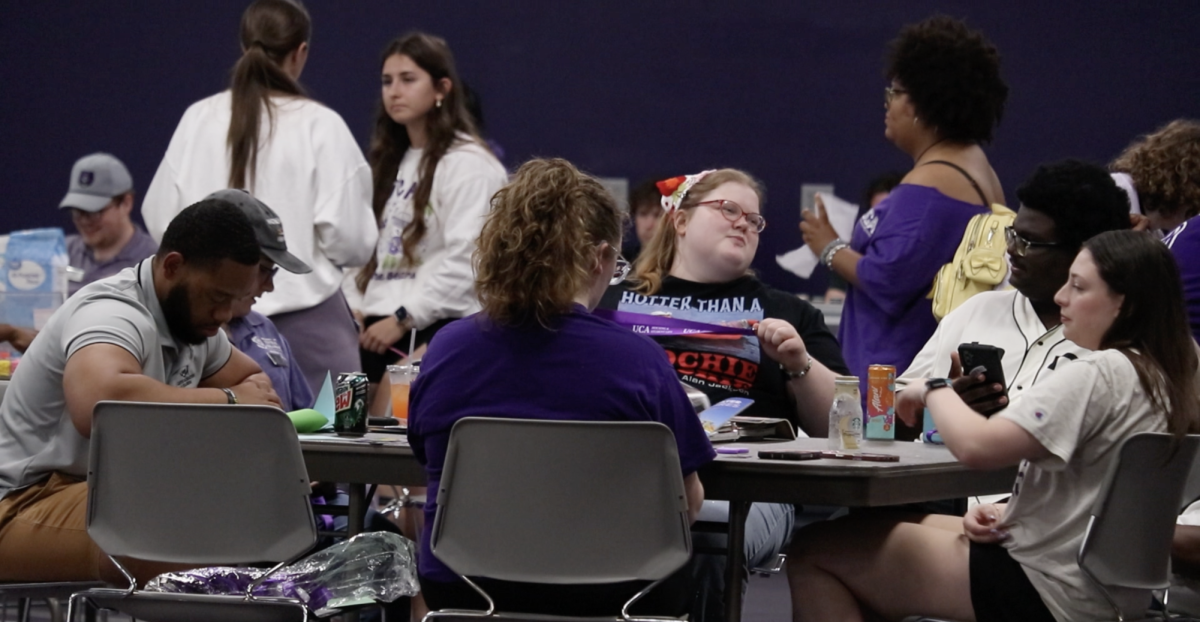

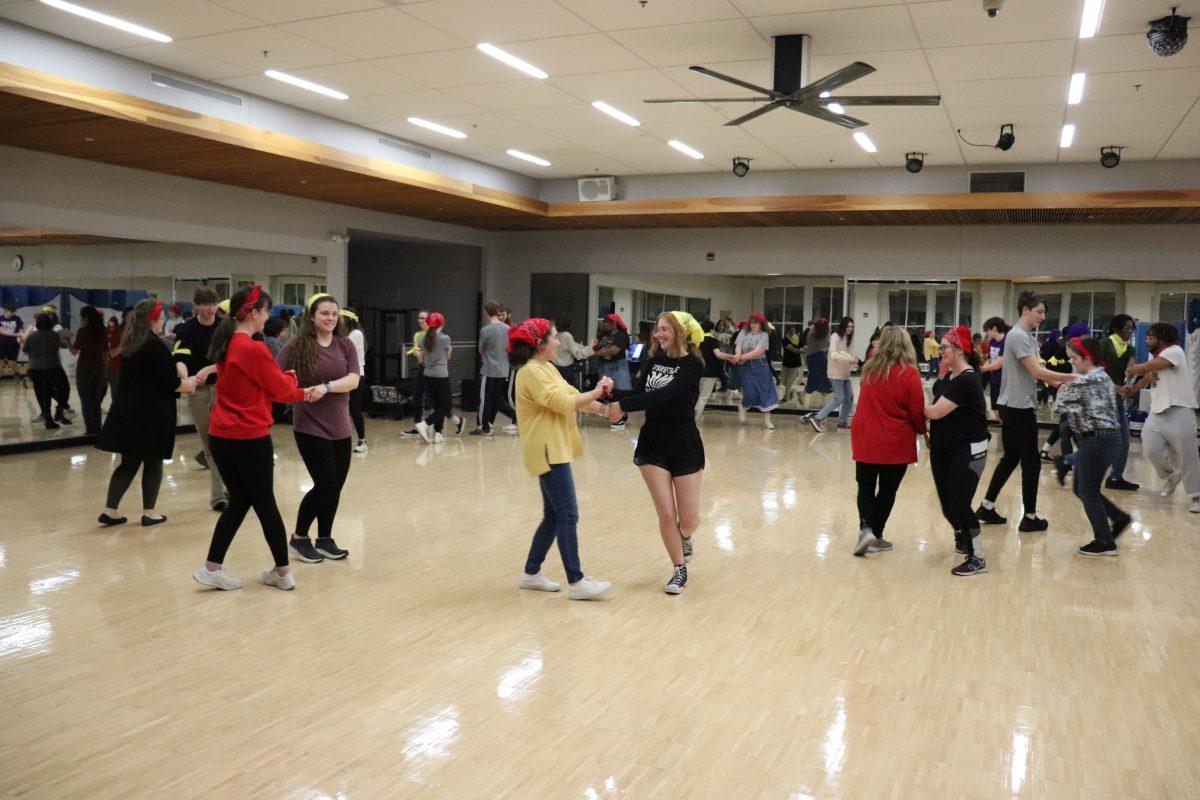
Dozens of students donned bandanas and swung, circled and do-si-doed their way across the HPER Center large group studio at a contra dancing event hosted by professor Ellen Hostetter on Jan. 26.
Contra dancing, a type of folk dance with roots in Europe and New England, is a group activity where dancers partner up and a caller, Hostetter, calls out dance moves for the crowd to follow. Contra dancing is usually accompanied by live music, in this case, provided by Hostetter’s husband, Rob Matson, performing as Bobby Fjsh and the Magic River. Matson used a looping pedal to emulate the sound of a full band with a keyboard and mandolin.
Dancers split up into robins and larks, represented by a red or yellow bandana respectively.
“If you are standing on the right-hand side of your partner, you get a red bandana … your role term is robin,” Hostetter said to the group. “And if you’re standing on the left … you are a lark, and you are wearing yellow.”
Attendees needed no experience to take part in the contra dancing. Hostetter spent time teaching all of the necessary moves before each dance.
Once everyone learned the parts and order of the dance, Matson would start up a song as Hostetter called out the moves before eventually stopping once everyone got comfortable and letting the group lead itself to the beat of the music.
Hostetter has hosted contra dance nights at UCA since 2021 and said she wanted to provide an environment where people could come together and build community with each other without any academic pressure.
“Rob and I wanted to create a space for students to gather, have fun, dance, move and just kind of let loose in a safe environment. No pressure,” Hostetter said. “Post-COVID, in particular, we were seeing this real need to reconnect with each other in real space and physically.”
Hostetter said the growth of the contra dance nights has “kind of ebbed and flowed.”
“This is amazing,” Hostetter said, referring to the size of the group Jan. 26. “We would love to see it like this every night.”
“This is probably the largest dance that we’ve had, which is so exciting,” Hostetter said.
Hostetter said Matson introduced her to contra dance, and she took lessons over Zoom with an experienced caller to learn how to call the dances.
Freshman Emma Brown, a biochemistry major, said she heard about contra dance nights in the honors college and attended every event last semester.
“I think everyone should try it, at least once. It’s not hard to learn,” Brown said. “I know dancing can scare people but if you know your left from your right, you’ll be fine.”
Hannah Harris, a freshman English major, said the dance nights feel “like a really open community.”
“It’s very welcoming,” Harris said. “It’s a good way to get to know people outside of class and just very, very low pressure.”
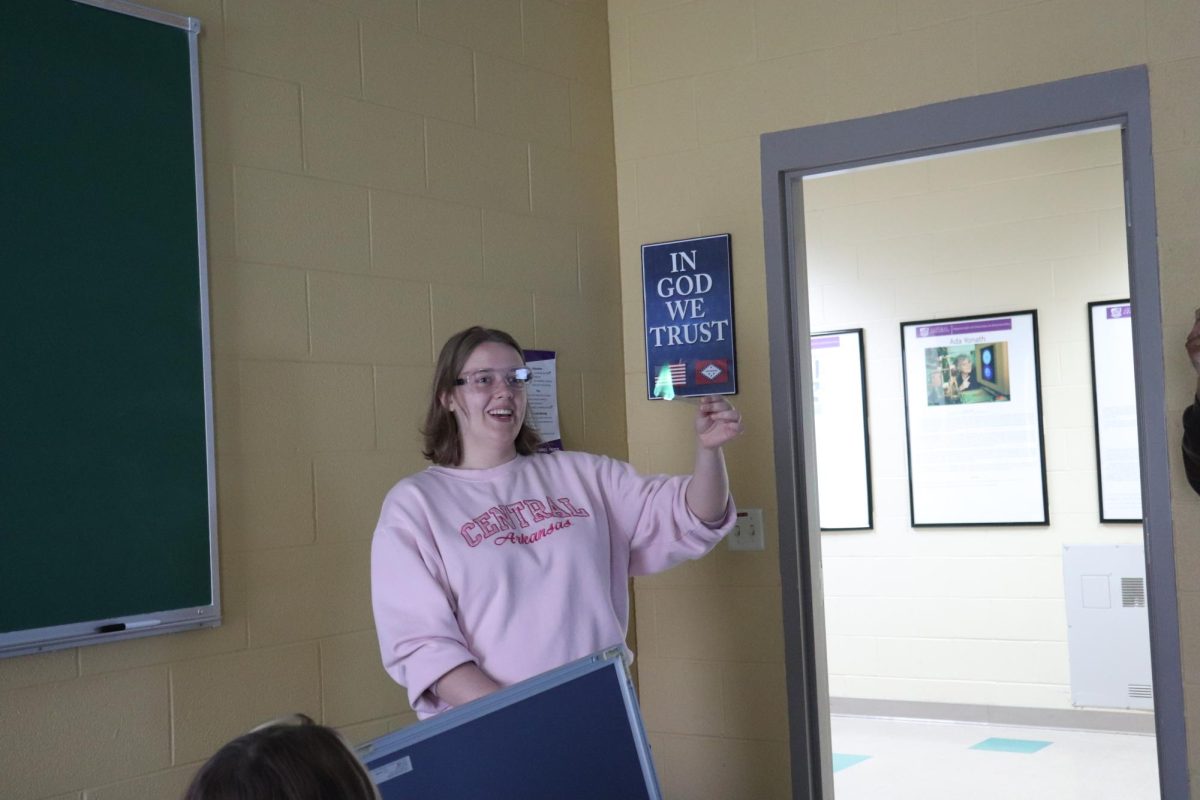
Several students, including Harris, also brought their artwork to display while attendees danced, a first for the contra dance nights.
Hostetter said, “For me, having danced in the space without the art, it just made it so special, added so much color, literally, to the space.”
Eliot Spann, an undeclared freshman and first-time attendee who had several art pieces on display, heard about the event from Hostetter in a class she instructed.
“I heard about the art aspect from one of my classmates, and so that was just another reason that made me want to come by and check it out,” Spann said.
Spann said his favorite part of the contra dancing was the “carefreeness.”
“People aren’t so pressed about getting it absolutely right. There are people who mess up the moves, there are people who maybe have the rhythm wrong, but everyone seems to be having a good time,” Spann said.
Hostetter said the live music component adds “energy to the room.”
“What’s so special about the contra dance is that it’s this tri-communication, almost,” Hostetter said. “The musician is responding to the dancers, the dancers are responding to the music and the caller is in between, trying to respond to everybody.”
“There are plenty of dances that have recorded music because they don’t have the resources to have live music,” Hostetter said. “Rob, because he’s improvising, he can see the energy in the room and change the vibe as we’re dancing, which is really neat.”
Matson, a classically trained musician, has been contra dancing for years and said he enjoys the communal aspect of playing contra dance music.
“The reason you’re playing is not to be admired for your virtuosity. It’s not for a paycheck. It’s not for status … it is in order to facilitate this community, this dance,” Matson said. “There’s just a magic in the room with that.”
“The dance completely changes depending on who’s in the room and how many people,” Matson said. “Every single individual personality adds to the soup and that is just such a cool thing to experience.”
Matson’s music, as well as videos of contra dancing at UCA, can be found on his YouTube channel, Bobby Fjsh and the Magic River, or youtube.com/@rmatson.
Hostetter said anyone who wants to attend is welcome, whether you’re a UCA student, a faculty member, or even a student from another school.
“It’s not exclusive,” Hostetter said. “Anybody is invited.”
“It’s so much fun to see everybody’s faces light up and everybody just laugh and smile and we’re all just enjoying each other’s company,” Hostetter said. “School can be so intense and so much pressure … It’s just a delight to see everybody.”
There are five more contra dance nights in the HPER medium group studio scheduled this semester: Feb. 7 and 23, March 6 and 29 and April 10. Anyone interested in attending can reach Hostetter at [email protected].