


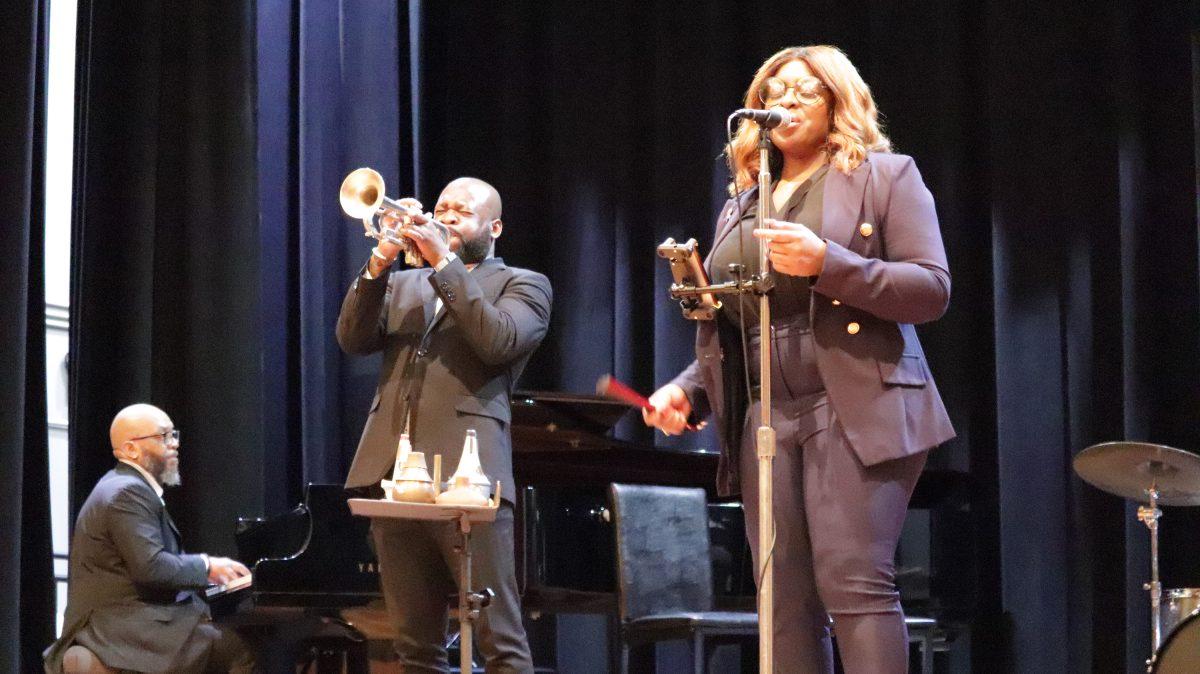
The soulful jazz notes of the Rodney Block Collective wisped through the audience as historian Brian Rodgers told the tale of West Ninth Street on Feb. 22.
The event took place in the Mosaic Templars Cultural Center, a museum focused on honoring Arkansas’ African American history.
The event also took the time to announce the MTCC’s 2024 artist of the year, Ebony Belvins.
“West Ninth Street is not just a Little Rock story — it’s a national story. A national incident that was meant to kill all of these Black business districts throughout the country,” said Rodgers, historian and adult education interpretive specialist at the Mosaic.
Throughout the story, Rodgers would occasionally stop to give the Rodney Block Collective the stage, allowing the band’s emotionally charged tunes to set an overarching tone for each part of the tale.
“What Beale Street is to Memphis, Ninth Street would have been to Little Rock,” said Rodney Block, frontman and trumpeter for the Rodney Block Collective.
The Union army occupied Little Rock on Sept. 10, 1863, giving southern enslaved people the opportunity to escape captivity.
Soon after, thousands of enslaved people began to pour into Little Rock, with the Union providing makeshift housing and tents. It would quickly transform from a place of living to an early Black commercial district, eventually being named Blissville.
Throughout the 1870s and 1880s, Black-owned businesses began to line the sidewalks from Broadway Street to Ringo Street, giving the historical West Ninth Street its eastern anchor.
“These people start businesses, they start organizations that are there for the betterment of the Black community,” Rodgers said.
The U.S. Supreme Court legalized segregation May 18, 1896. Yet this wouldn’t stop the Southern African American community.
Fraternal organizations such as The Knights and Daughters of Tabor began to pop up, giving African Americans a place to go when in need.
A notable congregating point was the Dreamland Ballroom, a Black-built and owned building that cost around $65,000 to erect.
The late 1910s to the 1920s is considered the peak of African American development.
“West Ninth Street begins to grow. Jim Crow Laws, Black codes, segregation, become entrenched, but at the same time the black middle class starts to grow in Little Rock,” Rodgers said. “We have Black doctors and Black lawyers, Black politicians. You have money in the Black community, and so they start to want things, and so you see more and more businesses begin to grow along West Ninth Street. So much so that at one point there are over 100 Black-owned businesses along West Ninth Street.”
Less than a decade after the end of World War I, the lynching of John Carter on May 4, 1927, led many African Americans to move out of Little Rock, yet conditions only continued to grow worse with the Great Depression three years later, forcing many stores along West Ninth Street to close.
The Black community eventually experienced a revival within the Dreamland Ballroom.
The ballroom became the epicenter for musical acts in Little Rock, a location where people would gather to party all night long with some of the biggest African American acts at the time, ranging from Louis Armstrong and B.B. King to Ella Fitzgerald and Al Green.
Following World War II, West Ninth Street underwent yet another reawakening, allowing the night-time scene the chance to return to its former glory.
Black servicemen from Camp Robinson, located in what is now considered North Little Rock, would often come to visit West Ninth Street to bask in the location’s nightlife, restaurants, cafes and more.
“The only place for them [servicemen] to come to enjoy their dead time is West Ninth Street. So, at that time you also start to see clubs explode on West Ninth Street,” Rodgers said.
Eventually, the servicemen as well as other locals began to move into West Ninth Street. The population grew so large that it began to become difficult to find housing in the area.
With the location’s entertainment, culture, and economic status, the period quickly became the pinnacle of West Ninth Street.
“There is an estimate that a dollar spent on West Ninth Street would change hands at least 15 times before it left the area,” Rodgers said.
Around the 1950s, West Ninth Street began to grow closer to its demise when geographical segregation began to become more prevalent.
During this time the Little Rock Housing Authorities and Urban Renewal began a project to beautify the city, which just so happened to include areas of the city that had a large Black population.
As the project progressed, West Ninth Street and the nearby neighborhood Dunbar were eventually surrounded by majority white-populated areas, leading businesses on West Ninth Street to plummet.
The final nail in the coffin was the creation of Interstate 630, which would continue to cut off West Ninth Street’s nightlife population.
“There were clubs and grocery stores and restaurants and hotels and liquor stores,” Rodgers said. “It was a vibrant, thriving community, and now, it is a side street in downtown.”
Rodgers said although the tale of West Ninth Street seems to end in doom and gloom, there is still hope for the historical street to be revitalized once more.
“The plan is to kind of have a revitalization campaign with public art projects and an amphitheater, so things to kind of bring traffic back to West Ninth,” Rodgers said. “We already do our Juneteenth Celebration every year, where we block Main Street off from Broadway to Izard, which is about four blocks. And we have hundreds of vendors. We have a music stage. So that’s one day a year that we kind of bring it back. And so we’re planning more and more things outside on Ninth Street to get people back in the area.”
Suzanne Ornelas, development director of the Mosaic Templars Cultural Center, said there are three phases planned for the rebirth of West Ninth Street. Phases one and two included the children’s gallery as well as two brand-new exhibits, whereas the third phase plans to go beyond the inside of the Cultural Center. Several ideas planned for the third phase include outside marques as well as restored sidewalks to bring businesses back to the area.
“Our store downstairs, we are Black-made. So the majority of all of the vendors are African American entrepreneurs. So we’re just trying to create a synergy again here on Ninth Street,” Ornelas said.
More information about West Ninth Street can be found in the Mosaic Templars Cultural Center as well as in the PBS documentary “Dream Land: Little Rock’s West 9th Street.”