


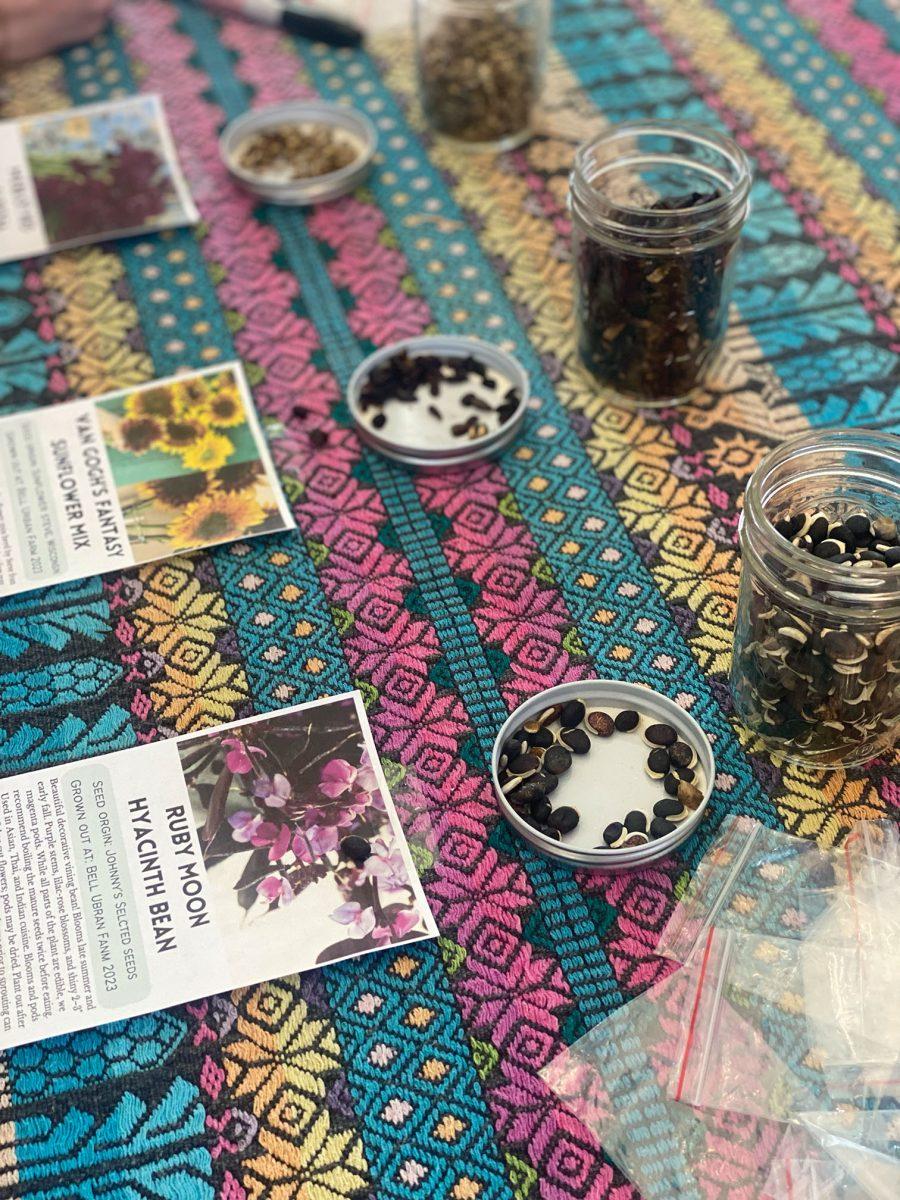
Local farmers and gardeners swapped seeds and stories to promote biodiversity during the second annual Conway Seed Swap at Hendrix’s Windgate Museum of Art on Feb. 24.
Kim Doughty-McCannon, the owner of Bell Urban Farm at 2011 Tyler St., said she got into seed swapping when she worked at the farm’s Little Rock location.
“I helped organize seed swaps across the state with an organization called CAAH, Conserving Arkansas’ Agricultural Heritage,” she said. “I got to learn so much about Arkansas heirlooms, seed saving, why seed saving is important.”
She said common misconceptions about organic farming are that “it’s really hard, it’s more expensive, that it’s hard to form organically because pest and weed pressure is too much.”
Doughty-McCannon said, “If you do it in the right way, that’s not necessarily true. We [Bell Urban Farm] can help you learn. We have a lot of great resources that we sell at our store. It doesn’t have to be hard or intimidating if you start just a little bit at a time.”
“I think commercial farming is promoted to be the way that we can feed the world, but [that’s] not necessarily true,” she said. “There’s a lot of waste and unsustainability associated with commercial farming.”
She said, “I think small-scale, diversified agriculture is where it’s at. It helps the whole community and helps small farmers.
“So, if you are an interested consumer, just trying to educate yourself on who your local farmers are and visit your local farmers market and choose to spend your money locally supporting smaller farmers — I think is a better investment than commercial farming.”
Kim Van Scoy, owner of Sheepy Hollow Farm in Clarksville, said seed swapping is important because she wants more people to have the opportunity to grow food.
She said, “I love sharing varieties that do really well in our area. So, any of the seeds that I bring are seeds that I’ve saved, so I know they’re going to grow around here. I think having a good local food source is really important. Food sovereignty for our community is really important.”
She said she and her husband, David Cooper, have been gardening for about three decades.
“We’ve always had a market garden sold at local farmers markets, and it’s because we like having this personal interaction with the community.”
Scoy said, “If I don’t grow a tomato, I don’t eat it. It’s because they taste better and they’re healthier. And I know I don’t use chemicals.”
Kassandra Schulze said she is “pretty new” to seed-swapping, and it’s her first year having her own garden, where she’s grown sugar snap peas and carrots for her children.
“I grew up having a garden every year,” she said. “So it was just as soon as I had my own place, it was like, let’s get some dirt, let’s get some stuff growing.”
Schulze said she was on the lookout for luffa seeds.
She said she is not a fan of genetically modifying food except for crossbreeding, and that Roundup, a herbicide used to kill weeds, has “class action lawsuits for blood cancers.”
Schulze said, “But the scientifically injected genetics — I think we’re playing with fire with that.”
“I don’t think that there’s been enough safety studies on Bill Gates’ Apeel, and it’s a protective barrier that they’re putting on fruits and vegetables that apparently you can’t wash off,” she said. “It makes them last a long time on grocery store shelves, but I don’t like that I can’t wash it off.”
Gardener Tom Frothingham said, “I’ve been growing for years and years and years. I just like the sharing aspect of it — the community. There are people here I only see at seed swaps.”
“I think it’s important to preserve this diversity and locally adapted seeds,” he said. I could spend a lot of money every year on seed catalogs, but this is free.”
He said when Brian Campell, a former UCA assistant professor of anthropology, collected local seeds from around Arkansas for his seed bank more than a decade ago, he gathered crowder pea seeds.
“I think they’re delicious. I grow them every year. Some years, the deer eat most of them, but I’ve never seen them for sale in a catalog anywhere, ever,” Frothingham said.
He said his wife grew up in Tennessee, and her grandparents were farmers.
“She said that these peas remind her of the crowder peas that she ate when she was a kid … I grow because I love good, fresh food. I love the taste of it, and there’s something very satisfying about eating the food that I grew.”
Frothingham said he grows crowder peas every year, and they’re “irreplaceable.”
“If the deer ate all of them, if there was a crop failure for whatever reason, I don’t know where else I would get more seeds unless somebody here still had them.”
Mellisa Cowper-Smith, an artist, farmer and real estate agent, said, “I have loved seeds since I was a kid, and most people will say that my mom was a gardener, and I’ve always realized that seeds were so important because it’s the way you carry one generation to the next generation.”
She said she’s been seed-saving for years, and as a college student, she moved a lot and took her seeds with her.
“It’s an easy way to take a plant from one place to the next,” she said.
She said her specialty is growing regionally adapted plants.
Cowper-Smith said, “I grow all the plants in my own garden, so I know they’re going to succeed in other people’s gardens.”
She said if she had to specialize in one plant category, it would be medicinal herbs because they have a “powerful possibility to impact our bodies.”
“I would feel really at a loss if they weren’t in my yard. It’s like a pharmacy,” she said.
Cowper-Smith said, “Small-scale farming, including in people’s backyards, and just do-it-yourself gardening is the most positive way that we can contribute environmentally to our community.”
She said growing your food is “incredibly intimate.”
“It’s not that all industrial food is not good, but it’s not loved,” she said.