


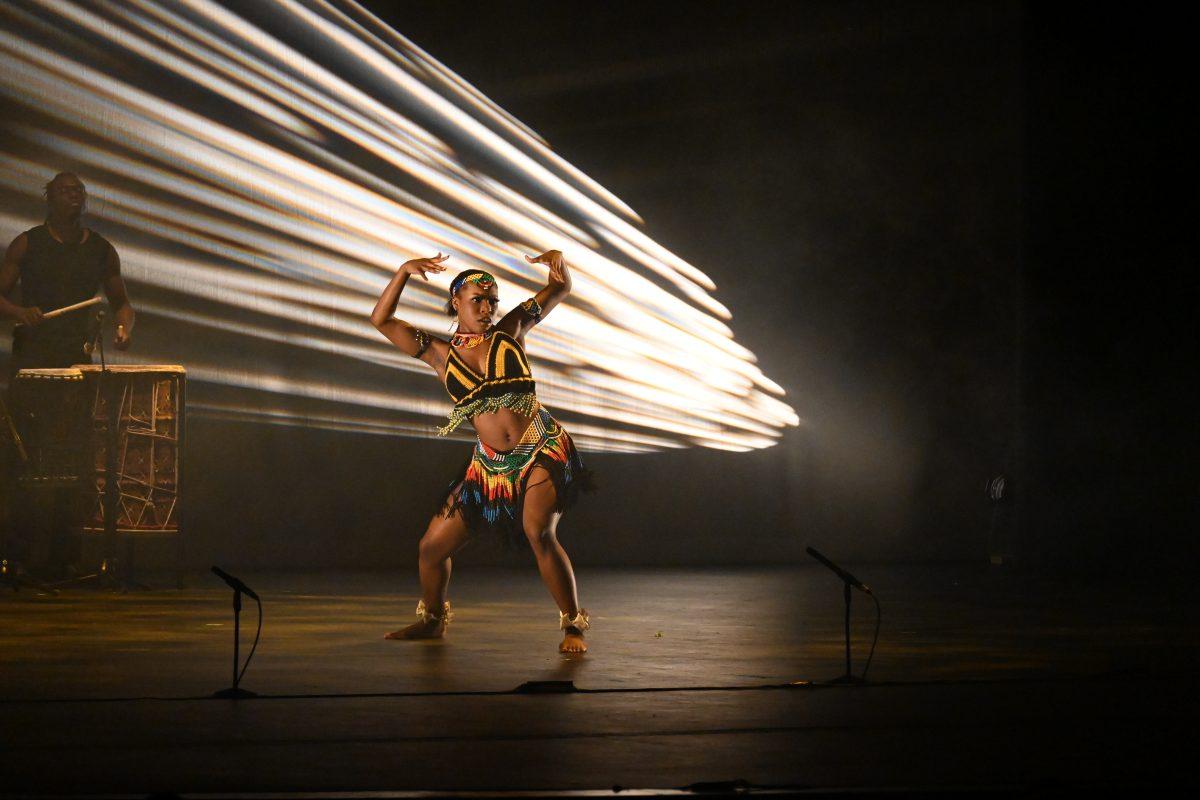
StepAfrika! brought the art of step dancing to Conway at the Reynolds Performance Hall the evening of Feb. 4.
According to stepafrika.org, StepAfrika! is “the world’s leading authority on the art form of stepping.”
Audience member Andrea Ealy said she had heard great things about StepAfrika!, which drew her to the show.
“I love high-energy performance and StepAfrika! was a fun, exciting show to experience,” Ealy said. “I enjoy dancing and I kind of just wanted to experience something new, so I thought it would be cool and entertaining to take out tonight.”
Founded in 1994 by Howard University graduate and Alpha Phi Alpha fraternity member C. Brian Williams, StepAfrika! performs blends of percussive dance styles practiced by historically African American fraternities and sororities, traditional South African dances and contemporary dance forms.
Artistic director Mfon Akpan said, “We travel around the world, sharing and preserving the art form of step.”
Akpan initially joined StepAfrika! in 2005 as a dancer after obtaining her undergraduate degrees in biochemistry and molecular genetics from the State University of New York at Stony Brook.
Akpan said that she found out about the company through one of her Delta Sigma Theta sorority sisters, who suggested that she audition.
“I said, ‘Well, you know, let me go ahead and do this; try this right now, and if I get it, I’ll do it for two years, and then I’ll go back to school for graduate studies or med school,’” Akpan said. “And this is year 19, so clearly I love what we are able to do in this company.”
Tuesday night’s program consisted of five sets of performances: Tribute, Ndlamu, Isicathulo, Solo and Chicago.
Tribute combined distinct stepping styles from different fraternities and sororities, showcasing the variety of stepping.
Ndlamu, a traditional dance of the Zulu people, featured solos choreographed by each dancer while blending contemporary and traditional movements.
The next performance was Isicathulo, a traditional dance that shares striking similarities to stepping.
Also known as “the gumboot dance,” Isicathulo is a traditional dance created by South African laborers who worked in the oppressive mining industry in the apartheid era, who would turn their rubber boots into percussion instruments to entertain as well as share secret messages with each other.
In Solo, the company continued a multitude of solo and group step performances.
Chicago was a symphony of body percussion and five simultaneously performed polyrhythms used to narrate a percussive dance story inspired by Chicago summers, and it combined traditional stepping into the art of contemporary performance.
The show concluded with a final call-and-response chant, led by performer Pelham Warner Jr., which incorporated the tradition of audience participation in step.
StepAfrika! has two separate tours: one that visits major theaters and another that focuses strictly on performing at college campuses.
Akpan said that the purpose of performing at college campuses is to “galvanize students and let them know that, hey, we were once your positions. We all went through the process of going through school and graduating, and now we’re doing this as our full-time job.”
“It’s a great unifier,” Akpan said. “When you look at the history of stepping and what stepping is, we define it as a highly energetic, polyrhythmic, percussive dance form, and is created by African American college students. So we’re back on a college campus. We are showing the students that it is the community that really brings stepping together, and we want you to participate in that energy with us.”
StepAfrika! will next return to Washington, D.C, Feb. 14-16, to perform in the StepAfrika! Step Classic.
If you ever get a chance to see StepAfrika! live in your city, wherever you are, it’s an experience you won’t forget,” Akpan said. “You can see it on [social media], and it’s great to see it there, but to actually come and see us in person is another worldly experience. And if you ever get the opportunity, you should do so.”