




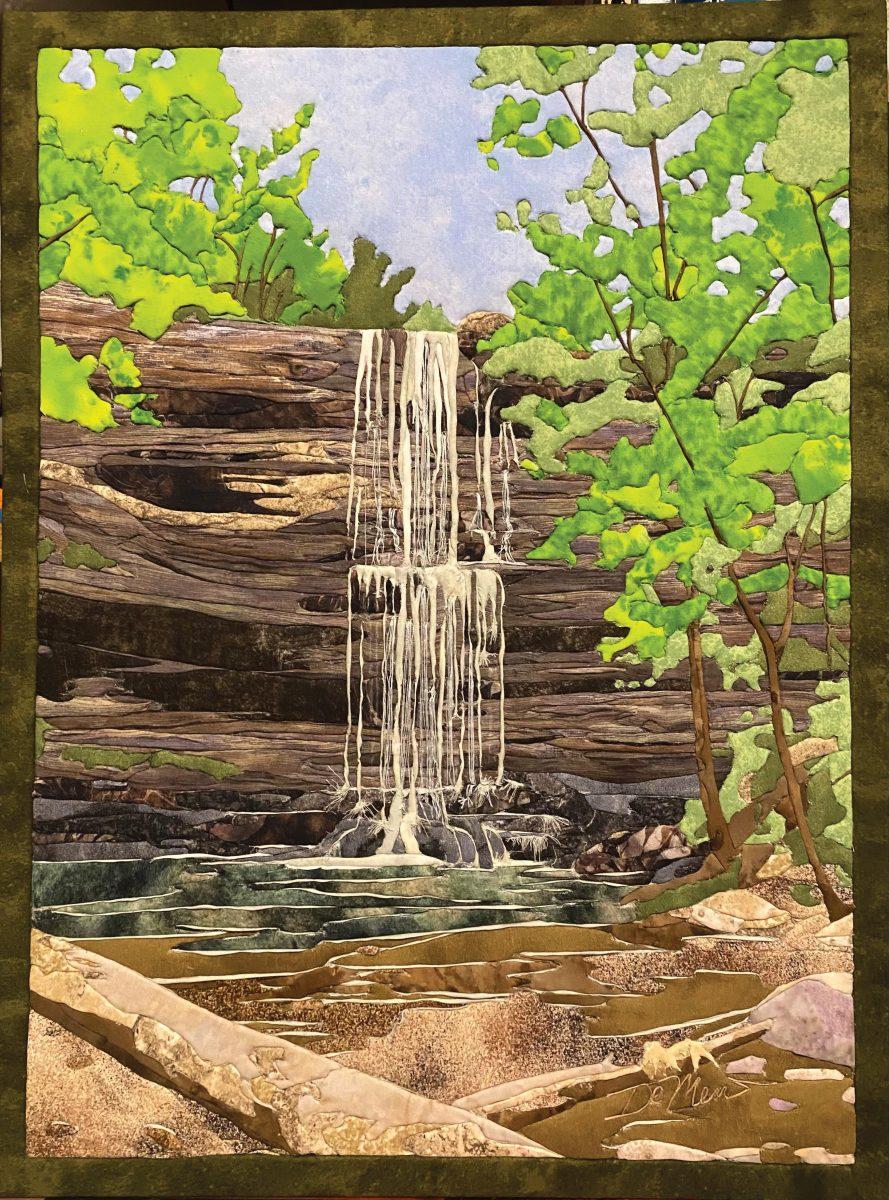
Artist, craftsman, musician, sculptor and Stephen King fanatic William Paul DeMent coined the phrase “fabric impressionism,” a technique he innovated three decades ago, thanks to his artistic upbringing.
DeMent said to “think of it as stained glass, only with cloth.”
“There’s no sewing involved. I actually use a foam core board and impress the fabric into that,” he said. “I did the illustration out on the board, cut it in with an X-Acto knife and then I cut the fabrics to fit where they need to go.”
He purchases the patterns at fabric stores and keeps them in a cabinet.
“I just try to pick things that I think I can incorporate to use as rocks and water and trees,” he said.
DeMent said the process is time-consuming, but he does it “out of love.”
“Sometimes just setting up before the fabric even touches a board could take five or six hours — just to get the layout, get the boards prepped,” he said. “Generally, 40 to 60 hours to do a 16 by 24 piece, but I do some 2-by-3-foot pieces. I’ve spent upwards of well over 80 hours on a piece in the past three months.”
DeMent said he became interested in fabric impressionism at least thirty years ago when his mother introduced it to him.
“My mother and I were at a theater, and they had these big, huge upholstered pieces of art. They were very simplistic — maybe 30 pieces, like a train, sailing ships, things like that nature,” he said. “I just remarked that I thought it would be really cool if we could think of a way to do that on a small scale. A few weeks later, my mom brought me this little thing that she did, and I said, ‘Okay, that’s very cool with the fabric.’ She told me how she did it, and I took her idea and innovated it and came up with what I coined as fabric impressionism.”
He said, “I do all kinds of artwork — lots of crafting, paper sculpting, scratch model building. At the time, I was actually doing sci-fi fantasy illustration, cartoon, comic book kind of stuff. But when I saw that, I said, ‘Well, I really need to try that,’ and I just very much enjoyed doing it and just kept doing it. The rest is history.”
DeMent said, “It’s tricky because when you see it in person — if you’re standing a bit away from it — you would think it’s a painting. You wouldn’t realize that you’re looking at individual little pieces of fabric that represent every single color.”
“The fabric impression just became a niche for me because I found it to be very unique, and I just wanted to do something that other people, especially folks looking for art, would say, ‘That’s very unusual. That’s something you don’t see every day,’” he said. “I don’t do prints. I don’t redo anything. They’re all 100% originals, not reproduced in any way, shape or form. So when somebody buys one of my pieces, they’re buying the only one on this planet.”
DeMent, who was born in 1960 in Chanute, Kansas, said he’s always been an artist.
“My mother’s a great artist,” he said. “My father was an awesome craftsman, and they did stained glass. My father was a cabinet builder, and my mother was a painter. My older sister is an artist, and she publishes and does quilting. It was just a family niche.”
DeMent said he sold his first piece of artwork at about 12 years old.
“An advertising agency that was looking for some cartoons for the American Kidney Foundation and mine was chosen as a little thing for there,” he said.
DeMent lived in Kansas City, Missouri, until he was 13, when his family moved to Columbus, Mississippi.
“I did freelance art for a few advertising agencies while I lived in Mississippi,” he said. “I used to paint signs and wall murals and did all that fun stuff back in the day.”
After serving in the navy for two years, DeMent returned to Columbus until moving to Florida in 1985.
He met his wife Sandra at a department store chain he worked at in Kissimmee; they raised two children, Ashley and Daniel.
“I would never be able to achieve the body of work that I have without the loving support of my wife of nearly 38 years,” he said.
He moved to Greenbrier, Arkansas, with Sandra, Daniel and his grandson to retire in 2021.
“If it can be drawn, I can do it in fabric,” he said. “When I was in Florida, and I was in a gallery there, I did a lot of the seascapes and tropical things. Since I’ve been in Arkansas, I’ve been doing a lot of waterfalls, local scenery.”
DeMent has a series in the Ellen Hobgood Gallery in Heber Springs.
He said, “I have a series there of some of Arkansas’ more local waterfalls, like Cedar Falls and Petit Jean Mountain. I did a Sugarloaf Mountain rendition.”
Ellen Hopgood said DeMent ventured into her gallery a year ago in the fall, “upon the request of the amazing Kathy Brown from our original Ozark Country Market.”
“Paul started showing me his pieces from his phone,” she said. “In all the 22 years of business, I have never seen anything like his beautiful pieces.”
DeMent also helps renovate The Village at Pickles Gap in Conway.
“One of my passion projects at the moment is I’ve been working at The Village at Pickles Gap for the last three years, helping to renovate The Village and bring it back to life,” he said. “I’ve done things from hand painting the floor in the marketplace and doing metal work all throughout.”
Kathy Brown, the owner of The Village at Pickles Gap, said she met DeMent in 2021, a couple of days before opening the first business in The Village, Doc’s Coffee + Creamery.
“Paul just showed up,” Brown said. “He walked in wanting to see what was going on because he’s always loved ‘this old village,’ and I was too busy to visit, so I just told him to leave his name and number.
“Instead, he showed up the next morning, and before I could open my mouth, he said, ‘Listen — there’s a ton of things that need to be done around here before your grand opening, so I’m just gonna start doing them.’ Then he turned around and started working outside, cleaning and painting. I’ve never experienced anything like it in my life. I asked if he wanted a job, and he said he’d love to be a part of resurrecting the old village back to life,” she said.
“Our vision for The Village was to make the spaces themselves functional art — not just ordinary rooms full of merchandise,” Brown said. “The creativity and artistry that Paul has poured into many of the projects, particularly his work in Ozark Country Market, are what truly make the customer experience spectacular. They get to actually walk inside of his art and be immersed in it, and I never tire of hearing them ‘ooh’ and ‘ahh’ at the beauty of his immense talent.”
DeMent’s advice to young artists exploring nontraditional art mediums is to “find something that you think you can enjoy because if you’re not enjoying what you’re doing, it’s going to show. If you find something that you have a passion for, that’s going to come through.”
“For anybody that’s looking to try something new, with the wealth of information that is online now, there’s always so many tutorials, so many avenues that can be pursued today that I didn’t have when I was younger,” he said.
He said, “Some of my funnest things have been just me going, ‘Well, I wonder what happens if?’”
DeMent said, “Art is a life philosophy.”
“Just about anything you do, you can find an art to it,” he said. “Even if it’s something as mundane as cleaning your floor. If you incorporate your attention to it, you can bring that detail, and it becomes an art form if you do it to that extent.”
DeMent has been a Stephen King fan since he was loaned a copy of “Carrie” in 1975, and his Stephen King fan Facebook group celebrated its fifth anniversary Sept. 13.
He does “all kinds of crafting that involve the Stephen King universe,” such as sculpting, book jackets and hand carving.
DeMent said, “For me, that’s the secret of a happy life, being able just to create things that are going to go on past what I’m doing here on the planet.”